
Addiction
342 resources created by 193 users
This Addiction page on GoConqr gathers community-made mind maps, flashcards, quizzes and notes on gambling, smoking and substance abuse, from biological, cognitive and learning approaches to risk factors, media influence and interventions. It's built for school students, university students and professional candidates revising a topic, plus teachers after ready-made material. There are over 330 resources here, including more than 10 quizzes and over 220 mind maps, with many aimed at A-level Psychology. Pick a topic, try a quiz to find your gaps, then make your own flashcards.
Select topic
- Dependence, Tolerance and Characteristics of Addiction10
- Behavioural Addictions16
- Gambling Addiction16
- Substance Addiction11
- Risk Factors for Addiction36
- Media Influences on Addiction8
- Biological Explanations of Addiction42
- Cognitive Explanations of Addiction32
- Learning Explanations of Addiction8
- Theory of Planned Behaviour8
- Biological Treatments for Addiction10
- Addiction Treatment and Interventions9
Top Addiction resources
-
Mind map Models of Addictive Behaviour - Smoking
-
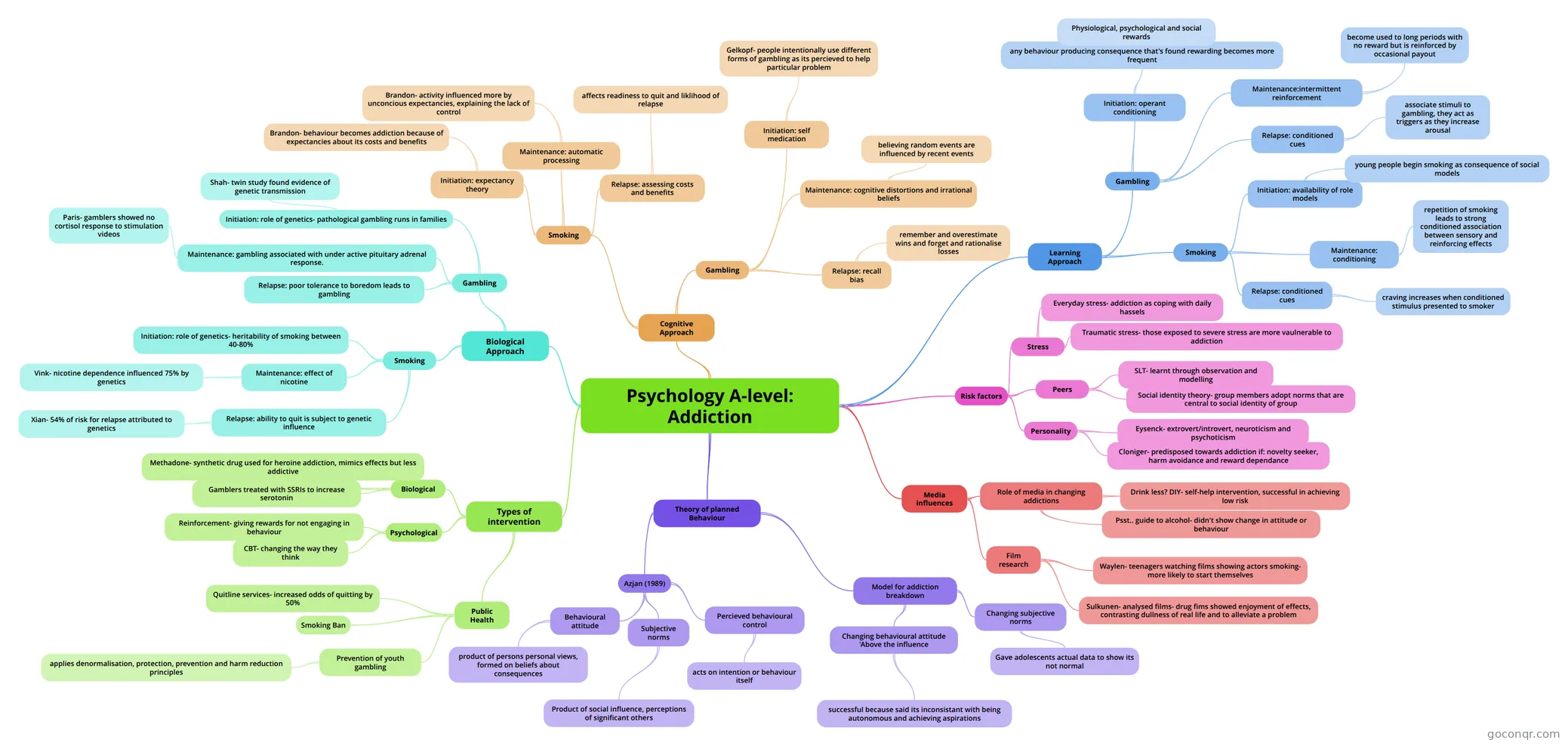 Mind map Psychology A-level: Addiction
-
22 cardsExplainations of Substance Abuse (Hereditary) Methods of Investiagtion
-
7 cardsGambling
-
12 questionssubstance abusation which stage of reward shows the greatest release of dopamine?
-
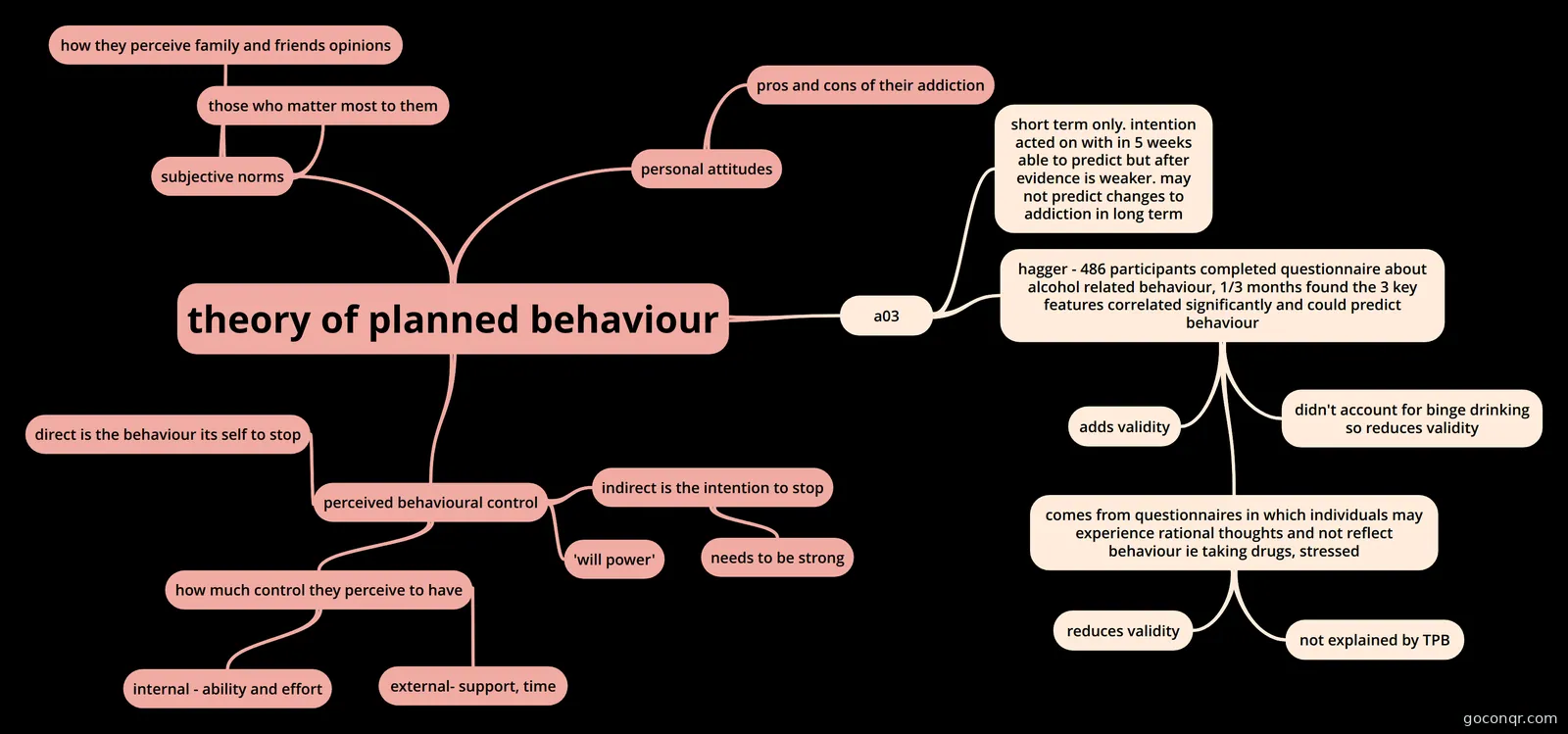 Mind map theory of planned behaviour TPB
-
Mind map Addiction psych 12 mind map about addiction
-
Mind map Addiction Addiction
Quizzes
See all 13 quizzes-
12 questionssubstance abusation which stage of reward shows the greatest release of dopamine?
-
80 questionsPSY3190 Which of the following is true regarding defining substance use and dependence?
-
21 questionsModels of addiction
-
36 questionsAddiction The cognitive approach states that it is faulty and delusional beliefs or expectations which lead to the in...
-
20 questionsSubstance Abuse Exam 2 What do we mean when a person has developed tolerance to a drug?
-
9 questionsWeek 12 Addiction Addicts take drugs for the rewarding effect and also to avoid withdrawals
-
7 questionsGriffiths
-
14 questionsAddictive Behaviours Exam #2 What are some examples of Narcotic Analgesics?
Mind maps
See all 231 mind mapsFlashcards
See all 81 flashcards-
22 cardsExplainations of Substance Abuse (Hereditary) Methods of Investiagtion
-
7 cardsGambling
-
111 cardsAddictions - psychology
-
41 cardsAddictions (Substance vs. Behavioural) Comparing Gambling Addiction with Substance Abuse Disorder
-
18 cardsPSYC2206 - Smoking
-
86 cardscase studies: issues and debates, addiction, bio ADDICTION Prochaska's (1977)
-
28 cardsThree explanations of gambling and smoking
-
94 cardsAddiction
Notes
See all 16 notes-
Psychology | Unit 4 | Addiction - Explanations Biological ExplanationInitiationThe role of genetics - family and twin studies estimate the heritability of tobacco smoking to be between 39% and 80%. Vink et al. (2005) studied 1,572 Dutch twin pairs. They found that...
-
Psychology | Unit 4 | Addiction - Explanations_1 Biological ExplanationInitiationThe role of genetics - family and twin studies estimate the heritability of tobacco smoking to be between 39% and 80%. Vink et al. (2005) studied 1,572 Dutch twin pairs. They found that...
-
Interventions - created from Mind Map BIOLOGICAL drug maintenance therapy. methadone mimics effects of heroin but is less addictive. Prescribed increasing doses to increase tolerance then doses are decreased until addict no longer needs it. can become jus...
-
Biological Approach Smoking - created from Mind Map INITIATION family & twin studies show heritability between 39%-80% Vink: individual differences in initiation explained by genetic (44%) and environmental (56%) influences. children of women who smoked 20 a day during...
-
(Y2) Activities Nature V Nurture - 12/09/2021 Read and make notes from chapter 50 of Gross, R. (2020) Psychology: Science of Mind and Behaviour (8th Edition). Gross, R. D. (2020). Psychology : The Science of ...
-
Substance Abuse General Terms Substance Use - Use of a substance that causes no immediate harm Substance Misuse - Use of a substance resulting in the person experiencing social, physical, legal or psychological problems Substance Abuse - Use...
-
Risk Factors - created from Mind Map STRESS engage in addictive behaviours as means of coping with everyday stress. contribute to initiation, maintenance as well as relapse as stress due to abstinence & withdrawal may lead them to start again some may no...
-
Media Influence - created from Mind Map communicates information about dependency through public formats which affect people's perceptions & behaviour. addictive behaviours also portrayed through exposure to role models who promote dependency through film &...
Slides
Topics in Addiction
More Psychology topics
About Addiction
GoConqr OriginalWhat this unit covers
The resources follow the A-level style of the topic. Models of addiction come first: the biological, cognitive and learning approaches, usually applied to both smoking and gambling. Around them sit risk factors, media influences, the Theory of Planned Behaviour and types of intervention. Many items split each model into initiation, maintenance and relapse, which is a handy way to organise your answers.
Where to start
Begin with the overview mind map Psychology A-level: Addiction. It branches into the approaches, risk factors, media influences, gambling and interventions, so you can see the whole unit on one screen. The mind map called Addiction, which opens with the question of what addiction is, helps with definitions.
Then move on in this order:
- Models of Addictive Behaviour - Smoking, to compare the three approaches across initiation, maintenance and relapse.
- The flashcard deck Gambling, covering the dopamine reward pathway, opioid antagonists such as naltrexone, gambling venues and self-help groups.
- theory of planned behaviour, which breaks down personal attitudes, subjective norms and perceived behavioural control.
- Types of Intervention and their Effectiveness, which covers biological options such as nicotine replacement through gum and patches.
Using quizzes and maps together
Read a mind map first, then test yourself. The quiz substance abusation asks about dopamine, the VTA and the effects of opiates, so it suits the biological material. The quizzes Models of addiction and Griffiths work well after the model maps. Note what you got wrong, then go back to the matching map or the deck Explainations of Substance Abuse, which covers hereditary and personality explanations.
The notes created from mind maps, such as the one on the biological approach to smoking, give you the same content in sentences. They quote twin-study heritability figures, which can help when you write evaluation points.
Where it fits
This unit sits in the Psychopathology and Treatment strand of Psychology. It links the explanations of behaviour with the treatments that follow from them, so it helps to keep each model next to its matching intervention.
When you are ready, pick one approach, work through its map and deck, and then build your own set of flashcards to fill any gaps you spot.
Frequently asked questions
Which resource should I open first?
Start with the mind map Psychology A-level: Addiction. It shows the biological, cognitive and learning approaches, risk factors, media influences, gambling and interventions together. Once you can see the shape of the unit, move to the smoking models map and the gambling flashcards to go deeper.
What do the mind maps cover?
There are over 220 mind maps. They cover models of addiction for smoking and gambling, the Theory of Planned Behaviour, Griffiths 1994, family and addiction, vulnerability and risk factors, media influence, and biological, psychological and public health interventions. Several are split by initiation, maintenance and relapse.
Are the resources free to use?
Yes. Every resource on this page is free to open, study and take, with no account needed. They were made by GoConqr users rather than by GoConqr itself. A free account lets you save quiz scores and make your own quizzes, mind maps, flashcards and notes.
Which exam are these resources for?
The listed resources mention A-level Psychology, and about two thirds of them are at school level. The rest are aimed at university students. Check each resource against your own specification, since they were written by different users and may stress different studies.
Are there quizzes on this page?
Yes, there are more than 10 quizzes. Examples include substance abusation, Models of addiction, Griffiths and Who gambles online, and on what?. They range from biology of dopamine and reward to models and studies, so you can test one area at a time.
What if I can't find the topic I need?
Try a related resource first. Gambling and smoking are often covered side by side, and the intervention maps and flashcards cross over with the models. If a topic is still missing, you can make your own mind map, flashcards or notes and fill the gap yourself.