
Mind map
Forgetting - interference
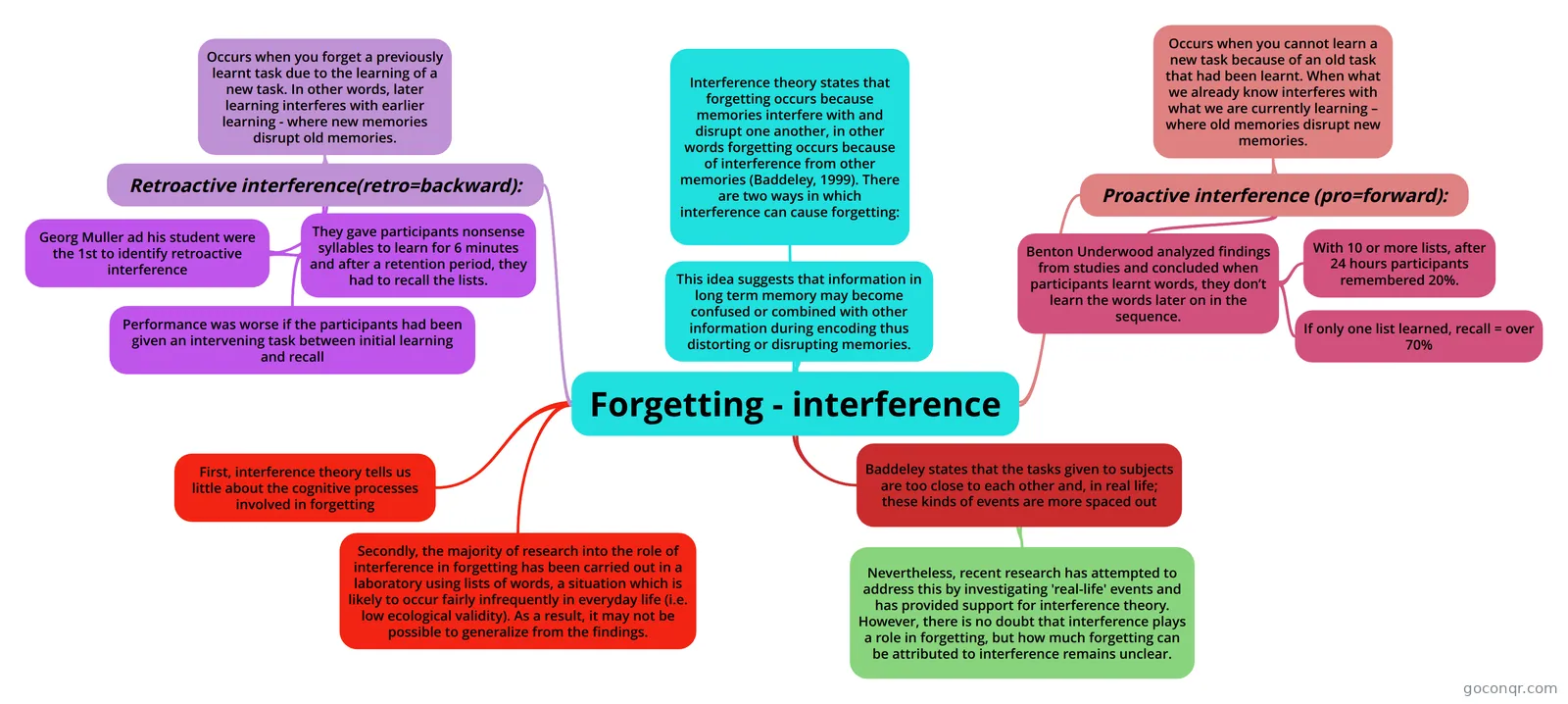
Mind map: Forgetting - interference
Map content
Forgetting - interference
This idea suggests that information in long term memory may become confused or combined with other information during encoding thus distorting or disrupting memories.
Interference theory states that forgetting occurs because memories interfere with and disrupt one another, in other words forgetting occurs because of interference from other memories (Baddeley, 1999). There are two ways in which interference can cause forgetting:
Proactive interference (pro=forward):
- Occurs when you cannot learn a new task because of an old task that had been learnt. When what we already know interferes with what we are currently learning – where old memories disrupt new memories.
- Benton Underwood analyzed findings from studies and concluded when participants learnt words, they don’t learn the words later on in the sequence.
- With 10 or more lists, after 24 hours participants remembered 20%.
- If only one list learned, recall = over 70%
Retroactive interference(retro=backward):
- Occurs when you forget a previously learnt task due to the learning of a new task. In other words, later learning interferes with earlier learning - where new memories disrupt old memories.
- Georg Muller ad his student were the 1st to identify retroactive interference
- They gave participants nonsense syllables to learn for 6 minutes and after a retention period, they had to recall the lists.
- Performance was worse if the participants had been given an intervening task between initial learning and recall
- They gave participants nonsense syllables to learn for 6 minutes and after a retention period, they had to recall the lists.
First, interference theory tells us little about the cognitive processes involved in forgetting
Secondly, the majority of research into the role of interference in forgetting has been carried out in a laboratory using lists of words, a situation which is likely to occur fairly infrequently in everyday life (i.e. low ecological validity). As a result, it may not be possible to generalize from the findings.
Baddeley states that the tasks given to subjects are too close to each other and, in real life; these kinds of events are more spaced out
- Nevertheless, recent research has attempted to address this by investigating 'real-life' events and has provided support for interference theory. However, there is no doubt that interference plays a role in forgetting, but how much forgetting can be attributed to interference remains unclear.
Information
- Description
- AS - Level Psychology (Memory) Mind Map on Forgetting - interference, created by Jess Hughes on 26/04/2016.
- Created by
- Jess Hughes
- Views
- 0
- Rating