
Mind map
Learning
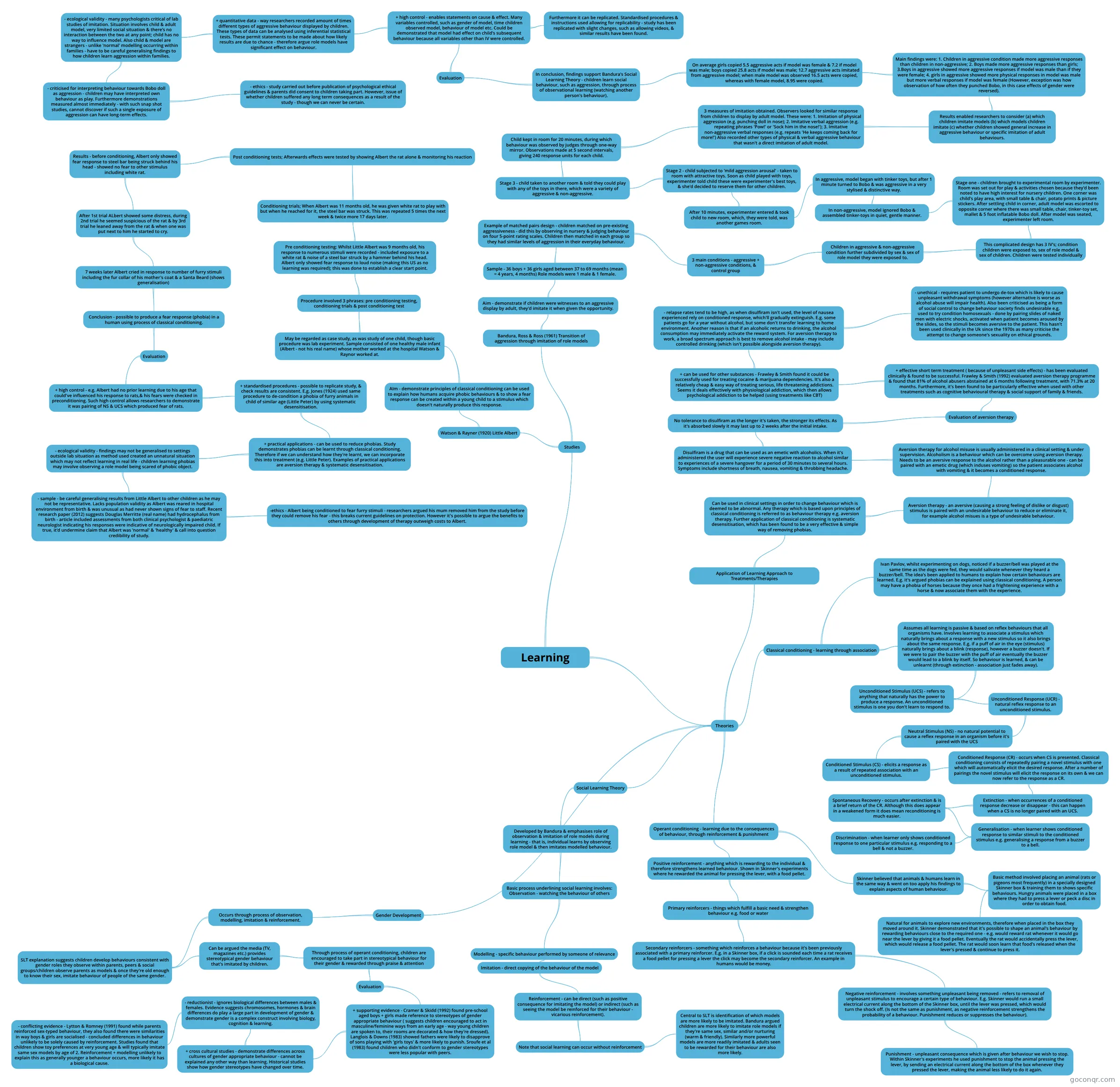
Mind map: Learning theories in psychology
Map content
Learning
Theories
- Classical conditioning - learning through association
- Assumes all learning is passive & based on reflex behaviours that all organisms have. Involves learning to associate a stimulus which naturally brings about a response with a new stimulus so it also brings about the same response. E.g. if a puff of air in the eye (stimulus) naturally brings about a blink (response), however a buzzer doesn't. If we were to pair the buzzer with the puff of air eventually the buzzer would lead to a blink by itself. So behaviour is learned, & can be unlearnt (through extinction - association just fades away).
- Unconditioned Stimulus (UCS) - refers to anything that naturally has the power to produce a response. An unconditioned stimulus is one you don't learn to respond to.
- Unconditioned Response (UCR) - natural reflex response to an unconditioned stimulus.
- Neutral Stimulus (NS) - no natural potential to cause a reflex response in an organism before it's paired with the UCS
- Conditioned Stimulus (CS) - elicits a response as a result of repeated association with an unconditioned stimulus.
- Conditioned Response (CR) - occurs when CS is presented. Classical conditioning consists of repeatedly pairing a novel stimulus with one which will automatically elicit the desired response. After a number of pairings the novel stimulus will elicit the response on its own & we can now refer to the response as a CR.
- Extinction - when occurrences of a conditioned response decrease or disappear - this can happen when a CS is no longer paired with an UCS.
- Spontaneous Recovery - occurs after extinction & is a brief return of the CR. Although this does appear in a weakened form it does mean reconditioning is much easier.
- Generalisation - when learner shows conditioned response to similar stimuli to the conditioned stimulus e.g. generalising a response from a buzzer to a bell.
- Discrimination - when learner only shows conditioned response to one particular stimulus e.g. responding to a bell & not a buzzer.
- Generalisation - when learner shows conditioned response to similar stimuli to the conditioned stimulus e.g. generalising a response from a buzzer to a bell.
- Spontaneous Recovery - occurs after extinction & is a brief return of the CR. Although this does appear in a weakened form it does mean reconditioning is much easier.
- Extinction - when occurrences of a conditioned response decrease or disappear - this can happen when a CS is no longer paired with an UCS.
- Conditioned Response (CR) - occurs when CS is presented. Classical conditioning consists of repeatedly pairing a novel stimulus with one which will automatically elicit the desired response. After a number of pairings the novel stimulus will elicit the response on its own & we can now refer to the response as a CR.
- Conditioned Stimulus (CS) - elicits a response as a result of repeated association with an unconditioned stimulus.
- Neutral Stimulus (NS) - no natural potential to cause a reflex response in an organism before it's paired with the UCS
- Unconditioned Response (UCR) - natural reflex response to an unconditioned stimulus.
- Unconditioned Stimulus (UCS) - refers to anything that naturally has the power to produce a response. An unconditioned stimulus is one you don't learn to respond to.
- Ivan Pavlov, whilst experimenting on dogs, noticed if a buzzer/bell was played at the same time as the dogs were fed, they would salivate whenever they heard a buzzer/bell. The idea's been applied to humans to explain how certain behaviours are learned. E.g. it's argued phobias can be explained using classical conditioning. A person may have a phobia of horses because they once had a frightening experience with a horse & now associate them with the experience.
- Assumes all learning is passive & based on reflex behaviours that all organisms have. Involves learning to associate a stimulus which naturally brings about a response with a new stimulus so it also brings about the same response. E.g. if a puff of air in the eye (stimulus) naturally brings about a blink (response), however a buzzer doesn't. If we were to pair the buzzer with the puff of air eventually the buzzer would lead to a blink by itself. So behaviour is learned, & can be unlearnt (through extinction - association just fades away).
- Operant conditioning - learning due to the consequences of behaviour, through reinforcement & punishment
- Positive reinforcement - anything which is rewarding to the individual & therefore strengthens learned behaviour. Shown in Skinner's experiments where he rewarded the animal for pressing the lever, with a food pellet.
- Primary reinforcers - things which fulfill a basic need & strengthen behaviour e.g. food or water
- Secondary reinforcers - something which reinforces a behaviour because it's been previously associated with a primary reinforcer. E.g. in a Skinner box, if a click is sounded each time a rat receives a food pellet for pressing a lever the click may become the secondary reinforcer. An example in humans would be money.
- Negative reinforcement - involves something unpleasant being removed - refers to removal of unpleasant stimulus to encourage a certain type of behaviour. E.g. Skinner would run a small electrical current along the bottom of the Skinner box, until the lever was pressed, which would turn the shock off. (Is not the same as punishment, as negative reinforcement strengthens the probability of a behaviour. Punishment reduces or suppresses the behaviour).
- Punishment - unpleasant consequence which is given after behaviour we wish to stop. Within Skinner's experiments he used punishment to stop the animal pressing the lever, by sending an electrical current along the bottom of the box whenever they pressed the lever, making the animal less likely to do it again.
- Negative reinforcement - involves something unpleasant being removed - refers to removal of unpleasant stimulus to encourage a certain type of behaviour. E.g. Skinner would run a small electrical current along the bottom of the Skinner box, until the lever was pressed, which would turn the shock off. (Is not the same as punishment, as negative reinforcement strengthens the probability of a behaviour. Punishment reduces or suppresses the behaviour).
- Secondary reinforcers - something which reinforces a behaviour because it's been previously associated with a primary reinforcer. E.g. in a Skinner box, if a click is sounded each time a rat receives a food pellet for pressing a lever the click may become the secondary reinforcer. An example in humans would be money.
- Primary reinforcers - things which fulfill a basic need & strengthen behaviour e.g. food or water
- Skinner believed that animals & humans learn in the same way & went on too apply his findings to explain aspects of human behaviour.
- Basic method involved placing an animal (rats or pigeons most frequently) in a specially designed Skinner box & training them to shows specific behaviours. Hungry animals were placed in a box where they had to press a lever or peck a disc in order to obtain food.
- Natural for animals to explore new environments, therefore when placed in the box they moved around it. Skinner demonstrated that it's possible to shape an animal's behaviour by rewarding behaviours close to the required one - e.g. would reward rat whenever it would go near the lever by giving it a food pellet. Eventually the rat would accidentally press the lever, which would release a food pellet. The rat would soon learn that food's released when the lever's pressed & continue to press it.
- Basic method involved placing an animal (rats or pigeons most frequently) in a specially designed Skinner box & training them to shows specific behaviours. Hungry animals were placed in a box where they had to press a lever or peck a disc in order to obtain food.
- Positive reinforcement - anything which is rewarding to the individual & therefore strengthens learned behaviour. Shown in Skinner's experiments where he rewarded the animal for pressing the lever, with a food pellet.
- Application of Learning Approach to Treatments/Therapies
- Can be used in clinical settings in order to change behaviour which is deemed to be abnormal. Any therapy which is based upon principles of classical conditioning is referred to as behaviour therapy e.g. aversion therapy. Further application of classical conditioning is systematic desensitisation, which has been found to be a very effective & simple way of removing phobias.
- Aversion therapy - an aversive (causing a strong feeling of dislike or disgust) stimulus is paired with an undesirable behaviour to reduce or eliminate it, for example alcohol misues is a type of undesirable behaviour.
- Aversion therapy for alcohol misuse is usually administered in a clinical setting & under supervision. Alcoholism is a behaviour which can be overcome using aversion therapy. Needs to be an aversive response to the alcohol rather than a pleasurable one - can be paired with an emetic drug (which induses vomiting) so the patient associates alcohol with vomiting & it becomes a conditioned response.
- Disulfiram is a drug that can be used as an emetic with alcoholics. When it's administered the user will experience severe negative reaction to alcohol similar to experiences of a severe hangover for a period of 30 minutes to several hours. Symptoms include shortness of breath, nausea, vomiting & throbbing headache.
- No tolerance to disulfiram as the longer it's taken, the stronger its effects. As it's absorbed slowly it may last up to 2 weeks after the initial intake.
- Evaluation of aversion therapy
- + effective short term treatment ( because of unpleasant side effects) - has been evaluated clinically & found to be successful. Frawley & Smith (1992) evaluated aversion therapy programme & found that 81% of alcohol abusers abstained at 6 months following treatment, with 71.3% at 20 months. Furthermore, it's been found to be particularly effective when used with other treatments such as cognitive behavioural therapy & social support of family & friends.
- + can be used for other substances - Frawley & Smith found it could be successfully used for treating cocaine & marijuana dependencies. It's also a relatively cheap & easy way of treating serious, life threatening addictions. Seems it deals effectively with physiological addiction, which then allows psychological addiction to be helped (using treatments like CBT)
- - relapse rates tend to be high, as when disulfiram isn't used, the level of nausea experienced rely on conditioned response, which'll gradually extinguish. E.g. some patients go for a year without alcohol, but some don't transfer learning to home environment. Another reason is that if an alcoholic returns to drinking, the alcohol consumption may immediately activate the reward system. For aversion therapy to work, a broad spectrum approach is best to remove alcohol intake - may include controlled drinking (which isn't possible alongside aversion therapy).
- - unethical - requires patient to undergo de-tox which is likely to cause unpleasant withdrawal symptoms (however alternative is worse as alcohol abuse will impair health). Also been criticised as being a form of social control to change behaviour society finds undesirable e.g. used to try condition homosexuals - done by pairing slides of naked men with electric shocks, activated when patient becomes aroused by the slides, so the stimuli becomes aversive to the patient. This hasn't been used clinically in the Uk since the 1970s as many criticise the attempt to change someone's sexuality on ethical grounds.
- - relapse rates tend to be high, as when disulfiram isn't used, the level of nausea experienced rely on conditioned response, which'll gradually extinguish. E.g. some patients go for a year without alcohol, but some don't transfer learning to home environment. Another reason is that if an alcoholic returns to drinking, the alcohol consumption may immediately activate the reward system. For aversion therapy to work, a broad spectrum approach is best to remove alcohol intake - may include controlled drinking (which isn't possible alongside aversion therapy).
- + can be used for other substances - Frawley & Smith found it could be successfully used for treating cocaine & marijuana dependencies. It's also a relatively cheap & easy way of treating serious, life threatening addictions. Seems it deals effectively with physiological addiction, which then allows psychological addiction to be helped (using treatments like CBT)
- + effective short term treatment ( because of unpleasant side effects) - has been evaluated clinically & found to be successful. Frawley & Smith (1992) evaluated aversion therapy programme & found that 81% of alcohol abusers abstained at 6 months following treatment, with 71.3% at 20 months. Furthermore, it's been found to be particularly effective when used with other treatments such as cognitive behavioural therapy & social support of family & friends.
- Evaluation of aversion therapy
- No tolerance to disulfiram as the longer it's taken, the stronger its effects. As it's absorbed slowly it may last up to 2 weeks after the initial intake.
- Disulfiram is a drug that can be used as an emetic with alcoholics. When it's administered the user will experience severe negative reaction to alcohol similar to experiences of a severe hangover for a period of 30 minutes to several hours. Symptoms include shortness of breath, nausea, vomiting & throbbing headache.
- Aversion therapy for alcohol misuse is usually administered in a clinical setting & under supervision. Alcoholism is a behaviour which can be overcome using aversion therapy. Needs to be an aversive response to the alcohol rather than a pleasurable one - can be paired with an emetic drug (which induses vomiting) so the patient associates alcohol with vomiting & it becomes a conditioned response.
- Aversion therapy - an aversive (causing a strong feeling of dislike or disgust) stimulus is paired with an undesirable behaviour to reduce or eliminate it, for example alcohol misues is a type of undesirable behaviour.
- Can be used in clinical settings in order to change behaviour which is deemed to be abnormal. Any therapy which is based upon principles of classical conditioning is referred to as behaviour therapy e.g. aversion therapy. Further application of classical conditioning is systematic desensitisation, which has been found to be a very effective & simple way of removing phobias.
- Social Learning Theory
- Developed by Bandura & emphasises role of observation & imitation of role models during learning - that is, individual learns by observing role model & then imitates modelled behaviour.
- Basic process underlining social learning involves: Observation - watching the behaviour of others
- Modelling - specific behaviour performed by someone of relevance
- Imitation - direct copying of the behaviour of the model
- Reinforcement - can be direct (such as positive consequence for imitating the model) or indirect (such as seeing the model be reinforced for their behaviour - vicarious reinforcement).
- Note that social learning can occur without reinforcement
- Central to SLT is identification of which models are more likely to be imitated. Bandura argued children are more likely to imitate role models if they're same sex, similar and/or nurturing (warm & friendly). Similarly more powerful models are more readily imitated & adults seen to be rewarded for their behaviour are also more likely.
- Note that social learning can occur without reinforcement
- Reinforcement - can be direct (such as positive consequence for imitating the model) or indirect (such as seeing the model be reinforced for their behaviour - vicarious reinforcement).
- Imitation - direct copying of the behaviour of the model
- Modelling - specific behaviour performed by someone of relevance
- Basic process underlining social learning involves: Observation - watching the behaviour of others
- Developed by Bandura & emphasises role of observation & imitation of role models during learning - that is, individual learns by observing role model & then imitates modelled behaviour.
- Gender Development
- Occurs through process of observation, modelling, imitation & reinforcement.
- SLT explanation suggests children develop behaviours consistent with gender roles they observe within parents, peers & social groups/children observe parents as models & once they're old enough to know their sex, imitate behaviour of people of the same gender.
- Can be argued the media (TV, magazines etc.) provides stereotypical gender behaviour that's imitated by children.
- Through process of operant conditioning, children are encouraged to take part in stereotypical behaviour for their gender & rewarded through praise & attention
- Evaluation
- + supporting evidence - Cramer & Skidd (1992) found pre-school aged boys + girls made reference to stereotypes of gender appropriate behaviour ( suggests children encouraged to act in masculine/feminine ways from an early age - way young children are spoken to, their rooms are decorated & how they're dressed). Langlois & Downs (1983) showed fathers were likely to disapprove of sons playing with 'girls toys' & more likely to punish. Sroufe et al (1983) found children who didn't conform to gender stereotypes were less popular with peers.
- + cross cultural studies - demonstrate differences across cultures of gender appropriate behaviour - cannot be explained any other way than learning. Historical studies show how gender stereotypes have changed over time.
- - reductionist - ignores biological differences between males & females. Evidence suggests chromosomes, hormones & brain differences do play a large part in development of gender & demonstrate gender is a complex construct involving biology, cognition & learning.
- - conflicting evidence - Lytton & Romney (1991) found while parents reinforced sex-typed behaviour, they also found there were similarities in way boys & girls are socialised - concluded differences in behaviour unlikely to be solely caused by reinforcement. Studies found that children show toy preferences at very young age & will typically imitate same sex models by age of 2. Reinforcement + modelling unlikely to explain this as generally younger a behaviour occurs, more likely it has a biological cause.
- - reductionist - ignores biological differences between males & females. Evidence suggests chromosomes, hormones & brain differences do play a large part in development of gender & demonstrate gender is a complex construct involving biology, cognition & learning.
- + cross cultural studies - demonstrate differences across cultures of gender appropriate behaviour - cannot be explained any other way than learning. Historical studies show how gender stereotypes have changed over time.
- + supporting evidence - Cramer & Skidd (1992) found pre-school aged boys + girls made reference to stereotypes of gender appropriate behaviour ( suggests children encouraged to act in masculine/feminine ways from an early age - way young children are spoken to, their rooms are decorated & how they're dressed). Langlois & Downs (1983) showed fathers were likely to disapprove of sons playing with 'girls toys' & more likely to punish. Sroufe et al (1983) found children who didn't conform to gender stereotypes were less popular with peers.
- Evaluation
- Through process of operant conditioning, children are encouraged to take part in stereotypical behaviour for their gender & rewarded through praise & attention
- Can be argued the media (TV, magazines etc.) provides stereotypical gender behaviour that's imitated by children.
- SLT explanation suggests children develop behaviours consistent with gender roles they observe within parents, peers & social groups/children observe parents as models & once they're old enough to know their sex, imitate behaviour of people of the same gender.
- Occurs through process of observation, modelling, imitation & reinforcement.
- Classical conditioning - learning through association
Studies
- Bandura, Ross & Ross (1961) Transition of aggression through imitation of role models
- Aim - demonstrate if children were witnesses to an aggressive display by adult, they'd imitate it when given the opportunity.
- Sample - 36 boys + 36 girls aged between 37 to 69 months (mean = 4 years, 4 months) Role models were 1 male & 1 female.
- Example of matched pairs design - children matched on pre-existing aggressiveness - did this by observing in nursery & judging behaviour on four 5-point rating scales. Children then matched in each group so they had similar levels of aggression in their everyday behaviour.
- 3 main conditions - aggressive + non-aggressive conditions, & control group
- Children in aggressive & non-aggressive condition further subdivided by sex & sex of role model they were exposed to.
- This complicated design has 3 IV's; condition children were exposed to, sex of role model & sex of children. Children were tested individually
- Stage one - children brought to experimental room by experimenter. Room was set out for play & activities chosen because they'd been noted to have high interest for nursery children. One corner was child's play area, with small table & chair, potato prints & picture stickers. After settling child in corner, adult model was escorted to opposite corner where there was small table, chair, tinker-toy set, mallet & 5 foot inflatable Bobo doll. After model was seated, experimenter left room.
- In non-aggressive, model ignored Bobo & assembled tinker-toys in quiet, gentle manner.
- In aggressive, model began with tinker toys, but after 1 minute turned to Bobo & was aggressive in a very stylised & distinctive way.
- After 10 minutes, experimenter entered & took child to new room, which, they were told, was another games room.
- Stage 2 - child subjected to 'mild aggression arousal' - taken to room with attractive toys. Soon as child played with toys, experimenter told child these were experimenter's best toys, & she'd decided to reserve them for other children.
- Stage 3 - child taken to another room & told they could play with any of the toys in there, which were a variety of aggressive & non-aggressive.
- Child kept in room for 20 minutes, during which behaviour was observed by judges through one-way mirror. Observations made at 5 second intervals, giving 240 response units for each child.
- 3 measures of imitation obtained. Observers looked for similar response from children to display by adult model. These were: 1. Imitation of physical aggression (e.g. punching doll in nose); 2. Imitative verbal aggression (e.g. repeating phrases 'Pow!' or 'Sock him in the nose!'); 3. Imitative non-aggressive verbal responses (e.g. repeats 'He keeps coming back for more!') Also recorded other types of physical & verbal aggressive behaviour that wasn't a direct imitation of adult model.
- Results enabled researchers to consider (a) which children imitate models (b) which models children imitate (c) whether children showed general increase in aggressive behaviour or specific imitation of adult behaviours.
- Main findings were: 1. Children in aggressive condition made more aggressive responses than children in non-aggressive; 2. Boys made more aggressive responses than girls; 3.Boys in aggressive showed more aggressive responses if model was male than if they were female; 4. girls in aggressive showed more physical responses in model was male but more verbal responses if model was female (However, exception was how observation of how often they punched Bobo, in this case effects of gender were reversed).
- On average girls copied 5.5 aggressive acts if model was female & 7.2 if model was male; boys copied 25.8 acts if model was male; 12.7 aggressive acts imitated from aggressive model; when male model was observed 16.5 acts were copied, whereas with female model, 8.95 were copied.
- In conclusion, findings support Bandura's Social Learning Theory - children learn social behaviour, such as aggression, through process of observational learning (watching another person's behaviour).
- Evaluation
- + high control - enables statements on cause & effect. Many variables controlled, such as gender of model, time children observed model, behaviour of model etc. Could be demonstrated that model had effect on child's subsequent behaviour because all variables other than IV were controlled.
- Furthermore it can be replicated. Standardised procedures & instructions used allowing for replicability - study has been replicated with slight changes, such as allowing videos, & similar results have been found.
- + quantitative data - way researchers recorded amount of times different types of aggressive behaviour displayed by children. These types of data can be analysed using inferential statistical tests. These permit statements to be made about how likely results are due to chance - therefore argue role models have significant effect on behaviour.
- - ecological validity - many psychologists critical of lab studies of imitation. Situation involves child & adult model, very limited social situation & there's no interaction between the two at any point; child has no way to influence model. Also child & model are strangers - unlike 'normal' modelling occurring within families - have to be careful generalising findings to how children learn aggression within families.
- - criticised for interpreting behaviour towards Bobo doll as aggression - children may have interpreted own behaviour as play. Furthermore demonstrations measured almost immediately - with such snap shot studies, cannot discover if such a single exposure of aggression can have long-term effects.
- - ethics - study carried out before publication of psychological ethical guidelines & parents did consent to children taking part. However, issue of whether children suffered any long term consequences as a result of the study - though we can never be certain.
- - criticised for interpreting behaviour towards Bobo doll as aggression - children may have interpreted own behaviour as play. Furthermore demonstrations measured almost immediately - with such snap shot studies, cannot discover if such a single exposure of aggression can have long-term effects.
- - ecological validity - many psychologists critical of lab studies of imitation. Situation involves child & adult model, very limited social situation & there's no interaction between the two at any point; child has no way to influence model. Also child & model are strangers - unlike 'normal' modelling occurring within families - have to be careful generalising findings to how children learn aggression within families.
- + high control - enables statements on cause & effect. Many variables controlled, such as gender of model, time children observed model, behaviour of model etc. Could be demonstrated that model had effect on child's subsequent behaviour because all variables other than IV were controlled.
- Evaluation
- In conclusion, findings support Bandura's Social Learning Theory - children learn social behaviour, such as aggression, through process of observational learning (watching another person's behaviour).
- On average girls copied 5.5 aggressive acts if model was female & 7.2 if model was male; boys copied 25.8 acts if model was male; 12.7 aggressive acts imitated from aggressive model; when male model was observed 16.5 acts were copied, whereas with female model, 8.95 were copied.
- Main findings were: 1. Children in aggressive condition made more aggressive responses than children in non-aggressive; 2. Boys made more aggressive responses than girls; 3.Boys in aggressive showed more aggressive responses if model was male than if they were female; 4. girls in aggressive showed more physical responses in model was male but more verbal responses if model was female (However, exception was how observation of how often they punched Bobo, in this case effects of gender were reversed).
- Results enabled researchers to consider (a) which children imitate models (b) which models children imitate (c) whether children showed general increase in aggressive behaviour or specific imitation of adult behaviours.
- 3 measures of imitation obtained. Observers looked for similar response from children to display by adult model. These were: 1. Imitation of physical aggression (e.g. punching doll in nose); 2. Imitative verbal aggression (e.g. repeating phrases 'Pow!' or 'Sock him in the nose!'); 3. Imitative non-aggressive verbal responses (e.g. repeats 'He keeps coming back for more!') Also recorded other types of physical & verbal aggressive behaviour that wasn't a direct imitation of adult model.
- Child kept in room for 20 minutes, during which behaviour was observed by judges through one-way mirror. Observations made at 5 second intervals, giving 240 response units for each child.
- Stage 3 - child taken to another room & told they could play with any of the toys in there, which were a variety of aggressive & non-aggressive.
- Stage 2 - child subjected to 'mild aggression arousal' - taken to room with attractive toys. Soon as child played with toys, experimenter told child these were experimenter's best toys, & she'd decided to reserve them for other children.
- After 10 minutes, experimenter entered & took child to new room, which, they were told, was another games room.
- In aggressive, model began with tinker toys, but after 1 minute turned to Bobo & was aggressive in a very stylised & distinctive way.
- In non-aggressive, model ignored Bobo & assembled tinker-toys in quiet, gentle manner.
- Stage one - children brought to experimental room by experimenter. Room was set out for play & activities chosen because they'd been noted to have high interest for nursery children. One corner was child's play area, with small table & chair, potato prints & picture stickers. After settling child in corner, adult model was escorted to opposite corner where there was small table, chair, tinker-toy set, mallet & 5 foot inflatable Bobo doll. After model was seated, experimenter left room.
- This complicated design has 3 IV's; condition children were exposed to, sex of role model & sex of children. Children were tested individually
- Children in aggressive & non-aggressive condition further subdivided by sex & sex of role model they were exposed to.
- 3 main conditions - aggressive + non-aggressive conditions, & control group
- Example of matched pairs design - children matched on pre-existing aggressiveness - did this by observing in nursery & judging behaviour on four 5-point rating scales. Children then matched in each group so they had similar levels of aggression in their everyday behaviour.
- Sample - 36 boys + 36 girls aged between 37 to 69 months (mean = 4 years, 4 months) Role models were 1 male & 1 female.
- Aim - demonstrate if children were witnesses to an aggressive display by adult, they'd imitate it when given the opportunity.
- Watson & Rayner (1920) Little Albert
- AIm - demonstrate principles of classical conditioning can be used to explain how humans acquire phobic behaviours & to show a fear response can be created within a young child to a stimulus which doesn't naturally produce this response.
- May be regarded as case study, as was study of one child, though basic procedure was lab experiment. Sample consisted of one healthy male infant (Albert - not his real name) whose mother worked at the hospital Watson & Raynor worked at.
- Procedure involved 3 phrases: pre conditioning testing, conditioning trials & post conditioning test
- Pre conditioning testing: Whilst Little Albert was 9 months old, his response to numerous stimuli were recorded - included exposure to a white rat & noise of a steel bar struck by a hammer behind his head. Albert only showed fear response to loud noise (making this US as no learning was required); this was done to establish a clear start point.
- Conditioning trials; When Albert was 11 months old, he was given white rat to play with but when he reached for it, the steel bar was struck. This was repeated 5 times the next week & twice more 17 days later.
- Post conditioning tests; Afterwards effects were tested by showing Albert the rat alone & monitoring his reaction
- Results - before conditioning, Albert only showed fear response to steel bar being struck behind his head - showed no fear to other stimulus including white rat.
- After 1st trial ALbert showed some distress, during 2nd trial he seemed suspicious of the rat & by 3rd trial he leaned away from the rat & when one was put next to him he started to cry.
- 7 weeks later Albert cried in response to number of furry stimuli including the fur collar of his mother's coat & a Santa Beard (shows generalisation)
- Conclusion - possible to produce a fear response (phobia) in a human using process of classical conditioning.
- Evaluation
- + high control - e.g. Albert had no prior learning due to his age that could've influenced his response to rats,& his fears were checked in preconditioning. Such high control allows researchers to demonstrate it was pairing of NS & UCS which produced fear of rats.
- + standardised procedures - possible to replicate study, & check results are consistent. E.g. Jones (1924) used same procedure to de-condition a phobia of furry animals in child of similar age (Little Peter) by using systematic desensitisation.
- + practical applications - can be used to reduce phobias. Study demonstrates phobias can be learnt through classical conditioning. Therefore if we can understand how they're learnt, we can incorporate this into treatment (e.g. Little Peter). Examples of practical applications are aversion therapy & systematic desensitisation.
- - ecological validity - findings may not be generalised to settings outside lab situation as method used created an unnatural situation which may not reflect learning in real life - children learning phobias may involve observing a role model being scared of phobic object.
- - sample - be careful generalising results from Little Albert to other children as he may not be representative. Lacks population validity as Albert was reared in hospital environment from birth & was unusual as had never shown signs of fear to staff. Recent research paper (2012) suggests Douglas Merritte (real name) had hydrocephalus from birth - article included assessments from both clinical psychologist & paediatric neurologist indicating his responses were indicative of neurologically impaired child. If true, it'd undermine claim that Albert was 'normal' & 'healthy' & call into question credibility of study.
- -ethics - Albert being conditioned to fear furry stimuli - researchers argued his mum removed him from the study before they could remove his fear - this breaks current guidelines on protection. However it's possible to argue the benefits to others through development of therapy outweigh costs to Albert.
- - sample - be careful generalising results from Little Albert to other children as he may not be representative. Lacks population validity as Albert was reared in hospital environment from birth & was unusual as had never shown signs of fear to staff. Recent research paper (2012) suggests Douglas Merritte (real name) had hydrocephalus from birth - article included assessments from both clinical psychologist & paediatric neurologist indicating his responses were indicative of neurologically impaired child. If true, it'd undermine claim that Albert was 'normal' & 'healthy' & call into question credibility of study.
- - ecological validity - findings may not be generalised to settings outside lab situation as method used created an unnatural situation which may not reflect learning in real life - children learning phobias may involve observing a role model being scared of phobic object.
- + practical applications - can be used to reduce phobias. Study demonstrates phobias can be learnt through classical conditioning. Therefore if we can understand how they're learnt, we can incorporate this into treatment (e.g. Little Peter). Examples of practical applications are aversion therapy & systematic desensitisation.
- + standardised procedures - possible to replicate study, & check results are consistent. E.g. Jones (1924) used same procedure to de-condition a phobia of furry animals in child of similar age (Little Peter) by using systematic desensitisation.
- + high control - e.g. Albert had no prior learning due to his age that could've influenced his response to rats,& his fears were checked in preconditioning. Such high control allows researchers to demonstrate it was pairing of NS & UCS which produced fear of rats.
- Evaluation
- Conclusion - possible to produce a fear response (phobia) in a human using process of classical conditioning.
- 7 weeks later Albert cried in response to number of furry stimuli including the fur collar of his mother's coat & a Santa Beard (shows generalisation)
- After 1st trial ALbert showed some distress, during 2nd trial he seemed suspicious of the rat & by 3rd trial he leaned away from the rat & when one was put next to him he started to cry.
- Results - before conditioning, Albert only showed fear response to steel bar being struck behind his head - showed no fear to other stimulus including white rat.
- Post conditioning tests; Afterwards effects were tested by showing Albert the rat alone & monitoring his reaction
- Conditioning trials; When Albert was 11 months old, he was given white rat to play with but when he reached for it, the steel bar was struck. This was repeated 5 times the next week & twice more 17 days later.
- Pre conditioning testing: Whilst Little Albert was 9 months old, his response to numerous stimuli were recorded - included exposure to a white rat & noise of a steel bar struck by a hammer behind his head. Albert only showed fear response to loud noise (making this US as no learning was required); this was done to establish a clear start point.
- Procedure involved 3 phrases: pre conditioning testing, conditioning trials & post conditioning test
- May be regarded as case study, as was study of one child, though basic procedure was lab experiment. Sample consisted of one healthy male infant (Albert - not his real name) whose mother worked at the hospital Watson & Raynor worked at.
- AIm - demonstrate principles of classical conditioning can be used to explain how humans acquire phobic behaviours & to show a fear response can be created within a young child to a stimulus which doesn't naturally produce this response.
- Bandura, Ross & Ross (1961) Transition of aggression through imitation of role models
Information
- Description
- A Level Psychology (Unit 2) Mind Map on Learning, created by jamesrobertdowdle on 28/04/2016.
- Created by
- jamesrobertdowdle
- Views
- 0
- Rating