
Mind map
Maintenance of relationships
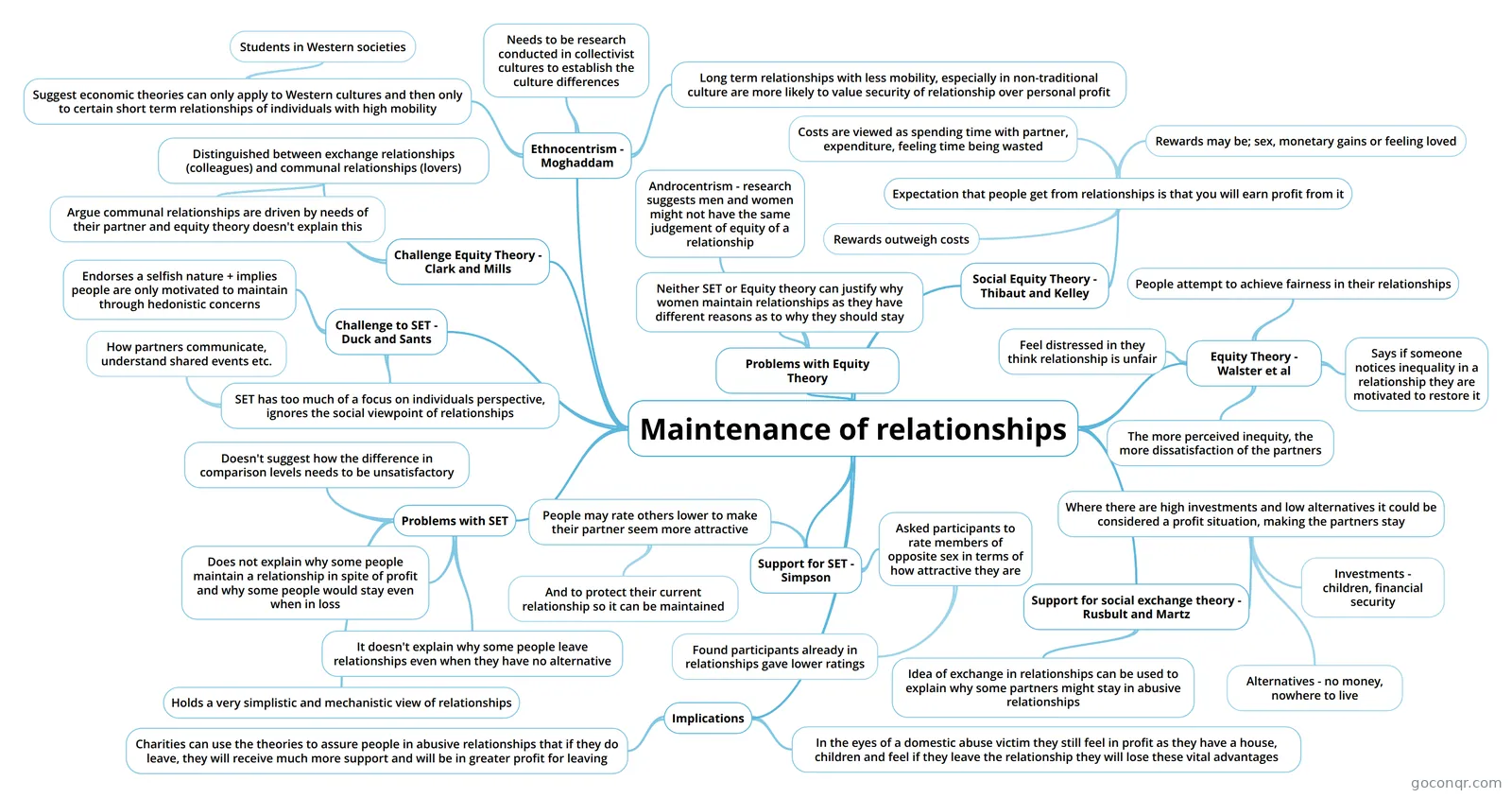
Mind map: Maintenance of relationships
Map content
Maintenance of relationships
Social Equity Theory - Thibaut and Kelley
- Expectation that people get from relationships is that you will earn profit from it
- Rewards outweigh costs
- Rewards may be; sex, monetary gains or feeling loved
- Costs are viewed as spending time with partner, expenditure, feeling time being wasted
- Expectation that people get from relationships is that you will earn profit from it
Equity Theory - Walster et al
- People attempt to achieve fairness in their relationships
- Feel distressed in they think relationship is unfair
- The more perceived inequity, the more dissatisfaction of the partners
- Says if someone notices inequality in a relationship they are motivated to restore it
Support for social exchange theory - Rusbult and Martz
- Idea of exchange in relationships can be used to explain why some partners might stay in abusive relationships
- Where there are high investments and low alternatives it could be considered a profit situation, making the partners stay
- Investments - children, financial security
- Alternatives - no money, nowhere to live
Support for SET - Simpson
- Asked participants to rate members of opposite sex in terms of how attractive they are
- Found participants already in relationships gave lower ratings
- People may rate others lower to make their partner seem more attractive
- And to protect their current relationship so it can be maintained
- Asked participants to rate members of opposite sex in terms of how attractive they are
Problems with SET
- It doesn't explain why some people leave relationships even when they have no alternative
- Doesn't suggest how the difference in comparison levels needs to be unsatisfactory
- Does not explain why some people maintain a relationship in spite of profit and why some people would stay even when in loss
- Holds a very simplistic and mechanistic view of relationships
Challenge to SET - Duck and Sants
- SET has too much of a focus on individuals perspective, ignores the social viewpoint of relationships
- How partners communicate, understand shared events etc.
- Endorses a selfish nature + implies people are only motivated to maintain through hedonistic concerns
- SET has too much of a focus on individuals perspective, ignores the social viewpoint of relationships
Challenge Equity Theory - Clark and Mills
- Distinguished between exchange relationships (colleagues) and communal relationships (lovers)
- Argue communal relationships are driven by needs of their partner and equity theory doesn't explain this
- Distinguished between exchange relationships (colleagues) and communal relationships (lovers)
Ethnocentrism - Moghaddam
- Suggest economic theories can only apply to Western cultures and then only to certain short term relationships of individuals with high mobility
- Students in Western societies
- Long term relationships with less mobility, especially in non-traditional culture are more likely to value security of relationship over personal profit
- Needs to be research conducted in collectivist cultures to establish the culture differences
- Suggest economic theories can only apply to Western cultures and then only to certain short term relationships of individuals with high mobility
Problems with Equity Theory
- Androcentrism - research suggests men and women might not have the same judgement of equity of a relationship
- Neither SET or Equity theory can justify why women maintain relationships as they have different reasons as to why they should stay
Implications
- In the eyes of a domestic abuse victim they still feel in profit as they have a house, children and feel if they leave the relationship they will lose these vital advantages
- Charities can use the theories to assure people in abusive relationships that if they do leave, they will receive much more support and will be in greater profit for leaving
Information
- Description
- A-Level Psychology Mind Map on Maintenance of relationships, created by Tom Peters on 29/05/2016.
- Created by
- Tom Peters
- Views
- 0
- Rating
More on Relationship maintenance