
Mind map
Physiological and Acoustic Phonetics: A Speech Science Foundation
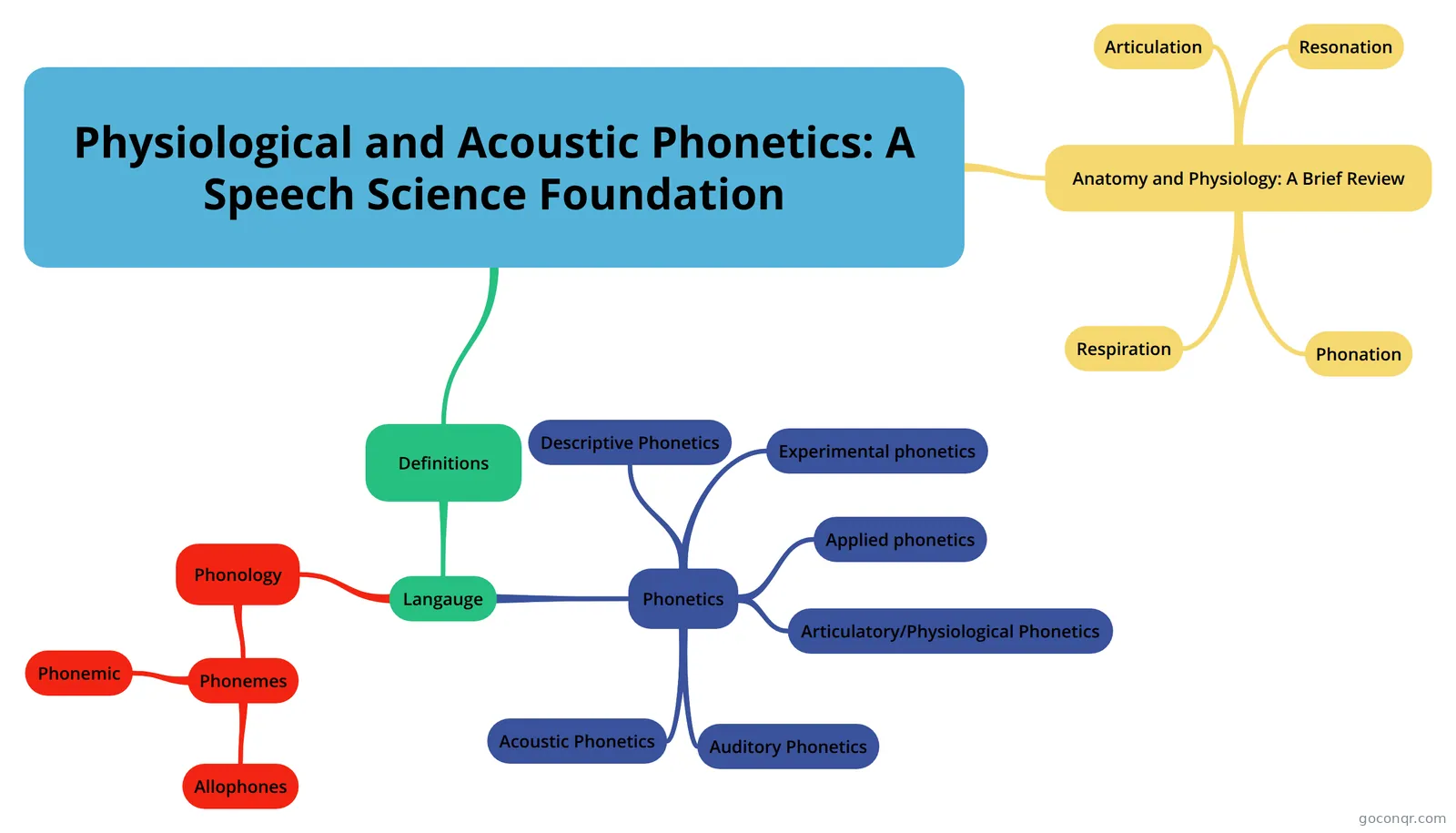
Mind map: Physiological and acoustic phonetics
Map content
Physiological and Acoustic Phonetics: A Speech Science Foundation
Definitions
- Langauge
- Linguistically, it's a code or system of symbols used to express concepts formed through exposure and experience. Speech is the production of language.
- Phonology
- The scientific study of the sound systems and patterns used to create the sounds and words of a language.
- Phonemes
- The smallest unit of sound that can affect meaning. For example, man and fan mean different things because of the different initial phonemes /m/ and /f/. Phonemes and families of sounds; the listener perceives family me members as belonging to the same phoneme. Phonemes are represented by other families or categories of sounds called allophones.
- Allophones
- Variations of phonemes. They don't change word meanings, and, although one person's pronunciation can be measurably distinct from another person's, listeners still perceive the allophones as being the same.
- The individual sound /r/ is a phoneme, but it sounds slightly different when speakers produce it in different linguistic contexts.
- For instance, the /r/ in green would be produced with more tongue retraction than the /r/ in red, which would be produced slightly more toward the front of the mouth. A speaker from New York would produce /r/ differently than a speaker from California. These different productions are allophonic variations of the /r/ phoneme.
- Phonemic
- The abstract system of sounds; for example, the idealized and abstract description of /s/ is phonemic. Slash marks indicate phonemic representation of a sound, or a general and abstract class of sounds.
- Phonetics
- Phonetic refers to the concrete productions of specific sounds. Phonetic productions are enclosed in square brackets [ ], indicating specific sound productions by given speakers.
- Phonetic is derived from the word phone. A phone may or may not be a speech sound; the term refers generically to any sound that can be produced by the vocal tract. Usually, a phone is a single speech sound. Phonetics is the study of speech sounds.
- Phonetics is divided into different categories.
- Acoustic Phonetics
- Examines the relationship between articulation and acoustic signal of speech. The concern is the acoustic properties of sound waves (e.g., periodicity and aperiodicity).
- Auditory Phonetics
- The study of hearing, perception, and the brain's processing of speech.
- Articulatory/Physiological Phonetics
- The study of speech sound production; emphasis is on how the articulators produce individual sounds.
- Applied phonetics
- The study of the practical application of research in articulatory, perceptual, acoustic, and experimental phonetics.
- Descriptive Phonetics
- The study and explanation of unique sound properties of various dialects and languages.
- Experimental phonetics
- Involves the use of objective laboratory techniques to scientifically analyze speech sounds.
- Langauge
Anatomy and Physiology: A Brief Review
- To produce sounds intelligibly, the speaker needs adequate respiration, phonation, articulation, and resonation. These processes work together synergistically.
- Respiration
- Respiratory system consists of lungs, diaphragm, rib cage, airway, and related structures.
- Inhalation and exhalation are necessary components of breathing for speech. They create the rhythmic cycle of respiration. The process of respiration supplies the air necessary for speech production.
- Phonation
- As air travels upward from the lungs and through the airway, it reaches the vocal folds housed within the larynx.
- Vocal fold vibrations create phonation, which is necessary for all voiced sounds. Sounds cannot be properly voiced without adequate phonation.
- Resonation
- Air continues to travel upwards past the level of the vocal folds and enters cavities above the larynx. In these nasal, pharyngeal, and oral cavities, the air is modified. Resonance is the modification of sound by structures or cavities through which the sound passes.
- Resonating bodies don't produce sound; rather, they modify sound produced by another source (e.g., the vocal folds).
- Articulation
- The production of speech sounds.
- The articulators, or primary structures involved in the process of articulation, are the lips, mandible, pharynx, velum, hard plate, tongue, and teeth.
Information
- Description
- Professional Speech language pathology (Chapter 2) Mind Map on Physiological and Acoustic Phonetics: A Speech Science Foundation, created by Steven Hesse on 02/08/2016.
- Created by
- Steven Hesse
- Views
- 6
- Rating