
Mind map
Psychology 104 Ch #7: Human Memory
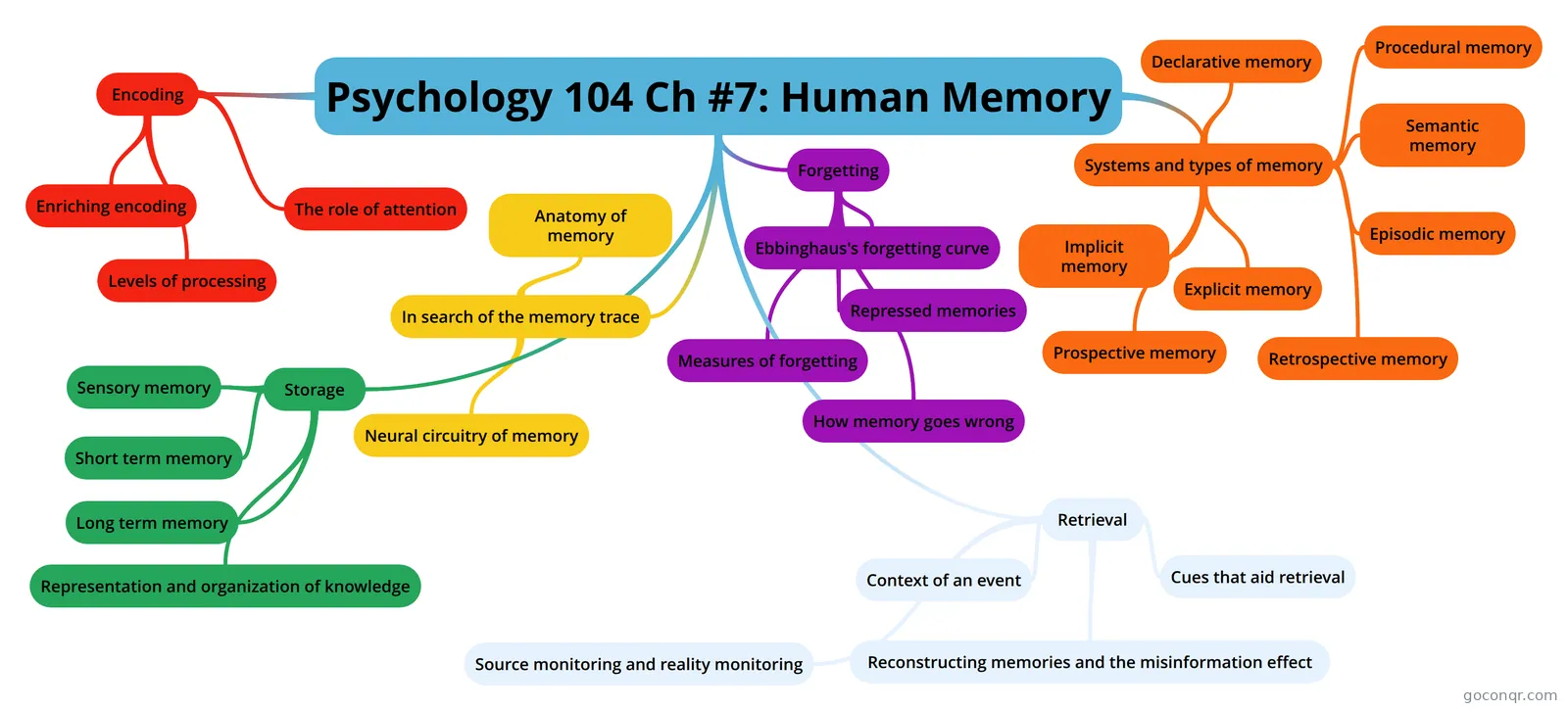
Mind map: Human Memory Systems and Processes
Map content
Psychology 104 Ch #7: Human Memory
Encoding
- Involves forming a memory code.
- The role of attention
- Involves focusing awareness on a narrow range of stimuli, selective attention is critical to everyday functioning. Attention involves late selection, based on the meaning of the stimuli. Multitasking involves switching attention from one task to another.
- Levels of processing
- The levels of processing theory proposes that deeper levels of processing result in longer lasting memory codes. When dealing with verbal stimuli, three levels are identified: Structural (shallow, emphasizes the physical structure of the stimulus) Phonemic (emphasizes what the word sounds like) semantic (emphasizes the meaning of the stimulus)
- Enriching encoding
- Elaboration: Linking a stimulus to other information at the time of encoding. visual imagery: The creation of visual images to represent words to be remembered. High imagery words are easier to remember than low imagery words. Dual coding theory: Memory is enhanced by forming semantic and visual codes, since either can lead to recall. Self referent encoding: Involves deciding how or whether information is personally relevant.
Retrieval
- Involves recovering information from memory stores.
- Cues that aid retrieval
- Tip of the tongue phenomenon: temporary inability to remember something you know, that is just out of reach. Occurrence increases with age. Retrieval cues can help someone remember something.
- Context of an event
- Encoding specificity principle: memory for information is better when the conditions during encoding and retrieval are similar.
- Reconstructing memories and the misinformation effect
- Recall is biased in the direction of higher level schemas. The misinformation effect: occurs when people's recall of an event is altered by introducing misleading postevent info.
- Source monitoring and reality monitoring
- Reality monitoring: process of deciding whether memories are based on external sources or internal sources. Happens when people wonder if something really happened. Source monitoring: involves making attributions about the origins of memories. Source monitoring error: when a memory derived from one source is misattributed to another source. Destination memory: involves whom has told what.
Storage
- Involves maintaining encoded information in memory over time.
- Sensory memory
- It is thought that stimuli pass through the sensory and the short term stores, before heading to the long term stores. Sensory memory preserves info in its original sensory form for a brief time, usually only a fraction of a second. In vision, you are viewing the afterimage rather than the original stimulus. This gives you enough time to recognize the stimulus. They also effect the richness of our visual perception.
- Short term memory
- Limited capacity store that can maintain unrehearsed info for up to 20 sec. ( Rehearsal is the process of repetitively verbalizing or thinking about the stimulus). (Elaborative rehearsal increases the probability that you will retain the info) (Maintenance rehearsal simply maintains the info in consciousness). Interference from competing stimuli also affects retention. Chunking (grouping familiar stimuli into a single unit) can increase the capacity of the STM. Working memory: limited capacity storage system that temporarily maintains and stores info by providing an interface between perception, memory and action. 4 components of working memory: phonological loop (recitation, and facilitates the acquisition of language) Visuospatial sketchpad (temporarily hols and manipulate visual images) Central executive system (coordinates the actions of other modules.) Episodic buffer (temporary store that allows components of WM to integrate, and acts as an interface working and long term memory) Working memory capacity: the ability to hold and manipulate info in conscious attention. ( affected by heredity, and environmental factors)
- Long term memory
- Unlimited capacity store that can hold info over lengthy periods of time. Info is stored permanently. Forgetting occurs when you can not retrieve things from the LTM. Flashbulb memories: unusually vivid recollections of special events. Become less detailed with time, and are often inaccurate. There is more emotional intensity attached to these memories.
- Representation and organization of knowledge
- Clustering: the tendency to remember similar or related items in groups. Conceptual hierarchy: multilevel classification system based on common properties among items. Schemas: an organized cluster of knowledge about a particular object or event abstracted from previous experience with the object or event. People are more likely to remember things that are consistent with their schemas. People may exhibit better recall of things that violate their schemas. Semantic networks: consists of nodes representing concepts joined together by pathways that link related concepts. Shorter connection = stronger connections. Parallel distributed processing: models assume that cognitive processes depend on patterns of activation in highly interconnected networks that resemble neural networks. Consists of nodes that may send either excitatory or inhibitory signals to other pathways. (in semantic networks, nodes represent concepts or pieces of knowledge) (in connectionist networks, a piece of knowledge is represented by a pattern of activation across the entire network)
Forgetting
- Forgetting is important because it reduces competition between stimuli. Can be caused by defects in encoding, storage, retrieval, or a combination of these. Ineffective encoding: the info may have never been inserted into the memory in the first place (pseudoforgetting) (usually due to a lack of attention). Decay: forgetting occurs because memory traces fade with time. Happens in the STM but not the LTM. Interference: people forget info because of competition from other material. Thought to be the greatest when the intervening material is similar to the retained info. Retroactive interference: when new info impairs the retention of previously learned info. Proactive interference: when previously learned info interferes with the retention of new info. Retrieval failure: Encoding specificity principle: the value of a retrieval cue depends on how well it corresponds to the memory. Transfer appropriate processing: the initial processing of info is similar to the type of processing required by the subsequent measure of retention. Motivated forgetting: The tendency to forget painful memories.
- Ebbinghaus's forgetting curve
- Forgetting curve: graphs retention and forgetting over time. When people memorize meaningful material the forgetting curve is much shallower (slower).
- Measures of forgetting
- Retention: proportion of material retained. Retention interval: the length of time between the presentation of materials to be remembered, and the measurement of forgetting. (Three principles are used to measure forgetting-recall, recognition, relearning) Recall: requires subjects to reproduce info on their own without any cues. Recognition: requires subjects to select previously learned info from an array of options. Are especially sensitive tests. Relearning: requires the subjects to memorize info a second time to determine how much time is saved by learning it before.
- Repressed memories
- Repression: keeping distressed thoughts and feelings buried in the unconscious. It is thought that children who have experienced abuse tend to force their feelings down unconsciously in order to form proper relationships. It is also thought that repressed memories can resurface. It is thought that people may fail to report abuse for reason other than amnesia. Perhaps because they are embarrassed or scared, and therefore do not posses repressed memories. Hypnosis is also known to distort memories.
- How memory goes wrong
- Transience: weakening of memory over time.Absentmindedness: memory failure due to lack of attention Blocking: occurs when we fail to retrieve a piece of info. Misattribution: assigning memory to the wrong source. Suggestibility: the memory Is distorted due to misleading info. Bias: inaccuracy due to other our current knowledge on our reconstruction of the past. Persistence: unwanted memories or recollections that we can not forget.
In search of the memory trace
- Neural circuitry of memory
- Memory formation results in alterations in synaptic transmissions at specific sites. Specific memories may depend on localized neural circuits. Long term potentiation: long lasting increase in the neural excitability at synapses along a specific neural pathway. Involves changes in both pre and post synaptic neurons. The process of neurogenesis may contribute to the sculpting of neural circuits that underlie memory. This may allow the brain to time stamp the memories.
- Anatomy of memory
- Retrograde amnesia: the loss of memories for events that occurred prior to the onset of amnesia. Anterograde amnesia: the loss of memories that occur after the onset of the amnesia. consolidation: hypothetical process involving the gradual conversion of info into durable memory codes stored in the LTM. Memories are consolidated in the hippocampal region and stored in the cortex. The amygdala is critical in the formation of memories. The central executive component of the working memory is located in the prefrontal cortex.
- Neural circuitry of memory
Systems and types of memory
- Implicit memory
- Retention is exhibited on a task that does not require intentional remembering. perceptual and motor skills. not restricted to perceptual or procedural memories. Cerebellum. Unconscious and unintentional usage.
- Explicit memory
- Intention recollection of previous experiences. facts and events. Hippocampus and the temporal lobe. Conscious and deliberate usage.
- Declarative memory
- Handles factual info. recollection of words, definitions, names, dates, faces, events, concepts, and ideas. Depends on conscious processes. May be severely damaged by amnesia. Handled by the medial temporal lobe.
- Procedural memory
- Houses memory for actions, skills, operations, and conditioned responses. Require little effort to recall, and may not be damaged severely by amnesia. Cerebellum and amygdala contribute to the functioning.
- Semantic memory
- Contains general knowledge that is not tied to the time when the info was learned.
- Episodic memory
- Made up of chronological recollections of personal experiences. Hyperthymestic syndrome: can not forget.
- Prospective memory
- Involves remembering to perform actions in the future.
- Retrospective memory
- Involves remembering events from the past or previously learned information.
- Implicit memory
Information
- Description
- Psychology Mind Map on Psychology 104 Ch #7: Human Memory, created by chloe galambos on 26/11/2016.
- Created by
- chloe galambos
- Views
- 3
- Rating