
Mind map
Memory - Multistore model of memory.
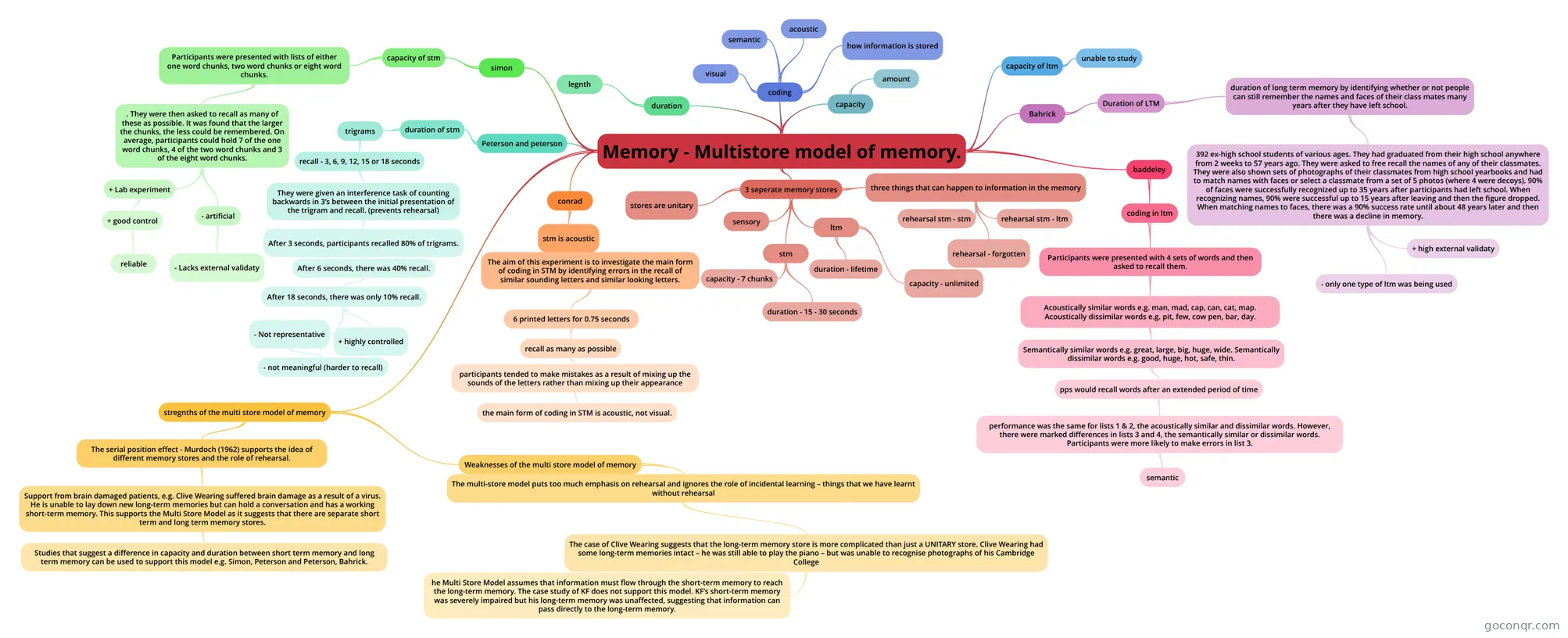
Mind map: Multistore model of memory
Map content
Memory - Multistore model of memory.
3 seperate memory stores
- sensory
- stm
- capacity - 7 chunks
- duration - 15 - 30 seconds
- ltm
- duration - lifetime
- capacity - unlimited
- three things that can happen to information in the memory
- rehearsal stm - stm
- rehearsal stm - ltm
- rehearsal - forgotten
- stores are unitary
coding
- visual
- semantic
- acoustic
- how information is stored
capacity
- amount
duration
- legnth
simon
- capacity of stm
- Participants were presented with lists of either one word chunks, two word chunks or eight word chunks.
- . They were then asked to recall as many of these as possible. It was found that the larger the chunks, the less could be remembered. On average, participants could hold 7 of the one word chunks, 4 of the two word chunks and 3 of the eight word chunks.
- + Lab experiment
- + good control
- reliable
- + good control
- - artificial
- - Lacks external validaty
- + Lab experiment
- . They were then asked to recall as many of these as possible. It was found that the larger the chunks, the less could be remembered. On average, participants could hold 7 of the one word chunks, 4 of the two word chunks and 3 of the eight word chunks.
- Participants were presented with lists of either one word chunks, two word chunks or eight word chunks.
- capacity of stm
Peterson and peterson
- duration of stm
- trigrams
- recall - 3, 6, 9, 12, 15 or 18 seconds
- They were given an interference task of counting backwards in 3’s between the initial presentation of the trigram and recall. (prevents rehearsal)
- After 3 seconds, participants recalled 80% of trigrams.
- After 6 seconds, there was 40% recall.
- After 18 seconds, there was only 10% recall.
- - Not representative
- - not meaningful (harder to recall)
- + highly controlled
- - Not representative
- After 18 seconds, there was only 10% recall.
- After 6 seconds, there was 40% recall.
- After 3 seconds, participants recalled 80% of trigrams.
- They were given an interference task of counting backwards in 3’s between the initial presentation of the trigram and recall. (prevents rehearsal)
- recall - 3, 6, 9, 12, 15 or 18 seconds
- trigrams
- duration of stm
conrad
- stm is acoustic
- The aim of this experiment is to investigate the main form of coding in STM by identifying errors in the recall of similar sounding letters and similar looking letters.
- 6 printed letters for 0.75 seconds
- recall as many as possible
- participants tended to make mistakes as a result of mixing up the sounds of the letters rather than mixing up their appearance
- the main form of coding in STM is acoustic, not visual.
- participants tended to make mistakes as a result of mixing up the sounds of the letters rather than mixing up their appearance
- recall as many as possible
- 6 printed letters for 0.75 seconds
- The aim of this experiment is to investigate the main form of coding in STM by identifying errors in the recall of similar sounding letters and similar looking letters.
- stm is acoustic
capacity of ltm
- unable to study
Bahrick
- Duration of LTM
- duration of long term memory by identifying whether or not people can still remember the names and faces of their class mates many years after they have left school.
- 392 ex-high school students of various ages. They had graduated from their high school anywhere from 2 weeks to 57 years ago. They were asked to free recall the names of any of their classmates. They were also shown sets of photographs of their classmates from high school yearbooks and had to match names with faces or select a classmate from a set of 5 photos (where 4 were decoys). 90% of faces were successfully recognized up to 35 years after participants had left school. When recognizing names, 90% were successful up to 15 years after leaving and then the figure dropped. When matching names to faces, there was a 90% success rate until about 48 years later and then there was a decline in memory.
- - only one type of ltm was being used
- + high external validaty
- 392 ex-high school students of various ages. They had graduated from their high school anywhere from 2 weeks to 57 years ago. They were asked to free recall the names of any of their classmates. They were also shown sets of photographs of their classmates from high school yearbooks and had to match names with faces or select a classmate from a set of 5 photos (where 4 were decoys). 90% of faces were successfully recognized up to 35 years after participants had left school. When recognizing names, 90% were successful up to 15 years after leaving and then the figure dropped. When matching names to faces, there was a 90% success rate until about 48 years later and then there was a decline in memory.
- duration of long term memory by identifying whether or not people can still remember the names and faces of their class mates many years after they have left school.
- Duration of LTM
baddeley
- coding in ltm
- Participants were presented with 4 sets of words and then asked to recall them.
- Acoustically similar words e.g. man, mad, cap, can, cat, map. Acoustically dissimilar words e.g. pit, few, cow pen, bar, day.
- Semantically similar words e.g. great, large, big, huge, wide. Semantically dissimilar words e.g. good, huge, hot, safe, thin.
- pps would recall words after an extended period of time
- performance was the same for lists 1 & 2, the acoustically similar and dissimilar words. However, there were marked differences in lists 3 and 4, the semantically similar or dissimilar words. Participants were more likely to make errors in list 3.
- semantic
- performance was the same for lists 1 & 2, the acoustically similar and dissimilar words. However, there were marked differences in lists 3 and 4, the semantically similar or dissimilar words. Participants were more likely to make errors in list 3.
- pps would recall words after an extended period of time
- Semantically similar words e.g. great, large, big, huge, wide. Semantically dissimilar words e.g. good, huge, hot, safe, thin.
- Acoustically similar words e.g. man, mad, cap, can, cat, map. Acoustically dissimilar words e.g. pit, few, cow pen, bar, day.
- Participants were presented with 4 sets of words and then asked to recall them.
- coding in ltm
stregnths of the multi store model of memory
- The serial position effect - Murdoch (1962) supports the idea of different memory stores and the role of rehearsal.
- Support from brain damaged patients, e.g. Clive Wearing suffered brain damage as a result of a virus. He is unable to lay down new long-term memories but can hold a conversation and has a working short-term memory. This supports the Multi Store Model as it suggests that there are separate short term and long term memory stores.
- Studies that suggest a difference in capacity and duration between short term memory and long term memory can be used to support this model e.g. Simon, Peterson and Peterson, Bahrick.
- Support from brain damaged patients, e.g. Clive Wearing suffered brain damage as a result of a virus. He is unable to lay down new long-term memories but can hold a conversation and has a working short-term memory. This supports the Multi Store Model as it suggests that there are separate short term and long term memory stores.
- Weaknesses of the multi store model of memory
- The multi-store model puts too much emphasis on rehearsal and ignores the role of incidental learning – things that we have learnt without rehearsal
- The case of Clive Wearing suggests that the long-term memory store is more complicated than just a UNITARY store. Clive Wearing had some long-term memories intact – he was still able to play the piano – but was unable to recognise photographs of his Cambridge College
- he Multi Store Model assumes that information must flow through the short-term memory to reach the long-term memory. The case study of KF does not support this model. KF’s short-term memory was severely impaired but his long-term memory was unaffected, suggesting that information can pass directly to the long-term memory.
- The case of Clive Wearing suggests that the long-term memory store is more complicated than just a UNITARY store. Clive Wearing had some long-term memories intact – he was still able to play the piano – but was unable to recognise photographs of his Cambridge College
- The multi-store model puts too much emphasis on rehearsal and ignores the role of incidental learning – things that we have learnt without rehearsal
- The serial position effect - Murdoch (1962) supports the idea of different memory stores and the role of rehearsal.
Information
- Description
- A level Psychology (Memory) Mind Map on Memory - Multistore model of memory., created by Lilly Clare on 16/02/2017.
- Created by
- Lilly Clare
- Views
- 4
- Rating