
Mind map
Western Front in WW1
Map content
Western Front in WW1
Schlieffen Plan
- Germany didn't want to fight a war on two fronts
- France and Britain to the West
- Russia to the East
- Germany believed it would take 6 weeks for Russia to mobilise
- The Plan
- Attack France (through Belgium, Holland and Luxembourg) and defeat them before Russia could mobilise
- Believed the Belgian army was weak and could be easily defeated
- Believed the British Expeditionary Force (BEF) were no match for the Germans and would arrive too late to help France
- Kaiser called then a 'contemptible little army'
- Why it failed
- Von Moltke changed Schlieffen's plan by sending some soldiers to fight the Russians - this weakened the German forces
- The Belgians put up much more of a fight than was expected and this delayed the Germans
- Slowed the German movement through France down
- Gave the French time to move their forces to meet the Germans at the Marne
- Slowed the German movement through France down
- British Expeditionary Force was underestimated
- Arrived in France much earlier than expected so Moltke had to call German forces from the Eastern Front to fight them
- German exhaustion
- Germany didn't want to fight a war on two fronts
Key battles
- Marne, September 1914
- 5th September 1914 - Germans reached the River Marne
- Plan changed from sweeping west round Paris to going east
- German advancing armies left a gap between them
- French took advantage and moved to protect Paris
- British and French sent troops into the gap
- French took advantage and moved to protect Paris
- Lasted 1 week
- Germans were forced to retreat to bridge the gap
- Marked the failure of the Schlieffen Plan
- Race to the Sea, October-December 1914
- In response to the Battle of the Marne the German forces raced north to try to block off the Channel ports
- Try to stop British reinforcements
- First Battle of Ypres, October 1914
- Britain trying to defend the Channel Ports
- British suffered 50,000 casualties, 8,000 dead
- Germans suffered 20,000 casualties
- End of the Race for the Sea
- stalemate
- In response to the Battle of the Marne the German forces raced north to try to block off the Channel ports
- Somme, July 1916
- Sir Douglas Haig
- Butcher of the Somme
- First day was 1st July 1916
- 60,000 British casualties on this day
- worst day in British military history
- 60,000 British casualties on this day
- Finished in November 1916
- 420,000 British casualties total
- Why?
- Relieve the pressure on the French at Verdun
- Continue policy of attrition - wearing the Germans down
- Fresh troops from the British Empire
- Events
- artillery barrage ineffective
- German dugouts too deep
- barbed wire not cut
- walk across No Man's Land
- Tanks used for the first time in September
- artillery barrage ineffective
- Sir Douglas Haig
- Spring Offensive, March 1918
- German Commander, Ludendorff, began an offensive in March 1918
- Why?
- USA entered the war on the side of the British in 1917
- Allies were getting stronger - maybe too strong to beat
- The Communists in Russia pulled Russia out of the war in March 1917
- Allies were currently weak as 1917 had been a bad year
- Mutinies in the French army
- British suffered huge casualties in the Third Battle of Ypres
- Germany's allies were talking about surrendering
- British naval blockade of Germany was beginning to take effect
- USA entered the war on the side of the British in 1917
- Operation Michael began on 21st March 1918
- advanced 8km on first day
- British reinforced their lines with troops from Italy and the Middle East
- 23rd March - Haig issued the 'Backs to the Walls' order
- French General Foche coordinated the Allied forces
- Germans attacked Ypres in April
- Germans attacked Verdun in May
- French retreated 60km and were close to losing Paris
- BUT
- The American soldiers started to arrive in large numbers
- The Germans had overstretched their supply lines
- The Germans had lost 880,000 men by July and morale was low
- The progress halted and now Germany had to defend a huge area
- BUT
- French retreated 60km and were close to losing Paris
- French General Foche coordinated the Allied forces
- 23rd March - Haig issued the 'Backs to the Walls' order
- British reinforced their lines with troops from Italy and the Middle East
- advanced 8km on first day
- Why?
- German Commander, Ludendorff, began an offensive in March 1918
- Marne, September 1914
Trench Warfare
- monotonous/boring
- dug-outs up to 10m down
- diseases
- cholera
- dysentry
- typhus
- lice
- rats
- all weather conditions
- trench foot
- food
- 'bully' beef
- bread
- rarely had hot meals
- unclean water
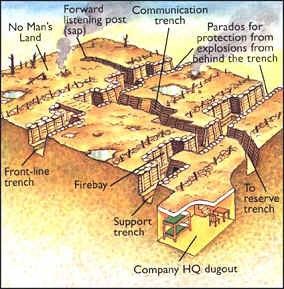
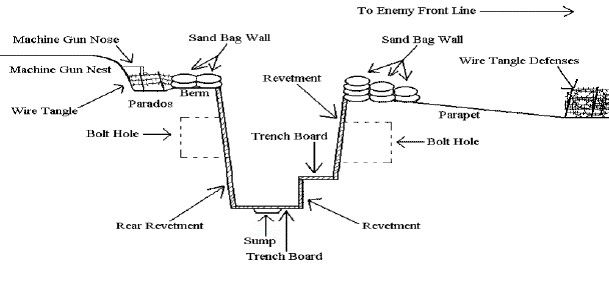
- zig zag trenches
- barbed wire
- No Man's Land
- shell craters
- trenches
- front line
- reserve
- communication
- reserve
- front line
- shell shock
Weapons
- Gas
- First used by the Germans in October 1914
- Chlorine gas
- First used by Germans in April 1915
- First Battle of Ypres
- denser than air so got stuck in the trenches
- First used by Germans in April 1915
- 63 poison gases by the end of the war
- gas masks
- started off as just weeing on some cloth
- proper gas masks issued in 1915
- started off as just weeing on some cloth
- artillery
- creeping barrage was developed
- line of artillery just in front of the soldiers moving forward
- creeping barrage was developed
- Tanks
- First used during the Battle of the Somme
- First success was at the Battle of Cambrai in November 1917
- 474 tanks used
- First success was at the Battle of Cambrai in November 1917
- scary
- problems
- slow
- hot inside
- difficult to manoeuvre
- got stuck in the mud
- mechanically unreliable
- machine gun bullets could get through
- difficult to communicate instructions
- First used during the Battle of the Somme
- Aircraft
- aerial photography
- direct artillery to targets
- observe enemy troop movements
- machine gun and bomb the enemy
- unreliable at first
- used effectively in Battle of Cambrai in 1917 and August offensive in 1918
- Gas
How it ended
- German Spring Offensive
- Allied counter-offensive from 8th August 1918
- Artillery bombardment, then aircraft attack, then troops and tanks
- Forced the Germans to retreat
- 'Black Day of the German army'
- Had to retreat past the Hindenburg Line
- 'Black Day of the German army'
- Forced the Germans to retreat
- Artillery bombardment, then aircraft attack, then troops and tanks
- Allied counter-offensive from 8th August 1918
- German weaknesses
- exhausted
- running out of troops
- British naval blockade was effective
- Allied strengths
- Fresh American soldiers
- United control under General Foch
- Haig's effective leadership
- use of tanks
- Allies surrendered
- September-October - Bulgaria, Turkey and Austria-Hungary surrender
- British naval blockade was starving Germany
- German Spring Offensive
Images and files in the map
Information
- Description
- GCSE History Mind Map on Western Front in WW1, created by Hannah Keeble on 15/03/2017.
- Created by
- Hannah Keeble
- Views
- 76
- Rating