
Mind map
Individual differences explanations of addiction
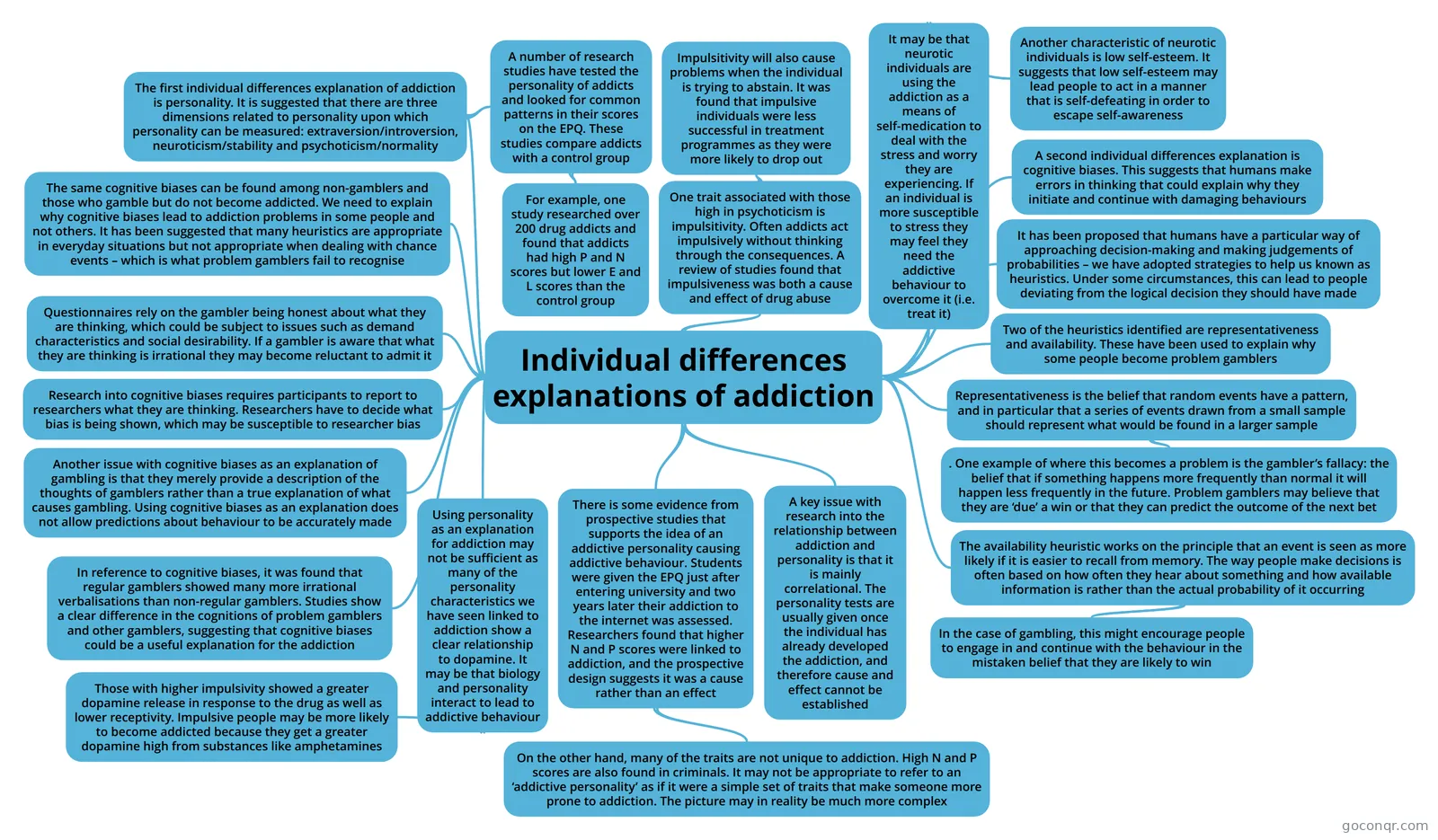
Mind map: Individual differences explanations of addiction
Map content
Individual differences explanations of addiction
The first individual differences explanation of addiction is personality. It is suggested that there are three dimensions related to personality upon which personality can be measured: extraversion/introversion, neuroticism/stability and psychoticism/normality
- A number of research studies have tested the personality of addicts and looked for common patterns in their scores on the EPQ. These studies compare addicts with a control group
- For example, one study researched over 200 drug addicts and found that addicts had high P and N scores but lower E and L scores than the control group
- A number of research studies have tested the personality of addicts and looked for common patterns in their scores on the EPQ. These studies compare addicts with a control group
One trait associated with those high in psychoticism is impulsitivity. Often addicts act impulsively without thinking through the consequences. A review of studies found that impulsiveness was both a cause and effect of drug abuse
- Impulsitivity will also cause problems when the individual is trying to abstain. It was found that impulsive individuals were less successful in treatment programmes as they were more likely to drop out
It may be that neurotic individuals are using the addiction as a means of self-medication to deal with the stress and worry they are experiencing. If an individual is more susceptible to stress they may feel they need the addictive behaviour to overcome it (i.e. treat it)
- Another characteristic of neurotic individuals is low self-esteem. It suggests that low self-esteem may lead people to act in a manner that is self-defeating in order to escape self-awareness
A second individual differences explanation is cognitive biases. This suggests that humans make errors in thinking that could explain why they initiate and continue with damaging behaviours
It has been proposed that humans have a particular way of approaching decision-making and making judgements of probabilities – we have adopted strategies to help us known as heuristics. Under some circumstances, this can lead to people deviating from the logical decision they should have made
Two of the heuristics identified are representativeness and availability. These have been used to explain why some people become problem gamblers
Representativeness is the belief that random events have a pattern, and in particular that a series of events drawn from a small sample should represent what would be found in a larger sample
- . One example of where this becomes a problem is the gambler’s fallacy: the belief that if something happens more frequently than normal it will happen less frequently in the future. Problem gamblers may believe that they are ‘due’ a win or that they can predict the outcome of the next bet
The availability heuristic works on the principle that an event is seen as more likely if it is easier to recall from memory. The way people make decisions is often based on how often they hear about something and how available information is rather than the actual probability of it occurring
- In the case of gambling, this might encourage people to engage in and continue with the behaviour in the mistaken belief that they are likely to win
A key issue with research into the relationship between addiction and personality is that it is mainly correlational. The personality tests are usually given once the individual has already developed the addiction, and therefore cause and effect cannot be established
There is some evidence from prospective studies that supports the idea of an addictive personality causing addictive behaviour. Students were given the EPQ just after entering university and two years later their addiction to the internet was assessed. Researchers found that higher N and P scores were linked to addiction, and the prospective design suggests it was a cause rather than an effect
- On the other hand, many of the traits are not unique to addiction. High N and P scores are also found in criminals. It may not be appropriate to refer to an ‘addictive personality’ as if it were a simple set of traits that make someone more prone to addiction. The picture may in reality be much more complex
Using personality as an explanation for addiction may not be sufficient as many of the personality characteristics we have seen linked to addiction show a clear relationship to dopamine. It may be that biology and personality interact to lead to addictive behaviour
- Those with higher impulsivity showed a greater dopamine release in response to the drug as well as lower receptivity. Impulsive people may be more likely to become addicted because they get a greater dopamine high from substances like amphetamines
In reference to cognitive biases, it was found that regular gamblers showed many more irrational verbalisations than non-regular gamblers. Studies show a clear difference in the cognitions of problem gamblers and other gamblers, suggesting that cognitive biases could be a useful explanation for the addiction
Another issue with cognitive biases as an explanation of gambling is that they merely provide a description of the thoughts of gamblers rather than a true explanation of what causes gambling. Using cognitive biases as an explanation does not allow predictions about behaviour to be accurately made
Research into cognitive biases requires participants to report to researchers what they are thinking. Researchers have to decide what bias is being shown, which may be susceptible to researcher bias
Questionnaires rely on the gambler being honest about what they are thinking, which could be subject to issues such as demand characteristics and social desirability. If a gambler is aware that what they are thinking is irrational they may become reluctant to admit it
The same cognitive biases can be found among non-gamblers and those who gamble but do not become addicted. We need to explain why cognitive biases lead to addiction problems in some people and not others. It has been suggested that many heuristics are appropriate in everyday situations but not appropriate when dealing with chance events – which is what problem gamblers fail to recognise
Information
- Description
- AS - Level Psychology (Addiction) Mind Map on Individual differences explanations of addiction, created by Siobhan Stagg on 10/04/2017.
- Created by
- Siobhan Stagg
- Views
- 0
- Rating
More on Risk Factors for Addiction