
Mind map
Explanations for forgetting: Retrieval failure
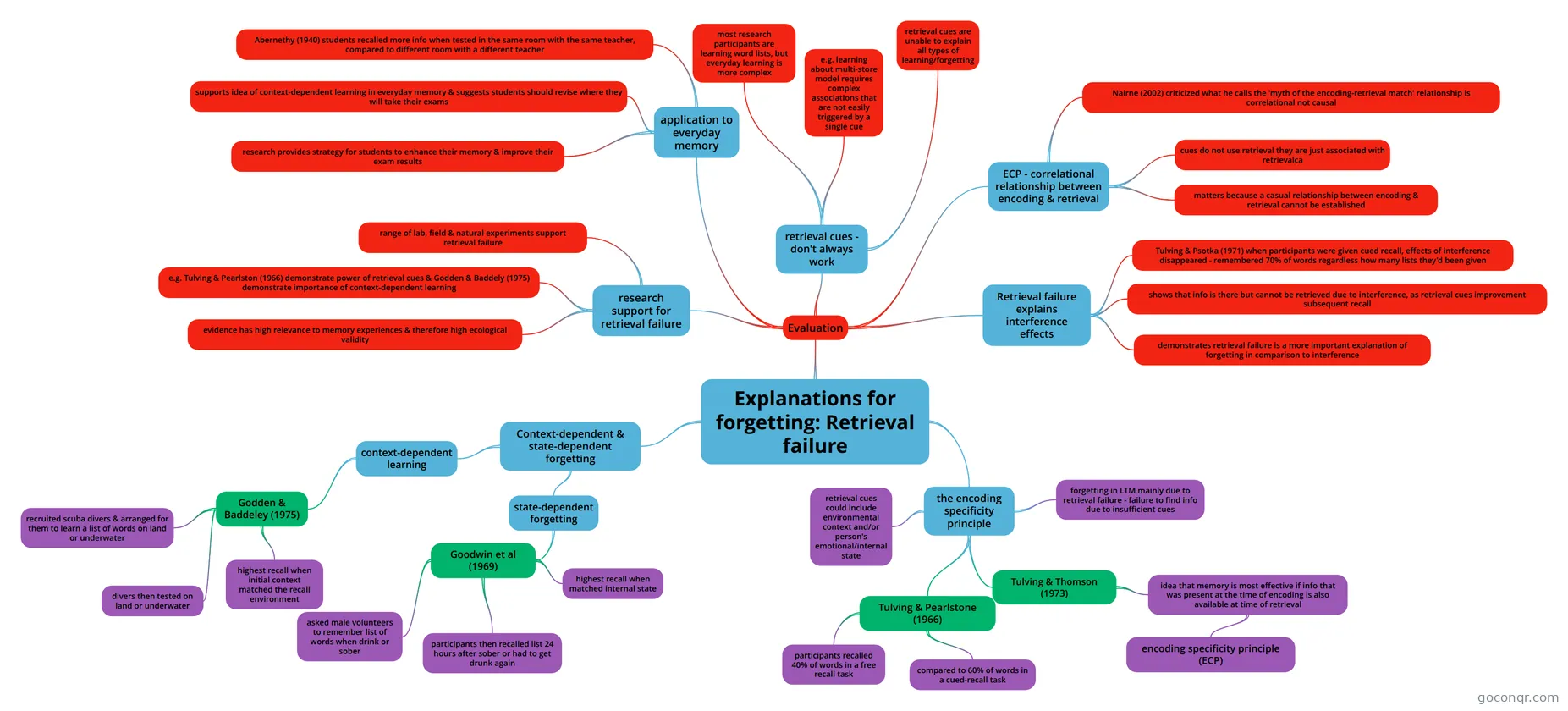
Mind map: Retrieval failure explanation for forgetting
Map content
Explanations for forgetting: Retrieval failure
the encoding specificity principle
- forgetting in LTM mainly due to retrieval failure - failure to find info due to insufficient cues
- Tulving & Thomson (1973)
- idea that memory is most effective if info that was present at the time of encoding is also available at time of retrieval
- encoding specificity principle (ECP)
- idea that memory is most effective if info that was present at the time of encoding is also available at time of retrieval
- Tulving & Pearlstone (1966)
- participants recalled 40% of words in a free recall task
- compared to 60% of words in a cued-recall task
- retrieval cues could include environmental context and/or person's emotional/internal state
Context-dependent & state-dependent forgetting
- context-dependent learning
- Godden & Baddeley (1975)
- recruited scuba divers & arranged for them to learn a list of words on land or underwater
- divers then tested on land or underwater
- highest recall when initial context matched the recall environment
- Godden & Baddeley (1975)
- state-dependent forgetting
- Goodwin et al (1969)
- asked male volunteers to remember list of words when drink or sober
- participants then recalled list 24 hours after sober or had to get drunk again
- highest recall when matched internal state
- Goodwin et al (1969)
- context-dependent learning
Evaluation
- research support for retrieval failure
- range of lab, field & natural experiments support retrieval failure
- e.g. Tulving & Pearlston (1966) demonstrate power of retrieval cues & Godden & Baddely (1975) demonstrate importance of context-dependent learning
- evidence has high relevance to memory experiences & therefore high ecological validity
- application to everyday memory
- Abernethy (1940) students recalled more info when tested in the same room with the same teacher, compared to different room with a different teacher
- supports idea of context-dependent learning in everyday memory & suggests students should revise where they will take their exams
- research provides strategy for students to enhance their memory & improve their exam results
- retrieval cues - don't always work
- most research participants are learning word lists, but everyday learning is more complex
- e.g. learning about multi-store model requires complex associations that are not easily triggered by a single cue
- retrieval cues are unable to explain all types of learning/forgetting
- ECP - correlational relationship between encoding & retrieval
- Nairne (2002) criticized what he calls the 'myth of the encoding-retrieval match' relationship is correlational not causal
- cues do not use retrieval they are just associated with retrievalca
- matters because a casual relationship between encoding & retrieval cannot be established
- Retrieval failure explains interference effects
- Tulving & Psotka (1971) when participants were given cued recall, effects of interference disappeared - remembered 70% of words regardless how many lists they'd been given
- shows that info is there but cannot be retrieved due to interference, as retrieval cues improvement subsequent recall
- demonstrates retrieval failure is a more important explanation of forgetting in comparison to interference
- research support for retrieval failure
Information
- Description
- A level Psychology (Memory) Mind Map on Explanations for forgetting: Retrieval failure, created by Hannah Atkinson on 19/04/2017.
- Created by
- Hannah Atkinson
- Views
- 1
- Rating