
Mind map
Tourism
Map content
Tourism
Reasons for increase in global tourism in last 60 years:
- Social/economic
- People generally have more disposable income (smaller families, both parents work)
- More paid holidays (average was 2 weeks in 1950s, now 6 weeks)
- Higher pension funds
- Cheaper travel
- Many countries invested in infrastructure for tourism (e.g. hotels)
- Increased car ownership
- Technological
- Improvements in transport (e.g. motorways, faster and larger aircraft)
- TV and internet allow advertisement and easy booking
- Product development / expansion of choice
- Package holidays
- Huge increase in holidays to Europe
- Dramatic decline in domestic tourism
- Weekend breaks
- Adventure holidays to all over the world
- Social/economic
Benefits of tourism
- Employment
- Economy growth
- Rich countries (e.g. USA, France) generate most income from tourism but poorer countries are more dependant on it (15% of Kenya's GNP, 3% of UK's)
- Increased income for tourist-based businesses
- Many governments (usually in poorer countries) tax visitors for services they use (e.g. road, water)
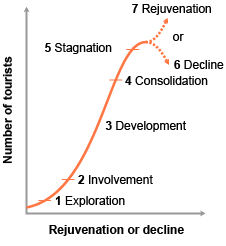
Butler Model
- Model that says that any tourist resort starts on small scale, develops into more significant then either declines or makes changes to maintain attraction. It has six stages
- Exploration: small number of visitors attracted by something in particular (e.g. beaches, historical features). Local people not yet developed tourist services
- Involvement: local population see opportunities and start to provide services (e.g. food, accommodation, transport)
- Development: large companies build hotels and leisure complexes and advertise package holidays. Number of visitors dramatically increases, employment opportunities grow, both pros and cons
- Consolidation: tourism is a major part of local economy, perhaps at the expense of other developments. Number of visitors makes employment secure, some hotels and facilities become older and unattractive so type of customer goes downmarket
- Stagnation: resort becomes unfashionable and number of visitors starts to fall, businesses often change hands and fail
- Decline: visitors prefer other resorts, day trippers become main source of income
- Rejuvenation: attempts made to modernise resort and attract different people (e.g. Blackpool)
- Model that says that any tourist resort starts on small scale, develops into more significant then either declines or makes changes to maintain attraction. It has six stages
Mass tourism
- Tourism on a large scale (e.g. package holidays) to one country or region. This equates to the 'development' stage of the Butler Model
- Positive impacts: employment, income, economic growth, improves infrastructure, income is reinvested, jobs halt urbanisation of young people
- Reconsolidate numbers by: improve infrastructure, offer new activities, make it cheaper, improve facilities, reduce tourism impacts (e.g. litter), advertise and market to attract different tourists
- Negative impacts: most of profit made by TNCs in MEDCs are they pay tax there, many jobs are low-skilled, low-paid and seasonal, traffic congestion, pollution, destruction of natural habitat (e.g. coral reef), offended locals, increase in crime, loss of culture
- Reduce impacts by: improving public transport, limit number of visitors to sensitive environments
- Positive impacts: employment, income, economic growth, improves infrastructure, income is reinvested, jobs halt urbanisation of young people
- Tourism on a large scale (e.g. package holidays) to one country or region. This equates to the 'development' stage of the Butler Model
Ecotourism
- Tourism that focuses on protecting the environment and local way of life (also called green tourism)
- Features: controlled numbers, conservation/stewardship, eco-friendly accommodation, small scale, local guides/services, often more expensive
- Stewardship: careful and planned use of resources in order to manage and maintain the environment for future generations. On a larger scale (perhaps even national)
- Conservation: personal responsibility for looking after the environment. Nobody should damage the present or future environment. On a small scale
- Features: controlled numbers, conservation/stewardship, eco-friendly accommodation, small scale, local guides/services, often more expensive
- Tourism that focuses on protecting the environment and local way of life (also called green tourism)
Images and files in the map
Information
- Description
- Mind Map on Tourism, created by Monty Kirk on 17/05/2014.
- Created by
- Monty Kirk
- Views
- 16
- Rating