
Mind map
Bowlby's Theory
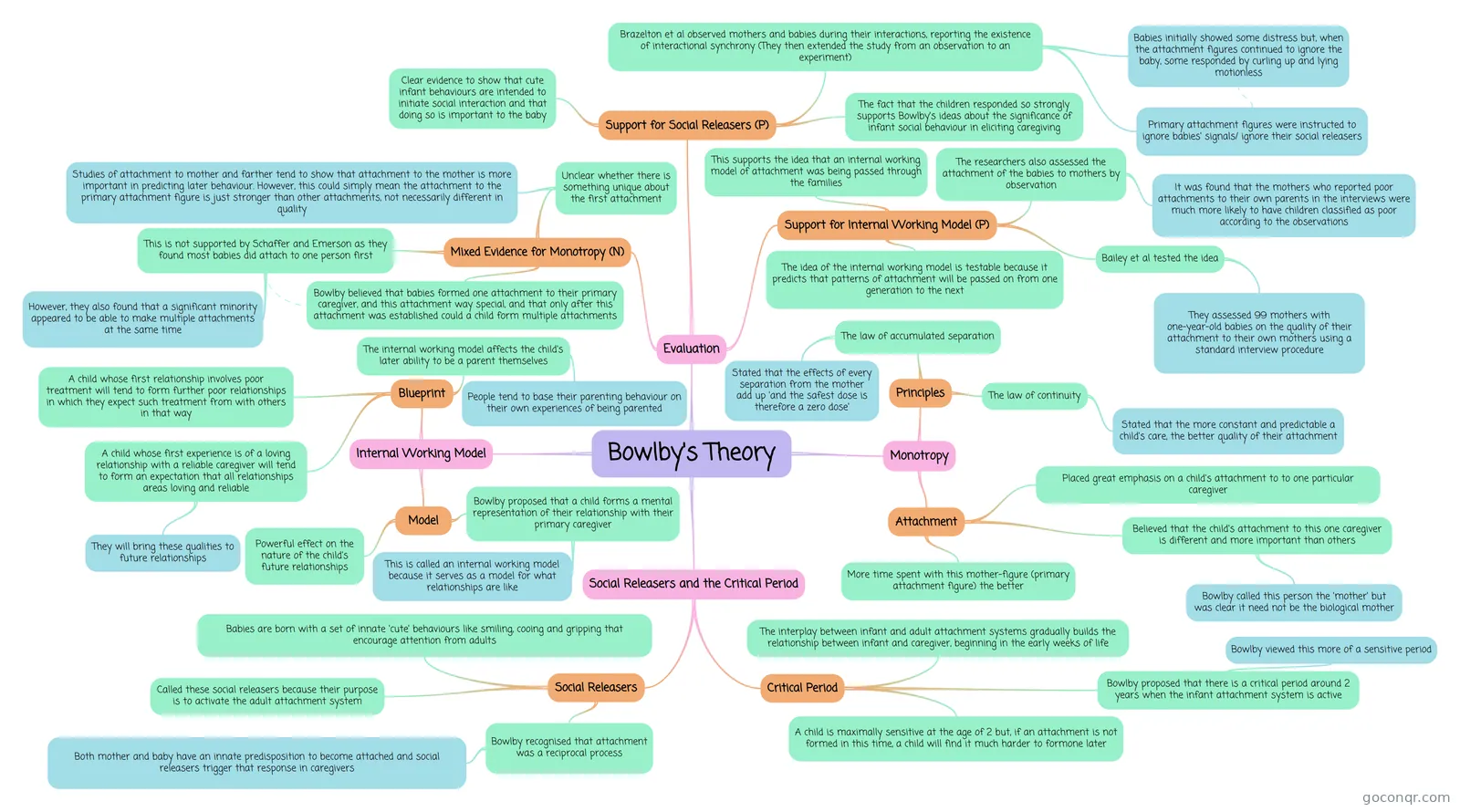
Mind map: Bowlby's theory
Map content
Bowlby's Theory
Monotropy
- Attachment
- Placed great emphasis on a child's attachment to to one particular caregiver
- Believed that the child's attachment to this one caregiver is different and more important than others
- Bowlby called this person the 'mother' but was clear it need not be the biological mother
- More time spent with this mother-figure (primary attachment figure) the better
- Principles
- The law of continuity
- Stated that the more constant and predictable a child's care, the better quality of their attachment
- The law of accumulated separation
- Stated that the effects of every separation from the mother add up 'and the safest dose is therefore a zero dose'
- The law of continuity
- Attachment
Social Releasers and the Critical Period
- Critical Period
- The interplay between infant and adult attachment systems gradually builds the relationship between infant and caregiver, beginning in the early weeks of life
- Bowlby proposed that there is a critical period around 2 years when the infant attachment system is active
- Bowlby viewed this more of a sensitive period
- A child is maximally sensitive at the age of 2 but, if an attachment is not formed in this time, a child will find it much harder to formone later
- Social Releasers
- Babies are born with a set of innate 'cute' behaviours like smiling, cooing and gripping that encourage attention from adults
- Called these social releasers because their purpose is to activate the adult attachment system
- Bowlby recognised that attachment was a reciprocal process
- Both mother and baby have an innate predisposition to become attached and social releasers trigger that response in caregivers
- Critical Period
Internal Working Model
- Model
- Bowlby proposed that a child forms a mental representation of their relationship with their primary caregiver
- This is called an internal working model because it serves as a model for what relationships are like
- Powerful effect on the nature of the child's future relationships
- Bowlby proposed that a child forms a mental representation of their relationship with their primary caregiver
- Blueprint
- A child whose first experience is of a loving relationship with a reliable caregiver will tend to form an expectation that all relationships areas loving and reliable
- They will bring these qualities to future relationships
- A child whose first relationship involves poor treatment will tend to form further poor relationships in which they expect such treatment from with others in that way
- The internal working model affects the child's later ability to be a parent themselves
- People tend to base their parenting behaviour on their own experiences of being parented
- A child whose first experience is of a loving relationship with a reliable caregiver will tend to form an expectation that all relationships areas loving and reliable
- Model
Evaluation
- Mixed Evidence for Monotropy (N)
- Bowlby believed that babies formed one attachment to their primary caregiver, and this attachment way special, and that only after this attachment was established could a child form multiple attachments
- This is not supported by Schaffer and Emerson as they found most babies did attach to one person first
- However, they also found that a significant minority appeared to be able to make multiple attachments at the same time
- Unclear whether there is something unique about the first attachment
- Studies of attachment to mother and farther tend to show that attachment to the mother is more important in predicting later behaviour. However, this could simply mean the attachment to the primary attachment figure is just stronger than other attachments, not necessarily different in quality
- Support for Social Releasers (P)
- Clear evidence to show that cute infant behaviours are intended to initiate social interaction and that doing so is important to the baby
- Brazelton et al observed mothers and babies during their interactions, reporting the existence of interactional synchrony (They then extended the study from an observation to an experiment)
- Primary attachment figures were instructed to ignore babies' signals/ ignore their social releasers
- Babies initially showed some distress but, when the attachment figures continued to ignore the baby, some responded by curling up and lying motionless
- The fact that the children responded so strongly supports Bowlby's ideas about the significance of infant social behaviour in eliciting caregiving
- Support for Internal Working Model (P)
- The idea of the internal working model is testable because it predicts that patterns of attachment will be passed on from one generation to the next
- Bailey et al tested the idea
- They assessed 99 mothers with one-year-old babies on the quality of their attachment to their own mothers using a standard interview procedure
- The researchers also assessed the attachment of the babies to mothers by observation
- It was found that the mothers who reported poor attachments to their own parents in the interviews were much more likely to have children classified as poor according to the observations
- This supports the idea that an internal working model of attachment was being passed through the families
- Mixed Evidence for Monotropy (N)
Information
- Description
- A level Psychology Mind Map on Bowlby's Theory, created by Olivia Owens on 23/05/2017.
- Created by
- Olivia Owens
- Views
- 0
- Rating