
Mind map
Memory - Accuracy of EWT
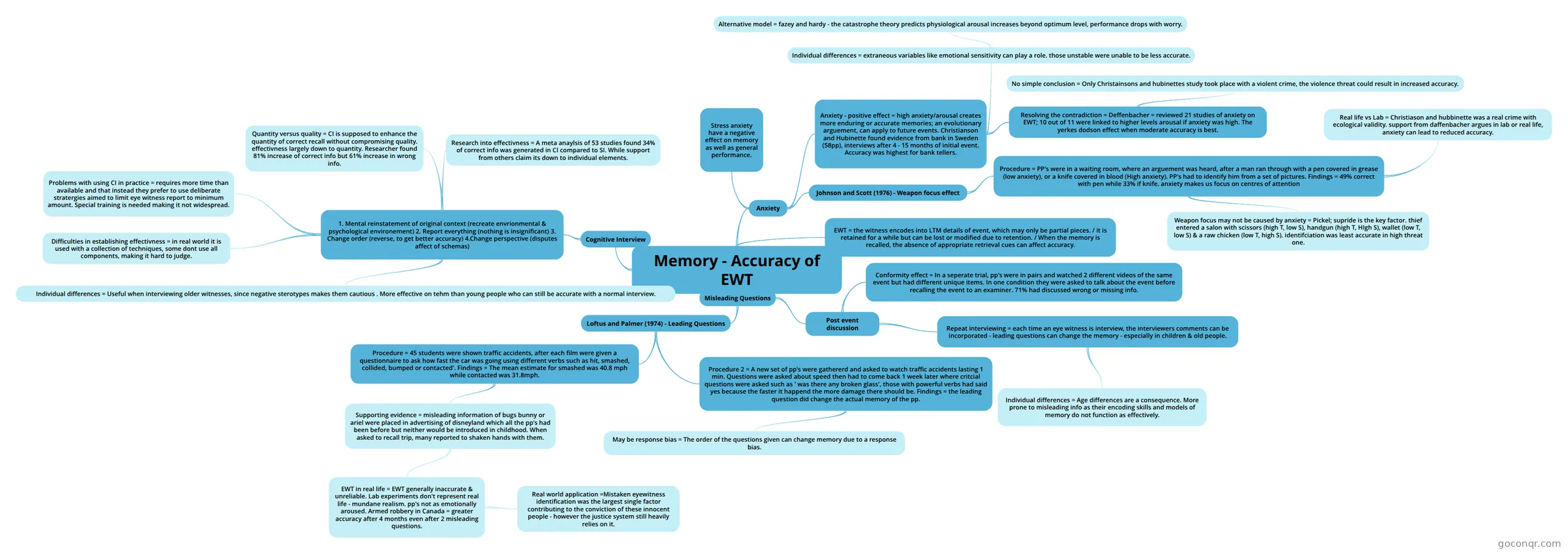
Mind map: Memory - Accuracy of EWT
Map content
Memory - Accuracy of EWT
Misleading Questions
- Loftus and Palmer (1974) - Leading Questions
- Procedure = 45 students were shown traffic accidents, after each film were given a questionnaire to ask how fast the car was going using different verbs such as hit, smashed, collided, bumped or contacted'. Findings = The mean estimate for smashed was 40.8 mph while contacted was 31.8mph.
- Supporting evidence = misleading information of bugs bunny or ariel were placed in advertising of disneyland which all the pp's had been before but neither would be introduced in childhood. When asked to recall trip, many reported to shaken hands with them.
- EWT in real life = EWT generally inaccurate & unreliable. Lab experiments don't represent real life - mundane realism. pp's not as emotionally aroused. Armed robbery in Canada = greater accuracy after 4 months even after 2 misleading questions.
- Real world application =Mistaken eyewitness identification was the largest single factor contributing to the conviction of these innocent people - however the justice system still heavily relies on it.
- EWT in real life = EWT generally inaccurate & unreliable. Lab experiments don't represent real life - mundane realism. pp's not as emotionally aroused. Armed robbery in Canada = greater accuracy after 4 months even after 2 misleading questions.
- Supporting evidence = misleading information of bugs bunny or ariel were placed in advertising of disneyland which all the pp's had been before but neither would be introduced in childhood. When asked to recall trip, many reported to shaken hands with them.
- Procedure 2 = A new set of pp's were gathererd and asked to watch traffic accidents lasting 1 min. Questions were asked about speed then had to come back 1 week later where critcial questions were asked such as ' was there any broken glass', those with powerful verbs had said yes because the faster it happend the more damage there should be. Findings = the leading question did change the actual memory of the pp.
- May be response bias = The order of the questions given can change memory due to a response bias.
- Procedure = 45 students were shown traffic accidents, after each film were given a questionnaire to ask how fast the car was going using different verbs such as hit, smashed, collided, bumped or contacted'. Findings = The mean estimate for smashed was 40.8 mph while contacted was 31.8mph.
- Post event discussion
- Conformity effect = In a seperate trial, pp's were in pairs and watched 2 different videos of the same event but had different unique items. In one condition they were asked to talk about the event before recalling the event to an examiner. 71% had discussed wrong or missing info.
- Repeat interviewing = each time an eye witness is interview, the interviewers comments can be incorporated - leading questions can change the memory - especially in children & old people.
- Individual differences = Age differences are a consequence. More prone to misleading info as their encoding skills and models of memory do not function as effectively.
- Loftus and Palmer (1974) - Leading Questions
EWT = the witness encodes into LTM details of event, which may only be partial pieces. / it is retained for a while but can be lost or modified due to retention. / When the memory is recalled, the absence of appropriate retrieval cues can affect accuracy.
Anxiety
- Johnson and Scott (1976) - Weapon focus effect
- Procedure = PP's were in a waiting room, where an arguement was heard, after a man ran through with a pen covered in grease (low anxiety), or a knife covered in blood (High anxiety). PP's had to identify him from a set of pictures. Findings = 49% correct with pen while 33% if knife. anxiety makes us focus on centres of attention
- Weapon focus may not be caused by anxiety = Pickel; supride is the key factor. thief entered a salon with scissors (high T, low S), handgun (high T, HIgh S), wallet (low T, low S) & a raw chicken (low T, high S). identifciation was least accurate in high threat one.
- Real life vs Lab = Christiason and hubbinette was a real crime with ecological validity. support from daffenbacher argues in lab or real life, anxiety can lead to reduced accuracy.
- Procedure = PP's were in a waiting room, where an arguement was heard, after a man ran through with a pen covered in grease (low anxiety), or a knife covered in blood (High anxiety). PP's had to identify him from a set of pictures. Findings = 49% correct with pen while 33% if knife. anxiety makes us focus on centres of attention
- Stress anxiety have a negative effect on memory as well as general performance.
- Anxiety - positive effect = high anxiety/arousal creates more enduring or accurate memories; an evolutionary arguement, can apply to future events. Christianson and Hubinette found evidence from bank in Sweden (58pp), interviews after 4 - 15 months of initial event. Accuracy was highest for bank tellers.
- Resolving the contradiction = Deffenbacher = reviewed 21 studies of anxiety on EWT; 10 out of 11 were linked to higher levels arousal if anxiety was high. The yerkes dodson effect when moderate accuracy is best.
- No simple conclusion = Only Christainsons and hubinettes study took place with a violent crime, the violence threat could result in increased accuracy.
- Individual differences = extraneous variables like emotional sensitivity can play a role. those unstable were unable to be less accurate.
- Alternative model = fazey and hardy - the catastrophe theory predicts physiological arousal increases beyond optimum level, performance drops with worry.
- Resolving the contradiction = Deffenbacher = reviewed 21 studies of anxiety on EWT; 10 out of 11 were linked to higher levels arousal if anxiety was high. The yerkes dodson effect when moderate accuracy is best.
- Johnson and Scott (1976) - Weapon focus effect
Cognitive Interview
- 1. Mental reinstatement of original context (recreate envrionmental & psychological environement) 2. Report everything (nothing is insignificant) 3. Change order (reverse, to get better accuracy) 4.Change perspective (disputes affect of schemas)
- Research into effectivness = A meta anaylsis of 53 studies found 34% of correct info was generated in CI compared to SI. While support from others claim its down to individual elements.
- Quantity versus quality = CI is supposed to enhance the quantity of correct recall without compromising quality. effectivness largely down to quantity. Researcher found 81% increase of correct info but 61% increase in wrong info.
- Problems with using CI in practice = requires more time than available and that instead they prefer to use deliberate stratergies aimed to limit eye witness report to minimum amount. Special training is needed making it not widespread.
- Difficulties in establishing effectivness = in real world it is used with a collection of techniques, some dont use all components, making it hard to judge.
- Individual differences = Useful when interviewing older witnesses, since negative sterotypes makes them cautious . More effective on tehm than young people who can still be accurate with a normal interview.
- 1. Mental reinstatement of original context (recreate envrionmental & psychological environement) 2. Report everything (nothing is insignificant) 3. Change order (reverse, to get better accuracy) 4.Change perspective (disputes affect of schemas)
Information
- Description
- A level Psychology Mind Map on Memory - Accuracy of EWT, created by Connor Liken on 04/06/2017.
- Created by
- Connor Liken
- Views
- 0
- Rating