
Mind map
Relationship between sexual selection and human reproductive behaviour
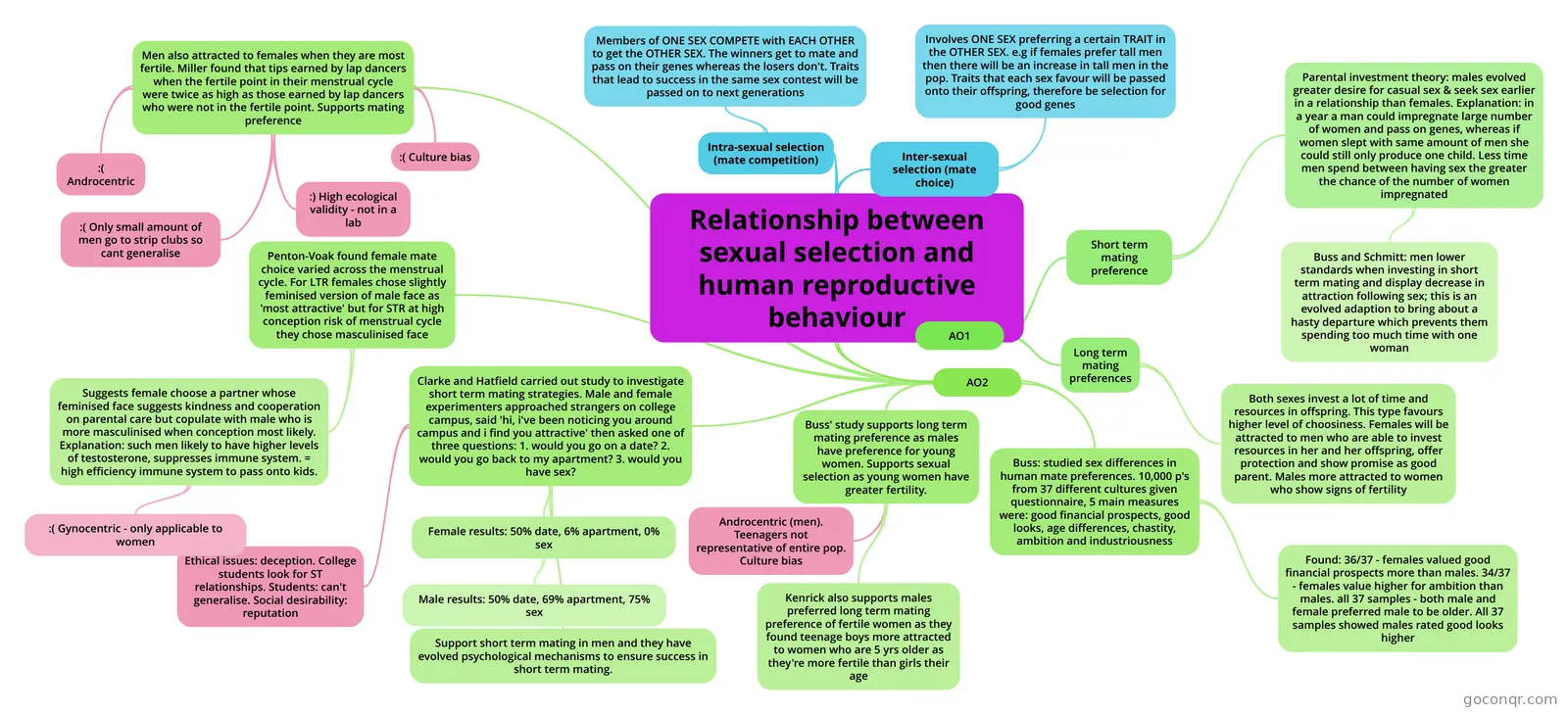
Mind map: Sexual selection and human reproductive behaviour
Map content
Relationship between sexual selection and human reproductive behaviour
Inter-sexual selection (mate choice)
- Involves ONE SEX preferring a certain TRAIT in the OTHER SEX. e.g if females prefer tall men then there will be an increase in tall men in the pop. Traits that each sex favour will be passed onto their offspring, therefore be selection for good genes
Intra-sexual selection (mate competition)
- Members of ONE SEX COMPETE with EACH OTHER to get the OTHER SEX. The winners get to mate and pass on their genes whereas the losers don't. Traits that lead to success in the same sex contest will be passed on to next generations
AO1
- Short term mating preference
- Parental investment theory: males evolved greater desire for casual sex & seek sex earlier in a relationship than females. Explanation: in a year a man could impregnate large number of women and pass on genes, whereas if women slept with same amount of men she could still only produce one child. Less time men spend between having sex the greater the chance of the number of women impregnated
- Buss and Schmitt: men lower standards when investing in short term mating and display decrease in attraction following sex; this is an evolved adaption to bring about a hasty departure which prevents them spending too much time with one woman
- Parental investment theory: males evolved greater desire for casual sex & seek sex earlier in a relationship than females. Explanation: in a year a man could impregnate large number of women and pass on genes, whereas if women slept with same amount of men she could still only produce one child. Less time men spend between having sex the greater the chance of the number of women impregnated
- Long term mating preferences
- Both sexes invest a lot of time and resources in offspring. This type favours higher level of choosiness. Females will be attracted to men who are able to invest resources in her and her offspring, offer protection and show promise as good parent. Males more attracted to women who show signs of fertility
- Short term mating preference
AO2
- Buss: studied sex differences in human mate preferences. 10,000 p's from 37 different cultures given questionnaire, 5 main measures were: good financial prospects, good looks, age differences, chastity, ambition and industriousness
- Found: 36/37 - females valued good financial prospects more than males. 34/37 - females value higher for ambition than males. all 37 samples - both male and female preferred male to be older. All 37 samples showed males rated good looks higher
- Buss' study supports long term mating preference as males have preference for young women. Supports sexual selection as young women have greater fertility.
- Kenrick also supports males preferred long term mating preference of fertile women as they found teenage boys more attracted to women who are 5 yrs older as they're more fertile than girls their age
- Androcentric (men). Teenagers not representative of entire pop. Culture bias
- Clarke and Hatfield carried out study to investigate short term mating strategies. Male and female experimenters approached strangers on college campus, said 'hi, i've been noticing you around campus and i find you attractive' then asked one of three questions: 1. would you go on a date? 2. would you go back to my apartment? 3. would you have sex?
- Female results: 50% date, 6% apartment, 0% sex
- Male results: 50% date, 69% apartment, 75% sex
- Support short term mating in men and they have evolved psychological mechanisms to ensure success in short term mating.
- Ethical issues: deception. College students look for ST relationships. Students: can't generalise. Social desirability: reputation
- Female results: 50% date, 6% apartment, 0% sex
- Penton-Voak found female mate choice varied across the menstrual cycle. For LTR females chose slightly feminised version of male face as 'most attractive' but for STR at high conception risk of menstrual cycle they chose masculinised face
- Suggests female choose a partner whose feminised face suggests kindness and cooperation on parental care but copulate with male who is more masculinised when conception most likely. Explanation: such men likely to have higher levels of testosterone, suppresses immune system. = high efficiency immune system to pass onto kids.
- :( Gynocentric - only applicable to women
- Suggests female choose a partner whose feminised face suggests kindness and cooperation on parental care but copulate with male who is more masculinised when conception most likely. Explanation: such men likely to have higher levels of testosterone, suppresses immune system. = high efficiency immune system to pass onto kids.
- Men also attracted to females when they are most fertile. Miller found that tips earned by lap dancers when the fertile point in their menstrual cycle were twice as high as those earned by lap dancers who were not in the fertile point. Supports mating preference
- :( Androcentric
- :( Only small amount of men go to strip clubs so cant generalise
- :) High ecological validity - not in a lab
- :( Culture bias
- Buss: studied sex differences in human mate preferences. 10,000 p's from 37 different cultures given questionnaire, 5 main measures were: good financial prospects, good looks, age differences, chastity, ambition and industriousness
Information
- Description
- A2 Psychology (PSYA3 - relationships) Mind Map on Relationship between sexual selection and human reproductive behaviour, created by Felicity Picton on 30/05/2014.
- Created by
- Felicity Picton
- Views
- 33
- Rating
More on Sexual selection and partner preferences