
Mind map
Clement Attlee 1945 - 1951
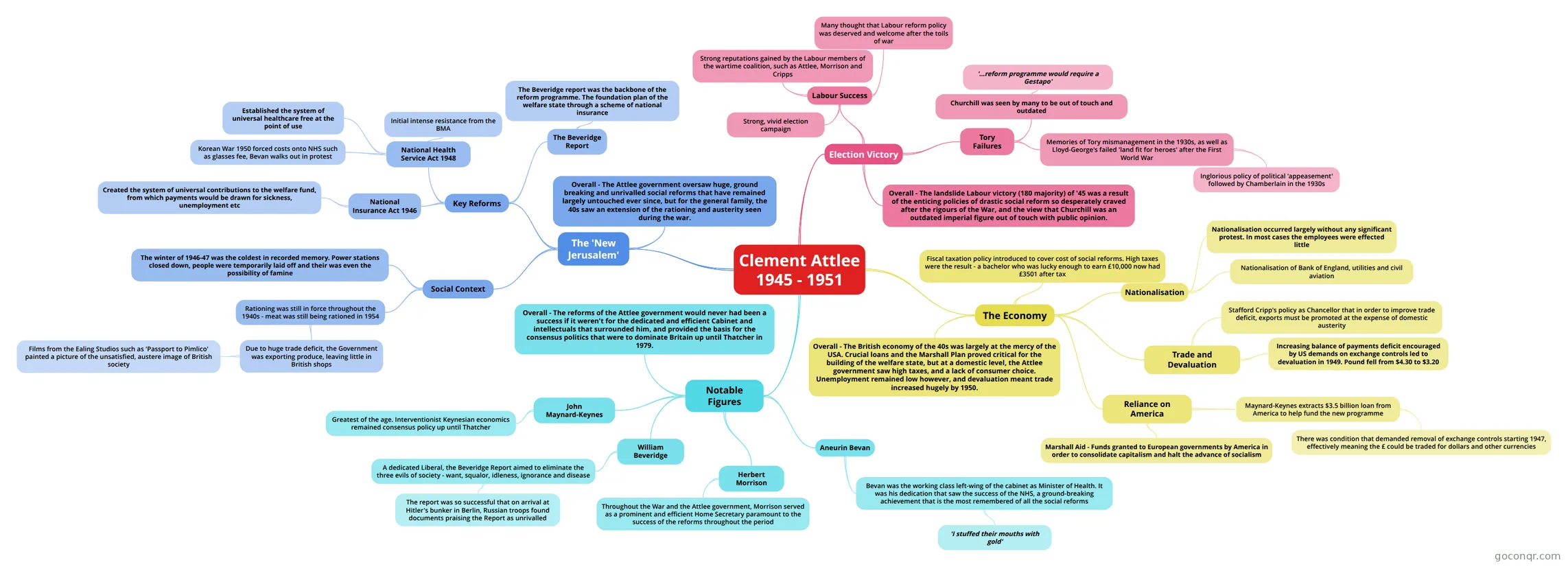
Mind map: Clement Attlee 1945-1951
Map content
Clement Attlee 1945 - 1951
The 'New Jerusalem'
- Social Context
- Rationing was still in force throughout the 1940s - meat was still being rationed in 1954
- Due to huge trade deficit, the Government was exporting produce, leaving little in British shops
- Films from the Ealing Studios such as 'Passport to Pimlico' painted a picture of the unsatisfied, austere image of British society
- Due to huge trade deficit, the Government was exporting produce, leaving little in British shops
- The winter of 1946-47 was the coldest in recorded memory. Power stations closed down, people were temporarily laid off and their was even the possibility of famine
- Rationing was still in force throughout the 1940s - meat was still being rationed in 1954
- Key Reforms
- The Beveridge Report
- The Beveridge report was the backbone of the reform programme. The foundation plan of the welfare state through a scheme of national insurance
- National Insurance Act 1946
- Created the system of universal contributions to the welfare fund, from which payments would be drawn for sickness, unemployment etc
- National Health Service Act 1948
- Established the system of universal healthcare free at the point of use
- Initial intense resistance from the BMA
- Korean War 1950 forced costs onto NHS such as glasses fee, Bevan walks out in protest
- The Beveridge Report
- Overall - The Attlee government oversaw huge, ground breaking and unrivalled social reforms that have remained largely untouched ever since, but for the general family, the 40s saw an extension of the rationing and austerity seen during the war.
- Social Context
Election Victory
- Labour Success
- Strong reputations gained by the Labour members of the wartime coalition, such as Attlee, Morrison and Cripps
- Many thought that Labour reform policy was deserved and welcome after the toils of war
- Strong, vivid election campaign
- Tory Failures
- Churchill was seen by many to be out of touch and outdated
- '...reform programme would require a Gestapo'
- Memories of Tory mismanagement in the 1930s, as well as Lloyd-George's failed 'land fit for heroes' after the First World War
- Inglorious policy of political 'appeasement' followed by Chamberlain in the 1930s
- Churchill was seen by many to be out of touch and outdated
- Overall - The landslide Labour victory (180 majority) of '45 was a result of the enticing policies of drastic social reform so desperately craved after the rigours of the War, and the view that Churchill was an outdated imperial figure out of touch with public opinion.
- Labour Success
The Economy
- Nationalisation
- Nationalisation occurred largely without any significant protest. In most cases the employees were effected little
- Nationalisation of Bank of England, utilities and civil aviation
- Trade and Devaluation
- Stafford Cripp's policy as Chancellor that in order to improve trade deficit, exports must be promoted at the expense of domestic austerity
- Increasing balance of payments deficit encouraged by US demands on exchange controls led to devaluation in 1949. Pound fell from $4.30 to $3.20
- Reliance on America
- Maynard-Keynes extracts $3.5 billion loan from America to help fund the new programme
- There was condition that demanded removal of exchange controls starting 1947, effectively meaning the £ could be traded for dollars and other currencies
- Marshall Aid - Funds granted to European governments by America in order to consolidate capitalism and halt the advance of socialism
- Maynard-Keynes extracts $3.5 billion loan from America to help fund the new programme
- Fiscal taxation policy introduced to cover cost of social reforms. High taxes were the result - a bachelor who was lucky enough to earn £10,000 now had £3501 after tax
- Overall - The British economy of the 40s was largely at the mercy of the USA. Crucial loans and the Marshall Plan proved critical for the building of the welfare state, but at a domestic level, the Attlee government saw high taxes, and a lack of consumer choice. Unemployment remained low however, and devaluation meant trade increased hugely by 1950.
- Nationalisation
Notable Figures
- John Maynard-Keynes
- Greatest of the age. Interventionist Keynesian economics remained consensus policy up until Thatcher
- Herbert Morrison
- Throughout the War and the Attlee government, Morrison served as a prominent and efficient Home Secretary paramount to the success of the reforms throughout the period
- William Beveridge
- A dedicated Liberal, the Beveridge Report aimed to eliminate the three evils of society - want, squalor, idleness, ignorance and disease
- The report was so successful that on arrival at Hitler's bunker in Berlin, Russian troops found documents praising the Report as unrivalled
- A dedicated Liberal, the Beveridge Report aimed to eliminate the three evils of society - want, squalor, idleness, ignorance and disease
- Aneurin Bevan
- Bevan was the working class left-wing of the cabinet as Minister of Health. It was his dedication that saw the success of the NHS, a ground-breaking achievement that is the most remembered of all the social reforms
- 'I stuffed their mouths with gold'
- Bevan was the working class left-wing of the cabinet as Minister of Health. It was his dedication that saw the success of the NHS, a ground-breaking achievement that is the most remembered of all the social reforms
- Overall - The reforms of the Attlee government would never had been a success if it weren't for the dedicated and efficient Cabinet and intellectuals that surrounded him, and provided the basis for the consensus politics that were to dominate Britain up until Thatcher in 1979.
- John Maynard-Keynes
Information
- Description
- History Mind Map on Clement Attlee 1945 - 1951, created by ChristianLowe on 19/05/2013.
- Created by
- ChristianLowe
- Views
- 78
- Tags
- Rating