
Notes
Chapter 3: Sensation and Perception
Content of the notes (1)
Page 1
Chapter 3: Sensation and Perception
Psychophysics (early psychology)
looks at the relationship between sensations and perceptions
thresholds= minimum amount of stimulus needed for detection
just noticeable difference= minimum amount of difference between two stimuli necessary to be noticed
phenomenological characteristics:
color perception-although people have normal color vision, people can't always agree on a color
sensory adaptation- diminishing sensitivity to an UNCHANGING stimuli (eyes adjusting to light, nose adjusting to smell)
The Eye
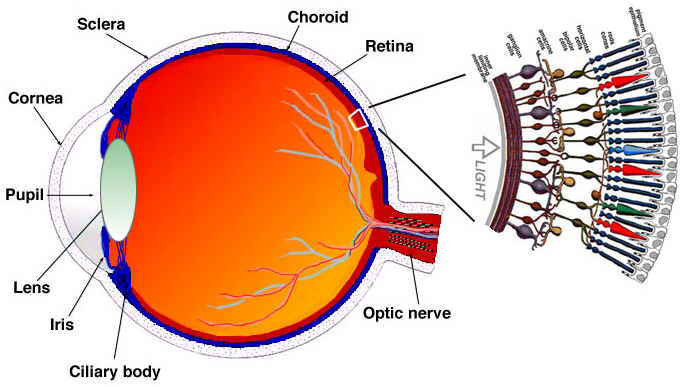
light first hits the cornea of the eye
The cornea: takes in light, protects the eye, helps to focus the light coming in (the lens does more refining than the cornea)
the retina converts the entire area of the eye behind the lens
the fovea is located directly behind the pupillary opening (where the most clear vision is located)
the blind spot is where the optic nerve LEAVES the eye
the brain fills in information so that you don't usually notice the blind spot
there are sensory receptors for the eye:
rods= 100-130 million, primarily located in the periphery (not the fovea); their primary functions are:
helping to see in low light situations (they are sensitive to light)
being really good at detecting movement
cones= 6-7 million, located in the FOVEA; their primary functions are:
color perception
visual acuity (seeing things in FOCUS)--the only part of your vision that is focused is what lies directly in front of the fovea
rods and cones are actually behind masses of ganglion cells (which seems the opposite of where they should be)
Color Vison Theory
Young-Helmholtz Theory or Trichromatic Theory (1802/1850)
theory is based on the idea of three primary colors of light (blue, green, and red)
said that each of the 3 types of cones were specific to one of the primary colors
Opponent-Process Theory (Ewald Hering, 1872)
he found that the Trichromatic theory of color did not explain color deficiencies well
he theorized that there are pairs of color-opponents (blue-yellow, red-green, white-black)
activation of one color in the pair suppresses the other color
There is merit to both of these theories; often considered together:
Trichromatic= referring to receptor sensitivity
Opponent-Process= referring to neural processes
Color Deficiencies
Men are 12-20 times MORE LIKELY to have color deficiencies
color deficiencies have a genetic link to the X-chromosome, so for girls to have a deficiency, they need 2 X-chromosomes with the color deficiency gene
Prevalence rate: 5-8% of men and 0.4-0.5% of women
Certain ethnicities are more likely to have color deficiencies
it is more common in WHITE men-->8% (Norwegians, Polish, Czechs-->10%)
it is less common in ASIAN (5%) and BLACK (4%) men
it is virtually nonexistent in: Navajo, Fiji, Eskimo, etc.
color deficiencies may allow better night vision and worse camouflage vision (which makes them better snipers)
color deficiencies are tested using isochromatic plates (which hide a series of numbers in dots of opponent color pairs)
Perceptual Processes
bottom-up processing= stimuli comes from the environment into the brain
top-down processing= memory and knowledge from the brain influence perception
Wesp et al (2014)
had subjects drop darts on a dart board and he counted the number of attempts it took for them to hit the board
he then asked the subjects to estimate what they thought the size of the target was
those who took fewer attempts estimated the target as being BIGGER
those who took more attempts estimated the target as being SMALLER
(r= -0.66)
Bruner and Goodman (1947)
had children make estimates about the sizes of coins or IDENTICALLY sized cardboard discs
RESULTS: their estimates were very accurate for cardboard discs, but they overestimated the coin size
as coins increased in value, the children increasingly thought the coins were larger than they actually were
this is an example of how top-down processing can affect one's perception of a stimulus
poorer kids saw the coins as EVEN LARGER; the results showed a similar pattern in adults, too
Information
- Description
- Psychology Note on Chapter 3: Sensation and Perception, created by Naomi Broussard on 25/09/2017.
- Created by
- Naomi Broussard
- Views
- 3
- Rating