
Notes
Respiratory viruses
Content of the notes (1)
Page 1
Respiratory viruses
Canine distemper virus
Cycle
Inhalation
Cross respiratory mucosa
Macrophages?
Lymphoid tissue?
Blood
CNS
Epithelial surfaces
Virus release
Why be pathogenic ?
Conventional wisdom
Parasite host co-evolution is towards commensalism or mutualism
Virulence is a measure of recent associations between pathogen + host
The enlightenment
Some level of virulence required for transmission
Too virulent kills host before transmission
Not virulent enough limits opportunities for transmission
Virulence may increase transmission
Amount of virus shed
Diarrhoea
Amount taken up by vectors
Contact rates with susceptible (behavioural)
Rabies
Main infectious causes of viral respiratory disease
Classification
Genome
Number and sense of strands
Morphology
Genome sequence similarity
Ecology
Orthomyxoviridae
RNA viruses
Family = Orthomyxoviridae
Genus
Influenza A virus
Species = Influenza A virus
Animals + humans
Human vaccinations
Influenza B virus
Species = influenza B virus
Humans
Vaccinations
Influenza C virus
Species = influenza C virus
Humans
Isavirus
Species = infectious salmon anaemia virus
Thogotovirus
Species = Thogoto virus
Tick borne
Influenza A virus particle
Segmented genome
Evolve quickly
New types
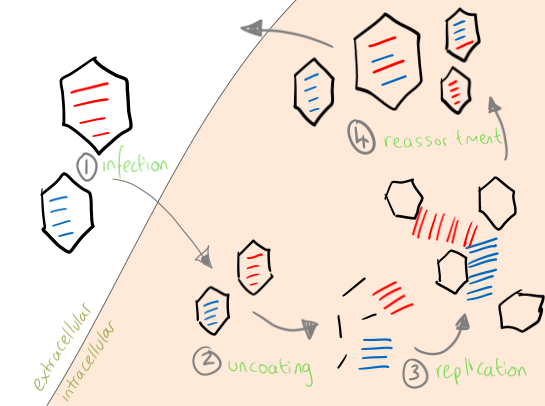
Point mutation + genetic reassortment
Mutations = antigenic drift
Variation within a subtype
Reassortment = antigenic shift
Two or viruses infect the same cell
Development new subtypes
Epidemic
Phases 1-3
In animals
Evolves to infect humans
Doesn't pass from human to human
Phase 4
Evolves to pass from human to human
Phase 5
Widespread human infection
Pandemic
Post peak
Possibility of recurrent events
Post pandemic
Influenza species jumps
H3N8 -horses to dogs
Been in horses for 40 yrs
Cough 10-14 days
Fear nasal discharge
Occasional death
Antigenic shift
Vaccine
Periodic updates
Competing horses
Evolved to infect dogs
Dogs
Evolved to spread dog to dog
Via food chain
10% inapparent infection
80% mild kennel cough
Nasal discharge and cough , 10-21 days
5-8% pneumonia and death
High fever, dyspnoea, lung consolidation?
Incubation period 2-5 days
Shedding period 7-10 days
Canine influenza in the UK
Outbreak of respiratory disease in foxhounds
Lung samples tested positive for H3N8
Some dogs are still antibody positive but low levels suggest virus no longer present
AHT did a serosurvey of 300 dog samples - suggests the virus is not prevalent in the UK
Vaccinated in USA
H3N2 spread from dogs in Asia to dogs in USA
H5N1 - avain to people
Highly pathogenic
Highly virulent
Very close contact with animals
Where present in poultry it must be reported
Low pathogenicity avian influenza
Proteases localised in respiratory and intestinal organs
Proteases cleavage can only occur in intestinal tract
Highly pathogenic avian influenza
Ubiquitous proteases
Protease cleavage can occur all over body
Cats
1 of 15 cats ate a chicken carcass on a farm with outbreak
That cat disappeared
14 became weak, started vomiting +coughed up blood
13 died
3 sent for necropsy which confirmed they had H5N1
Tigers
Fed with chickens who'd died from H5N1
Became transmissible tiger to tiger
147 tigers died or euthanised
Unlikely to pass from cats to peopl
Humans form chickens??
Amount excreted by cats much lower that chickens
No evidence
Recommended that cats in infected zones + outbreaks should be kept indoors
When it gets into people it kills
Not yet transmissible person to person
H1N1 pig recombinant to humans
Cat?
Clinical. signs
Depressed
Inappetant
Respiratory signs 4 days
Reluctant to lie in lateral recumbency
Dyspnea
Bilateral lung sounds
Afebrile
Dehydrated
Radiographs showed bilateral caudodorsal alveolar pattern
?
Infectious bronchitis virus
Coronavirus
Affects chickens
Acute
Highly contagious
High mortality in young chickens
Strains vary in pathogenicity / tissue tropism from respiratory ??
Kidney??
Most strains show some tropism for the urogenital tract in adults
Reduction in egg yield
Vaccination
Chicks vaccinated within first week
Attenuated vaccine
Aerosol
In drinking water
Outbreaks can still occur
New genotypes
Substitution/insertion/deletion/recombination
Surveillance strategies need to be in place to allow most appropriate antigens to be incorporated based on geographical context?
Coronaviruses
Ss+ sense RNA
biggest RNA genome
Enveloped
Common cold
Canine respiratory coronavirus
Problem in mild cases in respiratory disease
Likely to be new component of kennel cough
Feline viral respiratory disease
Feline calicivirus
Clinical signs
Oral ulceration
Oculonasal discharge
Conjuctivitis
Lameness
Carriers
30 days most
Most self cure
Evolution
Most continually shed virus
No clinical disease?
Very variable
Must pick one strain for vaccine
Reduce likelihood of clinical signs
Don't prevent them
Feline Herpesvirus
Clinical signs
Lethargy
Oculonasal discharge
Sneezing
Salivation
Keratitis
Carriers
100%
Lifelong
Latency
Intermittent reactivation
Recrudescence
Prevalence
Very common
FCV- whether diseased or not 10% shed disease
Cycles
FHV
Infection
Clinical disease
Shedding
Latently infected
Clinically normal
Not shedding
Variable period of time
Increase in stress
Reactivation of disease
Clinically normal or diseased
Shedding virus
FCV
Infection
clinical disease or not
Shedding disease
Clinically normal
Shedding virus
75 day half life
Immune
Not shedding virus
Naïve-susceptible
Not shedding virus
Vaccination
Immune
May still become infected
Shed disease
No clinical signs
Live vs killed vaccines
Live
Virus weakened - less likely to cause disease
Limited replication stimulates immune response
May under rare conditions cause infection
Not licensed during pregnancy
Killed
No chance of causing infection
Need adjuvants to stimulate immune response
Greater association with sarcomas
Licensed during pregnancy
Control
Husbandry
Ventilation
Stocking density
Biosecurity
Vaccination
Can't overcome bad husbandry
IBR marker vaccine
Delete component of virus
Differentiate injected from vaccinated animals !! (DIVA)
Change the way we control disease outbreaks
Information
- Description
- Vet Med 1 (ID) Note on Respiratory viruses, created by Alice Butterworth on 08/03/2018.
- Created by
- Alice Butterworth
- Views
- 0
- Rating