
Notes
The Multi-Store Model
Content of the notes (2)
Page 1
The Multi-Store Model
AO1
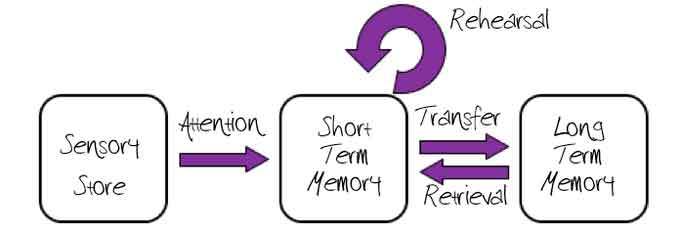
The multi-store model of memory was produced by Atkinson and Shiffrin and is a structured model. They proposed that memory consisted of three stores: sensory register, short-term memory (STM) and long-term memory (LTM).
Information passes from store to store in a linear way. Both STM and LTM are unitary stores.
Sensory memory is the information you get from your senses (e.g. eyes and ears). When attention is paid to something in the environment, it is then converted to short-term memory.
If any information is not important, then it decays or disappears. Once in the short-term memory store, information can be rehearsed to keep it in short-term memory longer, or it can be rehearsed deeper to be transferred into long-term memory. If information is not rehearsed when in short-term memory, then it is lost (forgotten) after the duration has passed. Information can later be retrieved from long-term memory, back into short-term memory, in the process of retrieval.
Each store has its own characteristics in terms of coding, capacity and duration.
Coding - this is the way information is changed so that it can be stored in the particular store. There are three main ways in which information can be coded: Visual (by what it looks like), acoustic (by sound) and semantic (by meaning).
Capacity - this is how much information can be stored in the particular store before things start to be forgotten.
Duration - this refers to the period of time that information can last in the particular memory store before it is forgotten.
Sensory Register
Coding: sense specific (different coding for each sense)
Capacity: all sensory experience
Duration: 1/4 - 1/2 a second
Short-Term Memory
Coding: mainly acoustic
Capacity: 7 +/- 2 items
Duration: 0-18 seconds
Long-Term Memory
Coding: mainly semantic (but can be visual and acoustic)
Capacity: unlimited
Duration: unlimited
AO3
One strength of the multi-store model is that it gives us a good understanding of the structure and process of STM. This is good because this allows researchers to expand on this model by doing experiments to improve on it and make it more valid, and also proving what the stores actually do.
It has now become apparent that both short-term and long-term memory are more complicated than previously thought. For example, the Working Memory model of memory - proposed by Baddeley and Hitch (1974) - showed that short-term memory is more than just one simple, unitary store and, really, is made up of different components - such as the central executive and the visuo-spatial sketchpad.
The multi-store model suggests that rehearsal helps to transfer information into LTM, but this is not essential. Why are we sometimes able to recall information which we did not rehearse (such as swimming) yet we are sometimes unable to recall information which we have rehearsed, such as the information you revise for exams. Therefore, the role of rehearsal as a means of transferring information from STM to LTM is much less important than Atkinson and Shiffrin (1968) claimed in their model.
Page 2
Information
- Description
- AS - Level Psychology (Memory) Note on The Multi-Store Model, created by Tom Povey on 07/04/2016.
- Created by
- Tom Povey
- Views
- 0
- Rating