
Notes
Working Memory Model of Memory
Content of the notes (1)
Page 1
Working Memory Model
AO1
The working memory model (Baddeley and Hitch (1974) replaced the idea of a unitary STM. It suggests a system involving active processing and short-term storage of information.
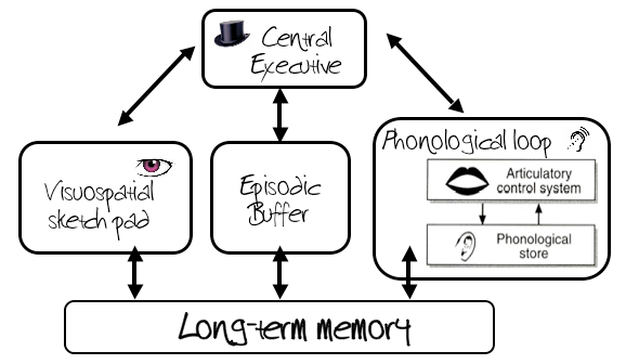
Key features include the central executive, the phonological loop and the visuo-spatial sketchpad.
Central Executive
This has a supervisory function and acts as a filter, determining where information goes to. It can process information in all sensory forms, directs information to other slave systems and collects responses. It has a limited capacity and deals with only one piece of information at a time.
Phonological Loop
One of the slave systems is the phonological loop, which is a temporary storage system for holding auditory information in a speech based form. It has two parts: 1 - the phonological store (the "inner ear"), which stores what you hear; and 2 - the articulatory control system (the "inner voice"), which allows maintenance rehearsal - repeating sounds or words to keep them in working memory while they are needed. The phonological loop plays a key role in the development of reading.
Visuo-Spatial Sketchpad
The second slave system is the visuo-spatial sketchpad (VSS). The VSS is a temporary memory system for holding visual and spatial information. It has two parts: 1 - the visual cache (the "inner eye"), which stores visual data about form and colour; and 2 - the "inner scribe", which records the arrangement of objects in the visual field and rehearses and transfers information in the visual cache to the central executive.
Episodic Buffer
The third slave system is the episodic buffer, which acts as a 'backup' (temporary) store for information which communicates with both long-term memory and the slave system components of working memory.
AO3
Working memory is supported by dual task studies. It is easier to do two tasks at the seem time if they use different processing systems (one visual, one verbal) than if they use the same system (both visual or both verbal). For example, participants would find it hard to do two visual tasks at the saem time because they would be competing for the same limited resources of the visuo-spatial sketchpad. However, a visual task and a verbal task would use different components and so could be performed with limited errors.
The KF case study supports the working memory model. KF suffered brain damage from a motorcycle accident that damaged his short-term memory. KF's impairment was mainly for verbal information - his memory for visual information was largely unaffected. This shows that there are separate STM components for visual information and verbal information (the VSS and the phonological loop). However, evidence from brain damaged patients may not be reliable because it concerns unique cases with patients who have had traumatic experiences.
One limitation is the fact that little is known about how the central executive works. It is an important part of the model but its exact role is unclear.
Another limitation is that the model does not explain the link between working memory and LTM.
Information
- Description
- AS - Level Psychology (Memory) Note on Working Memory Model of Memory, created by Tom Povey on 07/04/2016.
- Created by
- Tom Povey
- Views
- 1
- Rating