
Notes
Memory
Content of the notes (6)
Page 1
Explanations for forgetting:
Memory: The process in which we retain information about past
events.
Interference theory
An explanation for forgetting in terms of one
memory disrupting the ability to recall another. More likely when 2 memories
are similar.
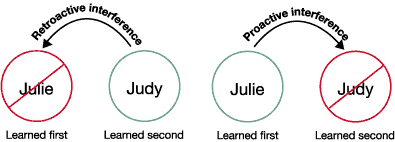
Retroactive interference (retro=backward) occurs
when you forget a previously learnt task due to the learning of a new task.
Later learning interferes with earlier learning - where new memories disrupt
old memories.
Proactive interference (pro=forward) occurs when
you can’t learn a new task because an old task that had been learnt. When what
we already know interferes with what we are currently learning – where old
memories disrupt new memories.
- Evaluation: It’s
artificial. Lab experiments e.g. in the Postman study it required groups to
remember a list of paired words e.g. cat – tree. But, in everyday life the
information we need to recall is different, e.g. people’s faces, their
birthdays, the ingredients of a pizza. So artificial lab studies lack mundane
realism and are low in ecological validity. Therefore, it means we can’t
generalise the findings from such studies to everyday life as there may well be
other factors that influence forgetting.
+ Evaluation: Real
world application. Is interference a better explanation for forgetting than the
passage of time. They asked rugby players to try to remember the names of the
teams they had played so far in that season, week by week. Most players had
missed games, for some the ‘last team’ they played might have been 2+ weeks
ago. The results showed that accurate recall didn’t depend on how long ago the
matches took place. It was also found that the number of games they played in
the meantime was also influential. So if a player’s recall of a team from 3 weeks
ago was better if they had played no matches since then. Therefore, this study
shows that interference explanations can apply to at least some everyday
situations.
Underwood and
Postman:
Aim: To investigate how retroactive interference
affects learning. So to investigate whether info you have recently received
interferes with the ability to recall something you learned earlier.
Method: lab experiment
Procedure: Pts were split into 2 groups. Both
groups had to remember a list of paired words e.g. cat-tree, jelly-moss,
book-tractor. The experimental group also had to learn another list of words
where the second paired word if different – e.g. cat–glass, jelly-time,
book–revolver. The control group were not given the 2nd list. All pts were
asked to recall the words on the first list.
Results: The recall of the control group was
more accurate than that of the experimental group.
Conclusion: This suggests that learning items in
the second list interfered with pts’ ability to recall the list. This is an
example of retroactive interference
Retrieval failure
Retrieval failure = A form of forgetting. It
occurs when we don’t have the necessary cues to access memory. The memory is
available but not accessible unless a suitable cue is provided.
Cue = A ‘trigger’ of information that allows
access to a memory.
+ Evaluation:
Research shows forgetting is due to the absence of cues. Pts were given 5 lists
of 24 words, each list organised into 6 categories. E.g. hut, cottage, tent,
hotel, cliff, river, hill, volcano. Categories weren’t explicit, it was
presumed that they would be obvious to pts. Recall 70% for the first list but
this fell as pts were given each additional list to learn, presumably due to
interference. However, at the end they were given a cued recall test – they
were told the names of the categories as a clue. Recall rose again to about
70%. Therefore, this shows info is available but can’t be retrieved this shows
retrieval failure is a more important explanation of forgetting than
interference.
- Evaluation: The danger
of circulatory, Claims: relationship between encoding cues and later retrieval
is a correlation not a cause. Cues don’t cause retrieval they’re just
associated with it. others argue the encoding specificity principle (ESP) is
impossible to test because its circular. Stimulus leads to retrieval of a
memory then it must have been encoded in memory. If it doesn’t lead to retrieval,
then according to the ESP it’s not been encoded. But it’s impossible to test an
item if it hasn’t been encoded so it can’t be proved.
Type of cue:
Encoding: Memory is most effective if info that
was present at encoding is also available at the time of retrieval. Also states
cue don’t have to be exactly but the closer the cue is to the original item,
the more useful it will be.
Tulving and Pearlstine- Pts had to learn 48
words in 12 categories. There were 2 recall conditions. Either 1. recalling as many
words as they could or 2. they were given cues (category name). Results: 1. 40%
recall, 2. 60% recall. Cues allow us to access memories.
Godden and Baddeley- Investigated contextual
cues. Scuba divers were pts they were tested on land or in water. 4
experimental conditions. Results showed recall was higher when in the same
condition e.g. learning on land and recall on land.
Goodwin et al- Asked male pts to remember words
drunk or sober (3 times the limit in the UK) they were asked to recall the
words after 24 hours. Results showed info learnt when drunk is more available
when in the same state later.
Page 2
Types of long term memory
Procedural memory: memory of how to do things
e.g. riding a bike or learning how to read. Such memories are automatic as a
result of repeated practise.
Episodic memory: Personal memories of events,
e.g. what you did yesterday or a teacher you liked. This kind of memory
includes contextual details plus emotional one.
Semantic memory: Shared memories for facts and
knowledge. These memories may be concrete, e.g. knowing that ice is made of
water, or abstract such as mathematical knowledge.
+ Evaluation: real
life applications. Being able to identify different aspects of LTM allows
psychologists to target certain kinds of memory in order to better people’s
lives. evidence shows that episodic memories could be improved in older people
who had a mild cognitive impairment. The trained pts performed better on a test
of episodic memory after training than a control group. Episodic memory is the
type of memory most often affected by mild cognitive impairment, which
highlights the benefit of being able to distinguish between types of LTM.
+ Evaluation: There’s
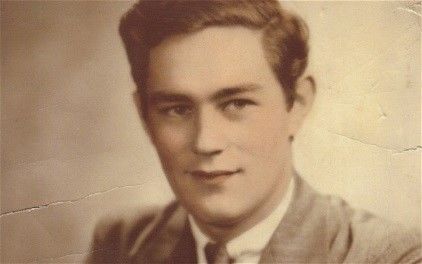
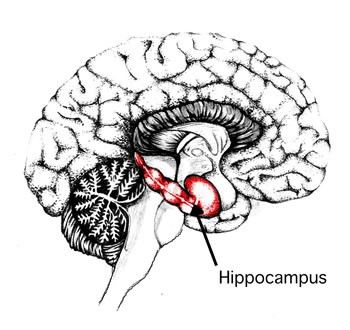
clinical evidence from people with brain-damage. Several cases of patients who
have suffered brain damage to their hippocampus & have memory deficits:
Clive Wearing and HM Their memory loss tends to be selective. Episodic memory
in both of these men was severely impaired as a consequence of amnesia. They
had difficulty recalling events that had happened from their pasts. But, their
semantic memories were relatively unaffected. E.g. they still knew the meaning
of words. So HM wouldn't be able to recall stroking a dog half an hour earlier
and couldn't remember owning one in the past, but he would never need the
concept of ‘dog’ explained to him over and over again. Their procedural
memories were also intact. They both knew how to tie their shoelaces, how to
walk and speak. In Clive Wearing’s case (he was a professional musician), how
to read music, sing and play piano.
+ Evaluation:
Neuroimaging Evidence. There's evidence from brain scan studies that different types
of memory are stored in different parts of the brain. Pts were asked to perform
various tasks while their brains were scanned using a PET scanner. E - They
found that episodic and semantic were both recalled from an area of the brain-
the prefrontal cortex. This area is divided into 2 areas, one on each side of
the brain. The left prefrontal cortex was involved in recalling semantic
memories. Episodic memories were recalled from the right prefrontal cortex.
Procedural memories, however, were recalled from the cerebellum and the basal
ganglia.

Page 3
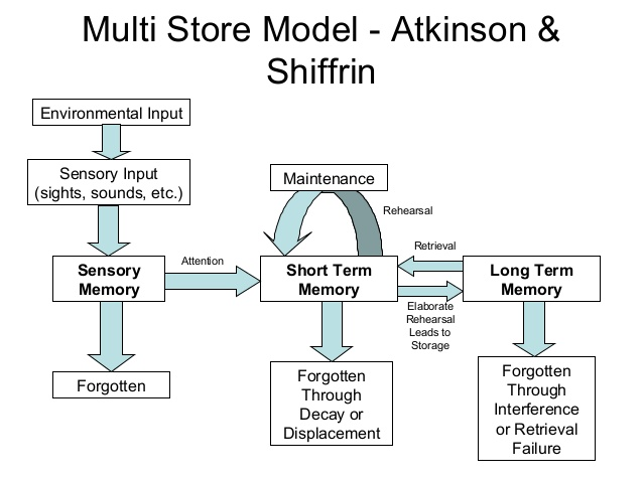
Multi Store Memory (MSM) Atkinson and Shiffrin
Duration: How long a piece of information can
stay in your memory before it is no longer available.
Haptically: By touch. - Acoustically: By sound.
- Semantically: By meaning. - Visually: By sight.
Capacity: A measure of how much information can
be stored in the memory.
Coding (Encoding): The way that info is changed
so that it can be stored in a memory store. Environmental stimuli enter the
brain and then is stored in various forms.
Forgetting: Memory traces in STM are fragile and
can be lost within 30 seconds, through displacement or decay, unless they are
repeated (rehearsed). Memory in the LTM is lost through decay, retrieval
failure or interference.
Attention: Information is transferred from one
store to another. You pay attention to pass information from the sensory store
to the STM.
Retrieval: The process of getting info from the
LTM involves the information passing it back through the STM so it’s available
for use.
Maintenance rehearsal: Repetition keeps info in
the STM but eventually will create a LTM. Atkinson and Sheffrin proposed a
direct link between rehearsal in STM and the strength of the LTM.
- Evaluation: The MSM
oversimplifies the memory structures and processes. The MSM suggests that the
STM and the LTM are 2 different unitary stores which operate in a single,
uniform fashion. But research opposes this. Someone known as 'KF' suffered from
brain damage which resulted in them having difficulty processing verbal
information in their STM. However, KF's ability to process visual information
was completely normal. This suggests that the STM is a non-unitary store with
different parts dedicated to processing different types of information (haptic,
visual, auditory).
+ Evaluation: Lab
studies on capacity, duration and coding support the existence of separate
stores. Studies using brain scanning techniques have also demonstrated a
difference between STM and LTM, the prefrontal cortex is active in STM tasks
but not LTM ones and found the hippocampus is active in LTM tasks.
+ Evaluation: pts
were given a list of 50 words that they needed to memorize in a given amount of
time. This experiment found that there was a 'recency effect' where the pts
remembered the most recent words that they had read because they had not yet
been displaced from their STM, they also found that there was a 'primary
effect' where the pts remembered the first words on the list because they had
been rehearsed more and thus transferred into their LTM. These findings support
the MSM because it shows that there are differences between the STM and the LTM
and that they are 2 separate, unitary memory stores.
3 unitary stores: sensory memory, short term memory (STM)
and long term memory (LTM).
Sensory Memory: First is the SM its constantly
receiving information, either visually, auditorily or haptically. But most of
this information actually receives no attention and stays in the sensory memory
until it decays (taking a matter of milliseconds). If a person is focusing on a
piece of information, then instead of decaying it will be directly transferred
to the STM.
Short Term Memory: When in the STM, information
is very 'fragile' and likely to be displaced if it’s not rehearsed. The average
duration for a piece of information in the STM is around 20 seconds and the
amount of information that can be held is 7+/-2 items. If the information is
rehearsed and payed attention too, then the information will be transferred to
the LTM.
Long term memory: has a potentially unlimited
capacity and the duration of which a piece of information can be held in the
LTM is unlimited also.

Page 4
Cognitive interview
Geiselman et al:
1. Context reinstatement (CR): Recall image of
the scene, the weather, what you were feeling.
2. Report everything (RE): Report every detail
you can even if they seem irrelevant or trivial.
3. Recall in reverse or a different order (RO):
Describe the event from memorable point.
4. Recall from a changed perspective: Describe
the event as it would have been seen from different viewpoints.
Additional techniques:
Minimising distractions.
Asking the witness to speak slowly.
Adapting the language used.
Reducing
anxiety.
Avoiding judgemental/personal comments.
- Evaluation: quantity vs quality: Its meant to
enhance quantity without compromising the quality. Research shows an 81%
increase of correct info but a 61% increase of incorrect info when enhanced CI
was compared to the standard interview. Meaning police need to treat all info
collected from CIs with caution. It doesn’t guarantee accuracy.
+ Evaluation: effectiveness of the CI: A
meta-analysis of 53 studies found an increase of 34% in correct info given in
the CI compared to the standard police interview. The effectiveness may be due
to some individual elements rather than the whole thing. children were
interviewed using 1 technique from the CI the control group were told to 'try
again' recall across the 4 components was similar and no different from the
control group. Pts interviews using report everything and mental reinstatement
caused higher recall.
Page 5
Working Memory Model (WMM)
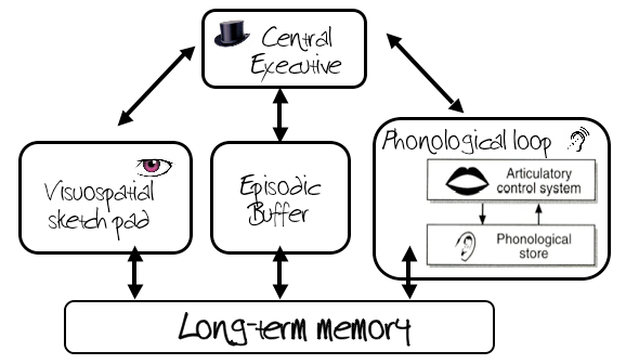
Originally designed by Baddeley and Hitch, the
WMM is an alternative to the multi-store model of memory (MSM), which they saw
as underestimating the complexities of the STM.
How short-term memory works: It has several
different components Each component has a particular function – includes
storage and manipulation and analysis of information It is an active system
which allows us to work things through. 2 tasks can be carried out
simultaneously in STM if they are being dealt with by different parts of the
memory system.
Central executive: Key component Supervises and
coordinates information to and from the slave systems Very limited capacity It
decides what needs to be done and when.
Episodic buffer: Added in 2000 as the model
needed a more general store. Slave systems deal with specific types of
information. Central executive has no storage capacity Episodic Buffer is extra
storage system but with limited capacity. it records events that happen, and
sends information to the LTM.
Visuo- spatial sketchpad- Inner Scribe Active
rehearsal system Processes spatial and movement information. Visual cache
Passive visual store Stores info about visual form and colour.
Phonological loop- Articulatory Loop Active
rehearsal system where words are maintained by sub vocal repetition. Repeats
info from phonological store Inner voice. Phonological store Passive storage
system Holds spoken information Inner ear.
+ Evaluation:
evidence from brain damaged patients: studies on a man called KF whose short
term forgetting of auditory information was much greater than that of visual
stimuli. In addition, his auditory problems were limited to verbal material
such as letters and digits but not meaningful sounds e.g. a phone ringing. his
brain damage seemed to be restricted to his phonological loop.
- Evaluation: evidence
from brain damaged patients: Key evidence for the WMM comes from case studies
of individuals who have suffered from serious brain damage. The process of
brain injury is traumatic, which may change the behaviour of a person making
them perform worse on certain tasks. these individuals have difficulty paying
attention and therefore underperform in some tasks.
Short term and long term memory:
- Evaluation: Duration:
Forgetting things could be due to displacement rather than decay.
+ Evaluation-
capacity: The size of the chunk matters: Research showed that people had a
shorter memory span for larger chunks, e.g. 8 word phrases, than similar chunks
e.g. one syllable words.
- Evaluation: Coding:
LTM might not have been tested. STM was tested by asking pts to recall a word
list immediately after hearing it. LTM was tested by waiting 20 mins, it’s
questionable if that’s testing LTM.
- Evaluation: Duration:
Testing STM is artificial: memorising syllables doesn’t reflect everyday life
where we are trying to remember is meaningful. Although it does have some
relevance when compared to remembering phone numbers or post codes.
- Evaluation: The STM isn’t
the same for everyone: research shows capacity increases with age. 8 year olds
could remember 6.6 digits, 19 year olds could remember 8.6 digits. Could be due
to gradual increase in brain capacity people may have developed strategies as
they got older to remember info by chunking etc.
Page 6
Eyewitness testimony
Eyewitness testimony:
Eyewitness testimony: The evidence provided in
court by a person who witnessed a crime, with a view to identifying the perpetrator
of the crime.
Post event discussion: Repeat interviewing: Each
time the witness is interviewed comments from the interviewer could become
incorporated into the recollection of events. Interviewer could use leading
questions to alter the individual’s memory especially when interviewing
children.
Post event discussion: Conformity effect:
Co-witnesses may reach a consensus view of what actually happened. Pts were in
pairs each partner watched a different video of the same event so they viewed
unique items. 71% who had discussed the event went in to mistakenly recall
items acquired during the discussion.
- Evaluation: Individual
differences: Age differences, an eyewitness typically acquires info from 2
sources observing the event and from subsequent suggestions. Compared to younger
people elderly people have trouble remembering the source of the info. They
become more prone to the effect of misleading info when giving testimony.
+ Evaluation: Real
world applications: Criminal justice system relies on eyewitness identification
for investigating and prosecuting crimes. Mistaken eyewitness identification
was the largest factor contributing to the conviction of innocent people.
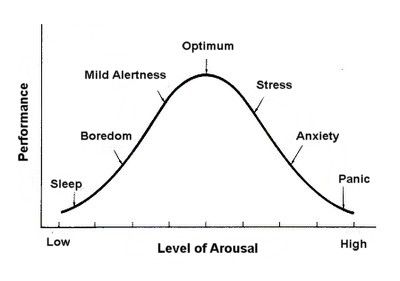
Accuracy of eyewitness testimony: anxiety
Yerkes Dodson effect.
Evaluation: real life vs lab studies: It was a
study of anxiety in context of a real life crime. lab studies may not create
real anxiety that would be created in an actual crime.
+ Evaluation: Anxiety
can improve accuracy: research shows evidence of enhanced recall when they
questioned 58 real witnesses to bank robberies in Sweden. They were either
victims of bystanders high and low anxiety levels would be shown. Interviews
took place 4-15 weeks after. All showed good memories for details of the
robbery itself (75% accurate recall) witnesses who were more anxious has the
best recall (the victims) so anxiety doesn’t reduce accuracy of recall.
- Evaluation: surprise
not anxiety: pts watch a thief enter a
hairdressing salon carrying scissors (high threat, low surprise) a handgun
(high threat, High surprise), a wallet (low threat, low surprise) or a whole
raw chicken (low threat, high surprise). Identification was least accurate in
the high surprise conditions rather than high threat. weapon focus affect is
based on surprise.
Johnson and Scott
Anxiety reduces the accuracy of recall. The view
of a weapon in a criminal’s hand distracts attention (as anxiety is created)
form other features which reduces the accuracy of identification.
Procedure: Pts sat in a waiting room where they
heard an argument in an adjoining room and then saw a man run through the room
either carrying a pen covered in grease or a knife covered in blood. People
were later asked to identify the man.
Findings: 49% in identifying the man in the pen
condition compared to 33% accuracy in the knife condition. Lotus et al showed
anxiety focuses attention on central features of the crime. Researchers
monitors the pt's eye movement and found that the presence of a weapon caused
attention to be drawn to the weapon and away from the persons face.
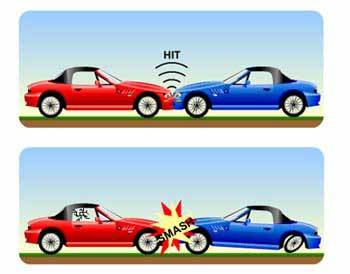
Loftus and Palmer leading
questions:
Aim – To investigate whether leading questions
affects the accuracy of EWT after an event.
Experiment 1: Procedure – 45 Pts were shown 7
films of different car accidents. After each film the pts were given a
questionnaire asking them to describe the accident then answer a series of
specific questions about it. One crucial question concerned the speed of the
car on impact. Group 1 got asked ‘How fast were the cars going when they hit
each other?’ Other groups were asked the same question but the verb was changed
to either ‘smashed’ ‘bumped’, ‘collided’, or ‘contacted’. This critical
question was a leading question as it suggested the answer that a pt would
give, therefore encouraging them to provide a certain response.
Results - The verb used significantly affected
speed estimates- Contacted=31.8MPH, hit=34.0MPH, bumped=38.1MPH,
Collided=39.3MPH, smashed=40.8MPH Therefore smashed’ produced the highest
estimate and ‘contacted’ produced the lowest estimate.
Experiment 2: Procedure – A leading question may
bias a pt’s response or cause info to be altered before is stored. A new set of
pts were divided into 3 groups and shown a film of a car accident lasting 1
minute, and asked questions about speed. The pts were asked to return 1week
later, they were asked a series of 10 questions about the accident, including a
critical question, ‘Did you see any broken glass?’ There wasn’t broken glass in
the film but, those who thought the car was travelling faster might be more
likely to think that there would be broken glass.
Results – Pts who had estimated a higher speed
were more likely to have said they had seen broken glass, as indicated by the
findings in the table.
+ Evaluation: type
of method used (lab) and its practical applications.
- Evaluation: Lacks
ecological validity as participants only watched a video clip of the accident.
As it was artificial, participants may be less motivated to remember the
incident. In real life witnessing a crime is more meaningful and important.
-Evaluation: Demand characteristics
The eye witnesses knew they were taking part in an experiment, may not have
taken the task as seriously as if it was real life. Demand characteristics could have affected
the pts behaviour, they may have worked out the aim of the experiment and
estimated faster speeds in the ‘smashed’ group on purpose. This could make results less valid as they
may not be a realistic measure of the effect of misleading info on EWT, so can’t
generalise findings to real life EWT accounts.
Information
- Description
- AS - Level Psychology (NOTE VERSIONS AS) Note on Memory , created by briony findlay on 07/05/2016.
- Created by
- briony findlay
- Views
- 0
- Rating