
Mapa mental
Leadership
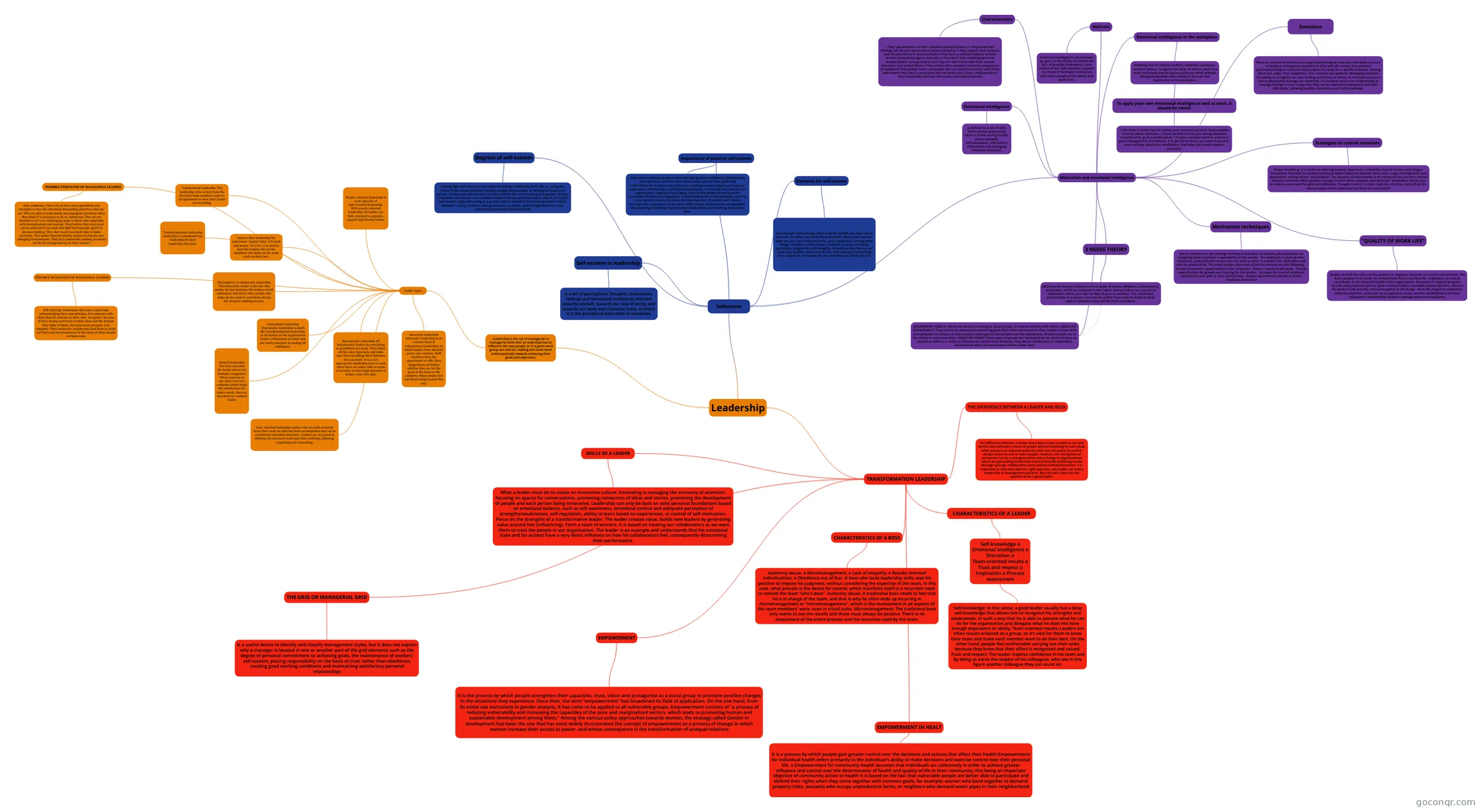
Mind map: Leadership
Conteúdo do mapa
Leadership
Leadership is the set of managerial or managerial skills that an individual has to influence the way people or in a given work group are and act, making this team work enthusiastically towards achieving their goals and objectives.
- Leader types
- autocratic leadership Autocratic leadership is an extreme form of transactional leadership, in which leaders have absolute power over workers. Staff members have the opportunity to offer their suggestions, including whether they are for the good of the team or the company. Many people feel bad about being treated this way.
- Bureaucratic leadership All bureaucratic leaders do everything as predefined in a book. They follow all the rules rigorously and make sure that everything their followers do is accurate. It is a very appropriate leadership style to work when there are many risks in terms of security or when high amounts of money come into play.
- Charismatic leadership Charismatic leadership is much like transformational leadership, as all leaders in the organization inspire enthusiasm in teams and are overly energetic in leading all employees.
- Participatory or democratic leadership The democratic leader is the one who makes the last decision, the leaders would participate and invite other people who make up the team to contribute during the decision-making process.
- Laissez-faire leadershipThe expression "Laissez-faire" is French and means "let it be", it is used to describe leaders who let the members who make up the team work on their own.
- People-oriented leadership It is an opposite of task-oriented leadership. With people-oriented leadership, all leaders are fully oriented to organize, support and develop teams.
- Natural leadership The term describes the leader who is not formally recognized. When someone at any other level of a company simply leads the satisfaction of a team's needs, they are described as a natural leader
- Task-oriented leadership Leaders who are task-oriented, focus their work on what has been accomplished and can be considered somewhat autocratic. Leaders are very good at defining the necessary work and roles, ordering, planning, organizing and controlling.
- Transactional leadership This leadership style is born from the idea that team members come to an agreement to obey their leader in everything.
- Transformational leadership leadership is considered true leadership by most leadership theorists.
- POSSIBLE STRENGTHS OF MANAGERIAL LEADERS
- Self-confidence. They rely on their own capabilities and strengths to face the extremely demanding objectives that are set. They are able to make harsh and unpopular decisions when they think it is necessary to do so. Ambitious. They do not hesitate to set very challenging goals to those who undertake with determination and courage. They believe that every goal can be achieved if you work and fight hard enough. Quick in decision making. They don't need too much time to make decisions. This makes them invaluable leaders in chaotic and changing environments. They feel comfortable making decisions on the fly relying heavily on their instinct
- POSSIBLE WEAKNESSES OF MANAGERIAL LEADERS
- Self-criticism. Sometimes they have a hard time acknowledging their own mistakes. Few patients with ideas that are contrary to their own. Arrogance. Because of their strong conviction in their ideas and the defense they make of them, they may seem arrogant. Low empathy. Their subjective realism may lead them to point out flaws and inconsistencies in the ideas of other people on their team.
- Leader types
Selfesteem
- Self-esteem in leadership
- is a set of perceptions, thoughts, evaluations, feelings and behavioral tendencies directed towards oneself, towards our way of being, and towards our body and character traits. In short: it is the perceptual evaluation of ourselves.
- Degrees of self-esteem
- Having high self-esteem is equivalent to feeling confidently fit for life, or, using the terms of the initial definition, feeling capable and valuable; or feeling accepted as a person. To have low self-esteem is to feel unfit for life; to feel wrong as a person. To have a medium self-esteem is to oscillate between the two previous states, that is, to feel fit and useless, right and wrong as a person, and to manifest these incongruities in one's behavior -acting, at times, with good sense, at others, with thoughtlessness-, thus reinforcing insecurity.Translated with
- Importance of positive self-esteem
- Self-esteem enables people to face life with greater confidence, benevolence and optimism, and therefore more easily achieve their goals and self-fulfillment. It allows one to be more ambitious about what one hopes to experience emotionally, creatively and spiritually. To develop self-esteem is to expand one's capacity to be happy; self-esteem allows one to have the conviction of deserving happiness. Understanding this is fundamental, and it is in everyone's interest, because the development of positive self-esteem increases the capacity to treat others with respect, benevolence and goodwill, thus favoring enriching interpersonal relationships and avoiding destructive ones.
- Elements for self-esteem
- Self-concept: Self-concept refers to all the beliefs you have about yourself, it is what you think about yourself, about your essence, what you are, your characteristics, your capabilities, among other things. Therefore, self-concept is defined in terms of beliefs, paradigms, judgments and thoughts. Sometimes they have a real basis, but in other cases they do not. Self-concept is something very subjective, it depends on you and what you think you are.
- Motivation and emotional intelligence
- Emotional intelligence
- is defined as a set of skills that a person acquires by birth or learns during his life, where empathy, self-motivation, self-control, enthusiasm and managing emotions stand out.
- Characteristics
- 1 They pay attention to their emotions (Analyze)(listen) 2 They know their feelings and do not repress them (Express)(clearly) 3 They analyze their projects and dreams (Know to Reason) (feel) 4 They have a constant balance in their actions (Everything) (good, bad side) 5 They don't take anything personal (Analyze)(Done wrong) (improve) 6 They are self-critical with their actions (Emotions not control them) 7 They notice other people's emotions (always try) (empathic) 8 They always meet new people but surround themselves with those with whom they have a connection (do not waste time) (toxic relationships) 9 They constantly motivate themselves (Renew)(emotions)
- Motivate
- Emotional intelligence can motivate us, gives us the ability to insist in the face of possible frustrations, have control of our own impulses, regulate our mood to facilitate coexistence with other people at the family and work level.
- Emotional intelligence in the workplace
- Knowing how to resolve conflicts, establish consensus, convince others, recognize the ideas of others, work as a team and know how to express what you think without disapproving what others think or do is of vital importance in the workplace.
- To apply your own emotional intelligence well at work, it should be noted:
- 1 You have to know how to contain your emotions at work. Reasonability must be above emotions. 2 If you cannot correct your wrong attitudes towards work, go to a professional. 3 It takes constant work to achieve a good management of emotions. 4 To get rid of stress, you have to practice some activity, physical or meditative, that helps you avoid negative emotions.
- To apply your own emotional intelligence well at work, it should be noted:
- Knowing how to resolve conflicts, establish consensus, convince others, recognize the ideas of others, work as a team and know how to express what you think without disapproving what others think or do is of vital importance in the workplace.
- Emotions
- What are emotions? Emotions are psychophysiological impulses that allow us to act instantly in emergency situations to deal with life events, they produce psychophysiological reactions that prepare the body for a specific behavior. Among them are: anger, fear, happiness, love, surprise and sadness. Managing emotions The ability to recognize our own feelings and those of others, to motivate ourselves and to adequately manage our emotions, in ourselves and in our relationships to manage feelings in such a way that they can be expressed adequately and with affectivity , allowing healthy coexistence and self-knowledge.
- Strategies to control emotions
- Proper breathing: It is useful in reducing anxiety, depression, irritability, muscle tension and fatigue. Relaxation: Essential to combat emotional states related to anxiety, stress, fear, anger management and depression, among others. Visualization: The purpose of visualization is to reprogram the person's mental attitudes and thus effect positive changes in their mind, emotion, and behavior. Meditation: Allows you to observe your own thoughts and attitudes. Thought control: In most cases the emotion comes from the interpretation of the event and not from the event itself.
- Motivation techniques
- Job Enrichment is a job redesign technique that aims to improve job satisfaction by assigning tasks of greater responsibility to the worker. The employee is given greater autonomy, authority and control over his work in order to enhance his motivation and also his productivity. The most notable objectives of Job Enrichment are the following: - Provide promotion opportunities to the employee - Reduce repetitive job tasks - Provide opportunities for growth and training for the worker - Increase the level of employee satisfaction and, with it, their productivity - Reduce absenteeism thanks to better employee motivation
- "QUALITY OF WORK LIFE"
- Quality of work life refers to the positive or negative character of a work environment. The basic purpose is to create an environment that is excellent for employees, as well as contributes to the financial health of the organization. Elements of a typical program include many aspects such as: open communication, equitable reward systems, concern for workers' job security, and participation in job design. Work life programs emphasize skills development, reduction of occupational stress, and the establishment of more cooperative relationships between management and employees.
- 3 NEEDS THEORY
- McClelland's theory is based on three types of needs: affiliation, achievement, and power; which are acquired in the culture and are taken as a source of motivation either your own or that of your co-workers. The needs that predominate in a person can even be useful if you want to know in what types of positions they will be most motivated.
- MEMBERSHIP NEED It reflects the desire to belong to social groups, to interact socially with others. NEED FOR ACHIEVEMENT They tend to be attracted to achieving goals that reflect hard work or that require certain skills and aptitudes to achieve it, they impose challenges on themselves and the satisfaction of these people lies in the ability to overcome them. NEED FOR POWER These types of people are motivated by the desire to have an impact on others, in order to influence or control their behavior, they derive satisfaction in competitive situations in which one party wins and the other loses
- Emotional intelligence
- Self-esteem in leadership
TRANSFORMATION LEADERSHIP
- THE DIFFERENCE BETWEEN A LEADER AND BOSS
- The difference between a leader and a boss is that a leader is one who directs and motivates a team of people without imposing his own ideas, while a boss is an imposed authority who uses his power to send or dictate orders to one or more people. However, the emergence of companies run by a new generation and a change in organizational values are generating leadership oriented towards achieving results through synergy, collaborative work and horizontal hierarchies. It is important to note that with the right expertise, any leader can hold a leadership or management position. But not every boss has the qualities to be a good leader.
- CHARACTERISTICS OF A LEADER
- Self-knowledge o Emotional intelligence o Discretion o Team-oriented results o Trust and respect o Inspiration o Process assessment
- Self-knowledge: In this sense, a good leader usually has a deep self-knowledge that allows him to recognize his strengths and weaknesses, in such a way that he is able to assume what he can do for the organization and delegate what he does not have enough experience or ability. Team-oriented results: Leaders are often results-oriented as a group, so it's vital for them to know their team and make each member want to do their best. On the other hand, people feel comfortable carrying out their tasks because they know that their effort is recognized and valued. Trust and respect: The leader inspires confidence in his team and by doing so earns the respect of his colleagues, who see in this figure another colleague they can count on.
- Self-knowledge o Emotional intelligence o Discretion o Team-oriented results o Trust and respect o Inspiration o Process assessment
- CHARACTERISTICS OF A BOSS
- Authority abuse. o Micromanagement. o Lack of empathy. o Results oriented individualities. o Obedience out of fear. A boss who lacks leadership skills uses his position to impose his judgment, without considering the expertise of the team. In this case, what prevails is the desire for control, which manifests itself in a recurrent need to remind the team “who's boss”. Authority abuse: A traditional boss needs to feel that he is in charge of the team, and that is why he often ends up incurring in micromanagement or "micromanagement", which is the involvement in all aspects of the team members' work, even in trivial tasks. Micromanagement: The traditional boss only wants to see the results and these must always be positive. There is no assessment of the entire process and the resources used by the team.
- SKILLS OF A LEADER
- What a leader must do to create an innovative culture. Innovating is managing the economy of attention, focusing on spaces for conversations, promoting connectors of ideas and stories, promoting the development of people and each person being innovative. Leadership can only be built on solid personal foundations based on emotional balance, such as self-awareness, emotional control and adequate perception of strengths/weaknesses, self-regulation, ability to learn based on experiences, or control of self-motivation. Focus on the strengths of a transformative leader. The leader creates value, builds new leaders by generating value around him (influencing). Form a team of winners. It is based on treating our collaborators as we want them to treat the people in our organization. The leader is an example and understands that his emotional state and his actions have a very direct influence on how his collaborators feel, consequently determining their performance.
- THE GRID OR MANAGERIAL GRID
- Is a useful device to identify and classify management styles, but it does not explain why a manager is located in one or another part of the grid elements such as the degree of personal commitment to achieving goals, the maintenance of workers' self-esteem, placing responsibility on the basis of trust rather than obedience, creating good working conditions and maintaining satisfactory personal relationships
- EMPOWERMENT
- It is the process by which people strengthen their capacities, trust, vision and protagonist as a social group to promote positive changes in the situations they experience. Since then, the term “empowerment” has broadened its field of application. On the one hand, from its initial use exclusively in gender analysis, it has come to be applied to all vulnerable groups. Empowerment consists of "a process of reducing vulnerability and increasing the capacities of the poor and marginalized sectors, which leads to promoting human and sustainable development among them." Among the various policy approaches towards women, the strategy called Gender in development has been the one that has most widely incorporated the concept of empowerment as a process of change in which women increase their access to power, and whose consequence is the transformation of unequal relations
- EMPOWERMENT IN HEALT
- It is a process by which people gain greater control over the decisions and actions that affect their health.Empowerment for individual health refers primarily to the individual's ability to make decisions and exercise control over their personal life. o Empowerment for community health assumes that individuals act collectively in order to achieve greater influence and control over the determinants of health and quality of life in their community, this being an important objective of community action to health It is based on the fact that vulnerable people are better able to participate and defend their rights when they come together with common goals, for example: women who band together to demand property titles, peasants who occupy unproductive farms, or neighbors who demand water pipes in their neighborhood
- THE DIFFERENCE BETWEEN A LEADER AND BOSS
Informações
- Descrição
- TOEFL Computadoras/Informática Mapa Mental sobre Leadership, criado por nestor santiago em 25-03-2022.
- Criado por
- nestor santiago
- Visualizações
- 0
- Histórico
-
- Criado por nestor santiago · 25 mar 2022
- Copiado por nestor santiago · 25 mar 2022
- Avaliação