
Mind map
Contingency Theories of Leadership
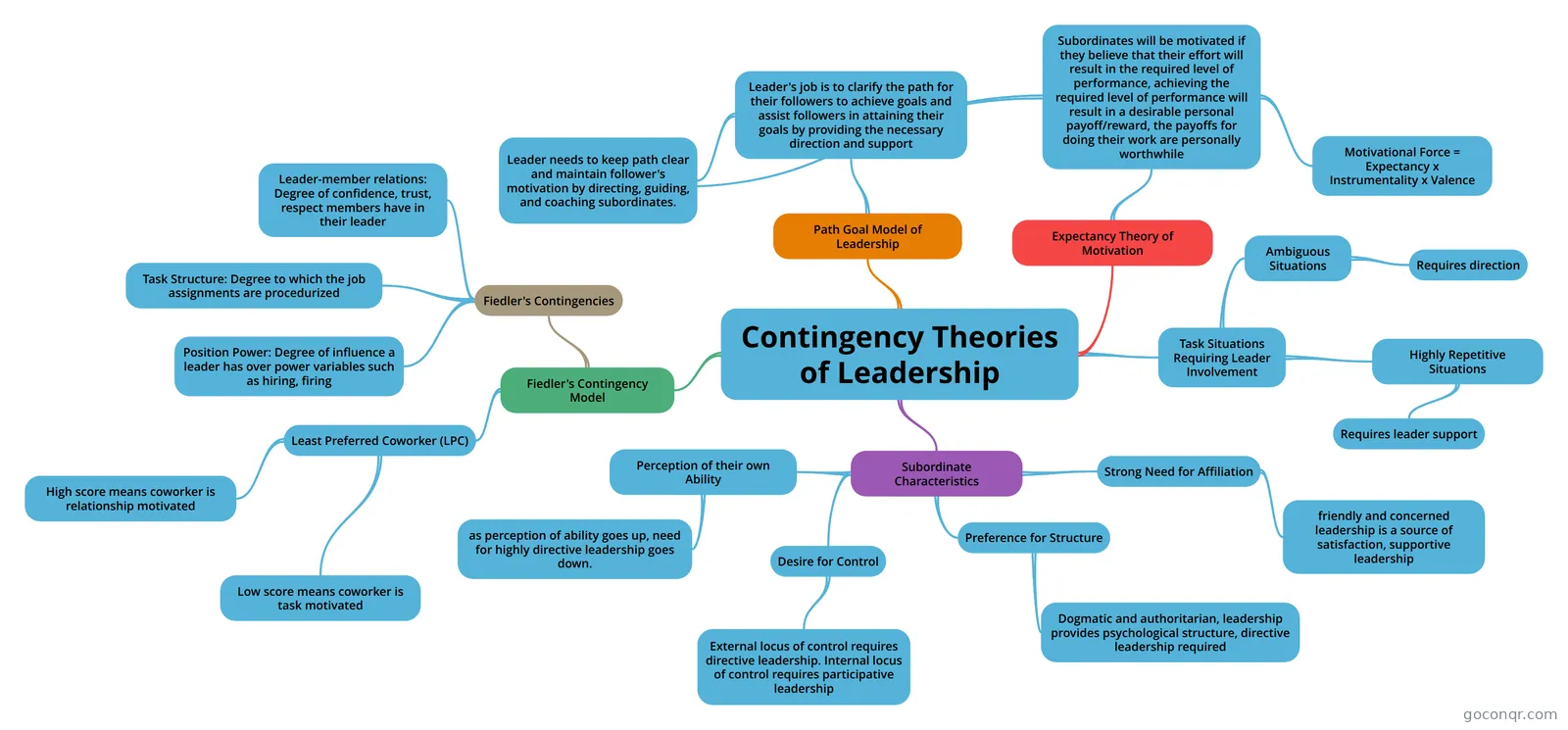
Mind map: Contingency theories of leadership
Map content
Contingency Theories of Leadership
Path Goal Model of Leadership
- Leader's job is to clarify the path for their followers to achieve goals and assist followers in attaining their goals by providing the necessary direction and support
- Leader needs to keep path clear and maintain follower's motivation by directing, guiding, and coaching subordinates.
- Leader's job is to clarify the path for their followers to achieve goals and assist followers in attaining their goals by providing the necessary direction and support
Expectancy Theory of Motivation
- Subordinates will be motivated if they believe that their effort will result in the required level of performance, achieving the required level of performance will result in a desirable personal payoff/reward, the payoffs for doing their work are personally worthwhile
- Motivational Force = Expectancy x Instrumentality x Valence
- Subordinates will be motivated if they believe that their effort will result in the required level of performance, achieving the required level of performance will result in a desirable personal payoff/reward, the payoffs for doing their work are personally worthwhile
Task Situations Requiring Leader Involvement
- Ambiguous Situations
- Requires direction
- Highly Repetitive Situations
- Requires leader support
- Ambiguous Situations
Subordinate Characteristics
- Strong Need for Affiliation
- friendly and concerned leadership is a source of satisfaction, supportive leadership
- Preference for Structure
- Dogmatic and authoritarian, leadership provides psychological structure, directive leadership required
- Desire for Control
- External locus of control requires directive leadership. Internal locus of control requires participative leadership
- Perception of their own Ability
- as perception of ability goes up, need for highly directive leadership goes down.
- Strong Need for Affiliation
Fiedler's Contingency Model
- Least Preferred Coworker (LPC)
- High score means coworker is relationship motivated
- Low score means coworker is task motivated
- Fiedler's Contingencies
- Leader-member relations: Degree of confidence, trust, respect members have in their leader
- Task Structure: Degree to which the job assignments are procedurized
- Position Power: Degree of influence a leader has over power variables such as hiring, firing
- Least Preferred Coworker (LPC)
Information
- Description
- Collaborative Leadership Mind Map on Contingency Theories of Leadership, created by mikerolph27 on 21/10/2014.
- Created by
- mikerolph27
- Views
- 225
- Rating