
Mapa mental
GENDER As
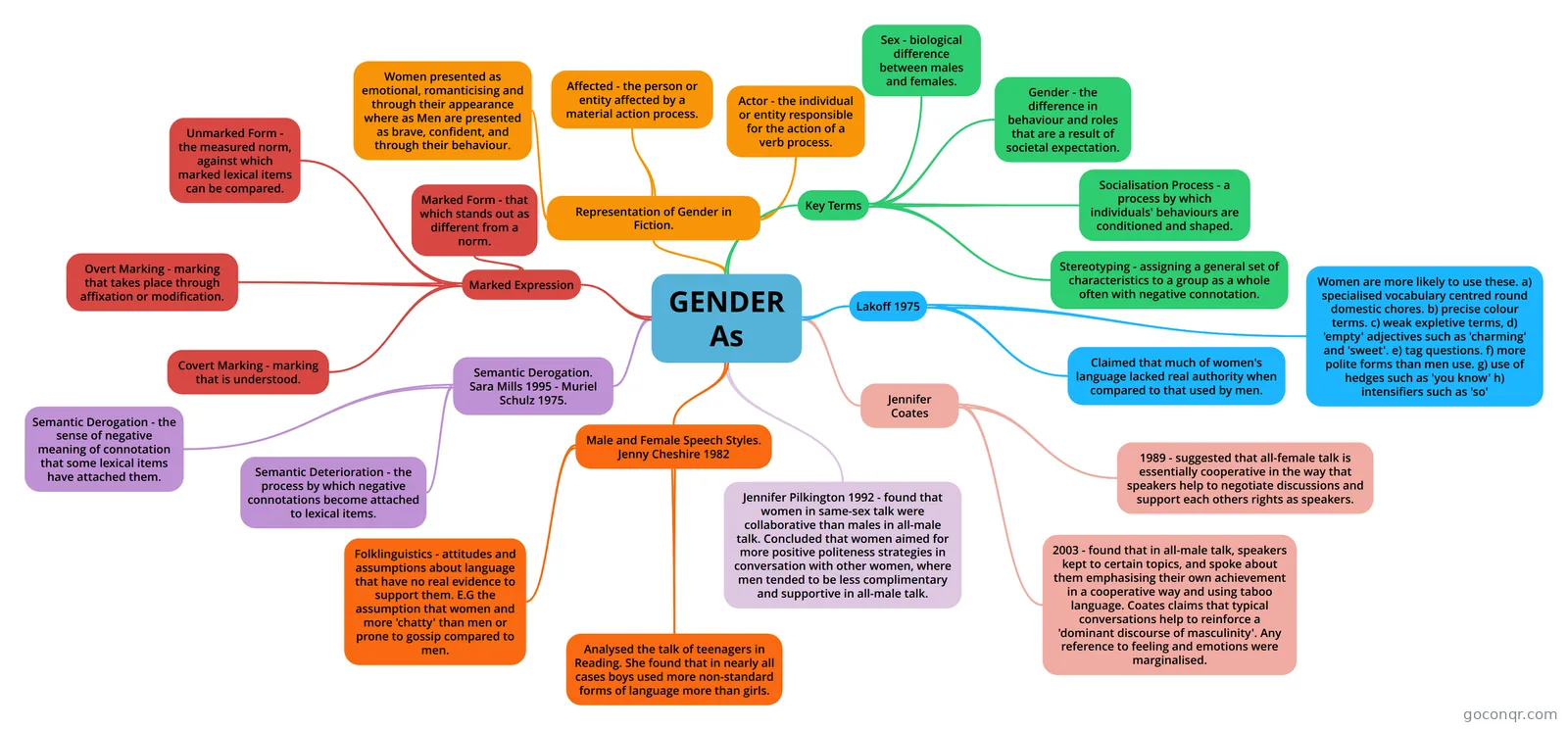
Mind map: Gender and language
Conteúdo do mapa
GENDER As
Key Terms
- Sex - biological difference between males and females.
- Gender - the difference in behaviour and roles that are a result of societal expectation.
- Socialisation Process - a process by which individuals' behaviours are conditioned and shaped.
- Stereotyping - assigning a general set of characteristics to a group as a whole often with negative connotation.
Representation of Gender in Fiction.
- Actor - the individual or entity responsible for the action of a verb process.
- Affected - the person or entity affected by a material action process.
- Women presented as emotional, romanticising and through their appearance where as Men are presented as brave, confident, and through their behaviour.
Marked Expression
- Marked Form - that which stands out as different from a norm.
- Unmarked Form - the measured norm, against which marked lexical items can be compared.
- Covert Marking - marking that is understood.
- Overt Marking - marking that takes place through affixation or modification.
Semantic Derogation. Sara Mills 1995 - Muriel Schulz 1975.
- Semantic Derogation - the sense of negative meaning of connotation that some lexical items have attached them.
- Semantic Deterioration - the process by which negative connotations become attached to lexical items.
Male and Female Speech Styles. Jenny Cheshire 1982
- Folklinguistics - attitudes and assumptions about language that have no real evidence to support them. E.G the assumption that women and more 'chatty' than men or prone to gossip compared to men.
- Analysed the talk of teenagers in Reading. She found that in nearly all cases boys used more non-standard forms of language more than girls.
Lakoff 1975
- Claimed that much of women's language lacked real authority when compared to that used by men.
- Women are more likely to use these. a) specialised vocabulary centred round domestic chores. b) precise colour terms. c) weak expletive terms, d) 'empty' adjectives such as 'charming' and 'sweet'. e) tag questions. f) more polite forms than men use. g) use of hedges such as 'you know' h) intensifiers such as 'so'
Jennifer Coates
- 1989 - suggested that all-female talk is essentially cooperative in the way that speakers help to negotiate discussions and support each others rights as speakers.
- 2003 - found that in all-male talk, speakers kept to certain topics, and spoke about them emphasising their own achievement in a cooperative way and using taboo language. Coates claims that typical conversations help to reinforce a 'dominant discourse of masculinity'. Any reference to feeling and emotions were marginalised.
Jennifer Pilkington 1992 - found that women in same-sex talk were collaborative than males in all-male talk. Concluded that women aimed for more positive politeness strategies in conversation with other women, where men tended to be less complimentary and supportive in all-male talk.
Informações
- Descrição
- Gender used for Section B of the paper.
- Criado por
- Becka
- Visualizações
- 18
- Avaliação