
Notas
Memory
Conteúdo das notas (2)
Página 1
Factors Affecting Eyewitness Testimony - Anxiety
Definition of Anxiety
state of emotional and physical arousal, it is a normal reaction to a stressful situation but can affect accuracy and detail of eyewitness testimony
it is unclear whether these effects have a positive or negative effect on recall
Negative effect
anxiety creates physiological arousal in the body which prevents us from paying attention to important cues - recall is worse
approach to studying eyewitness testimony and anxiety - look at the effect of weapons on the accuracy of recall of the witness
procedure
Johnson and Scott 1976
led researchers to believe that they were taking part in a lab study, while seated in the waiting room ptpts heard an argument in the next room
low anxiety condition - a man walked through waiting area with a pen and grease on his hands
high anxiety condition - argument accompanied by breaking glass and man was holding a paper knife covered in blood
findings
ptpts asked to pick out the man from a set of 50 photos
low anxiety condition - 49% able to identify him
high anxiety condition - 33% able to identify him
tunnel theory of memory argues that a witnesses attention narrows to focus on the weapon as its a source of anxiety
Positive effect
stress of witnessing a crime or accident creates anxiety through physiological arousal within the body
fight or flight response is triggered which increases alertness and improves memory for the event as we become more aware of the cues in the situation
procedure
Yuille and Cutshall 1986
study of real life shooting in a gunshop in Canada where the shop owner shot a thief dead
21 witnesses and 13 agreed to take part in the study
interviews held 4 - 5 months after the incident and were compared to original police interviews
accuracy determined by number of details reported in each account
witnesses asked to rate how stressed they had felt at the time using a 7 point scaleand asked if they had any emotional problems since the event
findings
witnesses accurate in their accounts and there was little change in amount of accuracy after 5 months - some details were less accurate such as age/height/weight estimates
ptpts who recorded highest levels of stress most accurate - 88% compared to 75% for less stressed group
Explaining contradictory findings
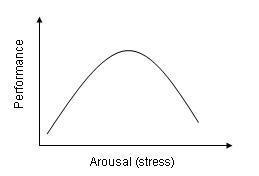
Yerkes and Dodson 1908 - relationship between emotional arousal and performance is like an inverted U
Deffenbacher 1983 applied Yerkes-Dodson Law to eyewitness testimony
lower levels of anxiety produce lower levels of recall accuracy but memory becomes more accurate as the level of anxiety experienced increases however there comes a point where the optimal level of anxiety is reached (this is the point of maximum accuracy) after this point recall drastically declines
Evaluation
Weapon focus effect may not be relevant
Johnson and Scott's study on weapon focus may test surprise rather than anxiety
participants may have focused on the weapon as they are surprised at what they saw
Pickel 1998 - experiment using scissors, handgun, wallet and raw chicken as the handheld items in a hairdressing salon video (scissors would be low anxiety and unusualness), eyewitness accuracy was significantly poorer in high unusualness conditions (chicken and handgun)
suggests that weapon focus effect is due to unusualness rather than anxiety and so tells us nothing specific about the effects of anxiety of EWT
Field studies lack control
researchers interview reallife eyewitnesses sometime after the event, all sorts of things would have happened to the participants in the meantime which researchers have no control over- discussions about the event, accounts that they have read or seen in the media, effects of being interviewed by the police etc.
possible that these extraneous variables may be responsible for accuracy of recall
the effects of anxiety may be overwhelmed by other factors and impossible to assess by the time the participants are interviewed
Ethical issues
creating anxiety in participants is risky and it's unethical as it may subject people to psychological harm purely for the purpose of research, real-life studies are beneficial as there is no need to create an event that provokes anxiety
this issue doesn't challenge the findings from studies such as Johnson and Scott but it does question the need for such research, one reason is to compare findings with the less controlled field studies
Inverted U explanation too simplistic
anxiety difficult to define and measure accurately as it has many elements cognitive, emotional, behavioural and physical but in the inverted U explanation only one of these is linked to poor performance - physiological arousal
Demand characteristics operate in lab studies of anxiety
most lab studies show ptpts a filmed crime and most are aware that they are watching a filmed crime for a reason to do with the study so most will work out that they will be asked questions on what they have seen
Página 2
Improving the Accuracy of Eyewitness Testimony - Cognitive Interview
Define cognitive interview
method of interviewing eyewitnesses to help them retrieve more accurate memories
Fisher and Geiselman 1992 argued that eyewitness testimony could be improved if police used better techniques when interviewing witnesses, they recommend that such techniques should be based on psychological insights into how memory works and called these techniques cognitive interviews (foundation in cognitive psychology)
4 main techniques used
report everything - witnesses encouraged to include every detail of the event, seemingly trivial details may be important or trigger other important memories
reinstate the context - witness returns to the original crime scene in their mind and imagen the environment and their emotions, context-dependent forgetting
reverse the order - events recalled in a different order to the original sequence as this prevents people reporting their expectations of how the event must have happened rather than the actual events, prevent dishonesty - harder to produce an untruthful account if its reversed
change perspective - witnesses recall the event from another's perspective to disrupt effect of expectations and schema on recall, the schema you have for a particular setting generates expectations of what would have happened and its the schema that is recalled rather than what actually happened
Enhanced cognitive interview
Fisher et al 1987 developed some additional elements of the cognitive interview to focus on social dynamics of the interaction e.g. eye contact
enhanced cognitive interview also includes ideas such as reducing eyewitness anxiety, minimising distractions, getting witnesses to speak slowly and asking open-ended questions
Evaluation
Time consuming
Some elements may be more valuable than others
Support for the effectiveness of ECI
Informações
- Descrição
- A level Psychology Notas sobre Memory, criado por Mol's Pears em 02-06-2018.
- Criado por
- Mol's Pears · jun 2018
- Atualizado
- 3 jun 2018
- Visualizações
- 1
- Tags
- Avaliação