
Flashcards
BMS09-1015 -Bone Cells, Cartilage and Function
Flashcards do conjunto (30)
- 1What is bone?Hard, rigid, calcified connective tissue
It is living and constantly remodelling - 2What are the functions of bone? (6)1. Reservoir for calcium/phosphate ions
2. Provide support/attachment for muscles
3. Forms blood cells (hemopoiesis) in bone marrow
4. Provides protection of internal organs
5. High tensile strength/mechanical loading
6. Slight elasticity to respond to stress - 3What are the 4 types of bone by shape on the human body, and what are some examples?1. Long bone with epiphysis, metaphysis, diaphysis
eg. Femur/humerus
2. Flat bones eg. skull
3. Short bones eg. wrist/ankle
4. Irregular bone eg. maxilla/pelvis - 4Bone is ...% organic matrix and ...% inorganic mineral What is each composed of?25%
75%
Organic: 95% TYPE 1 collagen
5% noncollagenous protein, GAGs
Inorganic: Hydroxyapatite - 5What cells are precursors to osteoblasts and make up the periosteum? What do they arise from?Osteoprogenitor cells
Mesenchymal Stem cells - 6Which cells line bone, synthesise osteoids, and secretes phosphatase for mineralisation?Osteoblasts
- 7What is an osteoid?Unmineralised bone consisting mainly of collagen
- 8What are osteoblasts joined by?Gap junctions
- 9When osteoblasts get trapped in matrix, what do they diffrentiate into? What are they embedded in?Osteocytes
Lacunae - 10What are osteoclasts connected by? What is their function?1. Connected by canaliculi and gap junctions
2. Function is to communicate/maintain bone matrix - 11What are lining cells formed by? Where are they located in the periosteum? What do they do?Osteoblasts that do not get trapped in lacunae
In the cellular layer of the periosteum
Can be reactivated to produce bone when needed - 12What are osteoclasts? What is their lineage? How many nuclei do they have? How do they make Howship's Lacunae?Bone cells that reabsorb/recycle matrix
Haematopoietic stem cells (same as macrophages)
Multinucleated
They secrete HCl to degrade hydroxyapatite - 13Which cartilage has perichondrium and which doesn't?Hyaline cartilage has perichondrium
Articular cartilage does not - 14Where is the perichondrium found? What is it made of? What are the two layers?1. At the perimeter of the elastic and hyaline cartilage
2. Made of chondroblasts, chondroblasts stem cells, fibroblasts, and blood vessels
3. Outer fibrous layer (fibroblasts/nerves) and inner cambium cellular layer (osteoprogenitor+osteoblasts) - 15What type of collagen do chondroblasts secrete? What do chondroblasts become?Type II collagen, which is what ECM is made of
Become chondrocytes when they are embedded in lacunae in matrix - 16Where are chondrocytes found? What do they do?Embedded in hyaline cartilage
Synthesis matrix - 17Which cells produce type 1 collagen (bone)?Osteoblasts, fibroblasts, mesenchymal stem cells
- 18Which cells produce type 2 collagen (cartilage)?chondroblasts and chondrocytes
- 19Bone or cartilage? 1. Deformable, semi-rigid 2. Not permeable 3. mainly collagen 1 4. appositional growth AND interstitial 5. No vascularisation1. Cartilage
2. Bone
3. Bone
4. Cartilage
5. Cartilage - 20What is woven bone? Regular or irregular collagen fibers? High or low cellular content? Found where?Immature bone
Has irregular collagen fibers
Found in fracture healing, first cycle of bone remodelling - 21What is lamellar bone? Regular or irregular collagen fibers? High or low cellular content? What are the two types?1. Mature bone
2. Regular straight collagen fibers
3. Low cellular content, heavily calcified
4. Cortical and Trabecular bone - 22What type of lamellar bone is hard, forms the outer layer of bone, and contains osteons?Cortical (compact) bone
- 23What type of lamellar bone is spongy, forms the inner of bone, and doesn't contain osteons?Trabecular (spongy) bone
- 24What is the endosteum?It coats the inner layer of compact, while lining the outside of trabecular bone
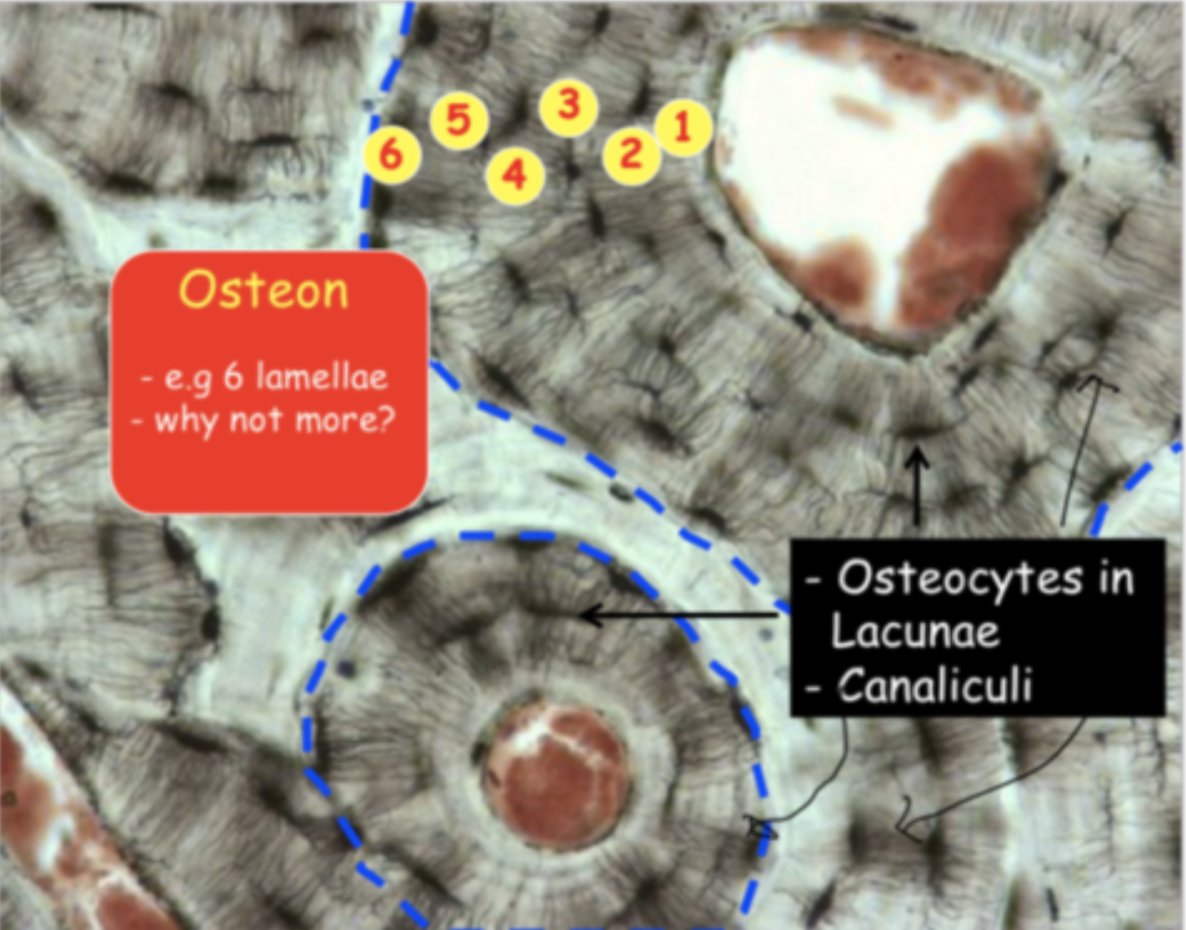
- 25What are lamellae? Are they present in trabecular bone, compact bone, or both?Layers of bone with collagen fibers running in different directions
Present in both, however only as osteons in compact bone - 26What are Haversian systems/Osteons? What bones are they found in? How do they communicate?1. CIrcle of lamellae around blood vessels/nerves
2. Cortical bone
3. Via osteocytes - 27What are the three types of lamallae?1. circumferential around outside
2. Concentric around vascular channels (osteon)
3. Interstitial between osteons - 28What is the purpose of Haversian Canals? What bone are they located in and what direction do they run?Nutrient channels
Located in cortical bone, run in direction of long axis - 29What is the purpose of Volkman's Canals? What bone are they located in and what direction do they run?1. Connect Haversian Canals with each other
2. Located in cortical bone
3. Run at right/oblique angles - 30Label the osteocytes in the osteon
Informações
- Descrição
- Define the main anatomical and structural features of a typical long bone. List all the types of each cell type normally found in bone and know their function. Understand the differences between woven and lamellar bone. Define lamellae and understand the different ways they are organised in bone. Understand the anatomy and function of osteons/Haversian systems. List the differences between bone and cartilage matrix.
- Criado por
- Evian Chai
- Visualizações
- 59
- Tags
- Avaliação