
Technology and war
Slides in this set (9)
-
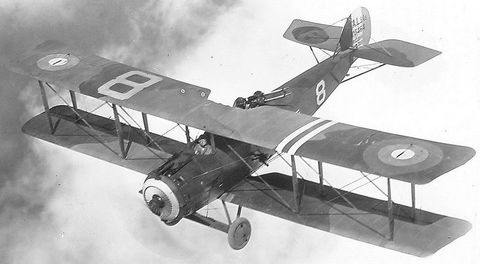
- Caption: Salmson 2 WWI recon aircraft
- The airplane, like many military innovations, was not immediately recognised by commanders as having any military potential beyond reconnaissance.
- The perhaps was understandable given that early model airplanes were little more than lacquered canvas stretched across a wooden frame with a seat, engine and fuel tank.
- The same with any other completely new technology, advancements came quickly, with new models being churned out in a matter of weeks in some instances.
- Aircrafts were very soon armed and fighting for domination of the sky, which meant hindering the reconnaissance of your enemy, sighting for more accurate artillery fire and eventually supporting the movement if ground troops with aerial fire.
-
- Types of aircrafts
- Fighters: Designed for air-to-air combat, manoeuvrability and firepower were the key factors in a successful fighter. Innovations included the interrupter gear, allowing machine guns to be fired forward through the propeller and triplanes e.g. the Fokker which, though more difficult to fly, were far more manoeuvrable than two-winged planes. Fighters were used to harass enemy reconnaissance airplanes and balloons and later provide fire support for the infantry while protecting their own bombing aircraft.
- Bombers: Fewer models of bomber aircraft were produced, but these were constantly improved upon, namely their range and the weight of bombs they could carry. Strategic bombing, whether by airplane or Zeppelins, targeted railroads and eventually factories in the enemy's rear from 1915.
- Airships: Germany's Zeppelins flew too high for most fighter planes and as such could attack British cities at will early in the war. By 1916 better airplanes armed with incendiary ammunition curtailed the effectiveness of Germany's Zeppelin fleet.
-
- Gas used in the First World War was generally of three types:
- tearing agents
- asphyxiants
- blistering agents
- The first gas to be used was deployed by Germany on the Eastern Front. It was a tearing agent and although it briefly incapacitated the Russians, it was generally ineffective.
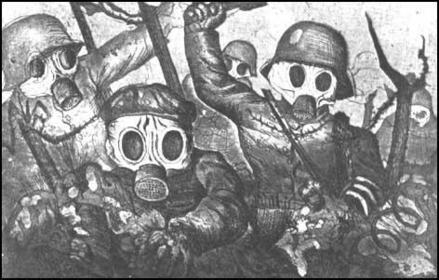
- Caption: Otto Dix, A German Gas Attack (1924)
-
- Chlorine was the first common gas used by both sides. It was greenish in colour and caused irritation to the eyes and corruption to the lungs.
- Phosgene was a deadlier variant of chlorine that was hard to detect. It was often mixed with chlorine, combining the controllability of chlorine with the lethality of phosgene.
- Mustard gas was the most common blistering agent. On contact with the skin, especially moist areas such as the armpits and the groin, it would cause severe burns. If inhaled it would burn away the lining of the lungs. Death would often come some day or even weeks after inhalation. Mustard gas was heavier than air and would rest in the low areas if shell holes for days, impeding an enemy's movements on the battlefield.
- More than one million casualties were caused by gas during the war.
-
Technology and war: Communications
- Directing the movement of groups of soldiers in as close to real time as possible has always been both the key to victory on the battlefield and a considerable challenge. When armies and formations were relatively small, runners or riders could carry commands verbally, the speed of communication limited only by the speed of the carrier and the distance travelled.
- As armies and battlefields grew in size and complexity, sound or visuals were used. The amount of smoke and noise produced in a Napoleonic or American Civil War battle, however, made such advances impractical once a large engagement commenced. The telephone held some promise, but was dependant on stable wires.
- The massive armies and immense battlefields of the First World War brought all these issues into sharp relief. Generals were often miles to the rear of front that stretched for miles - the Germans attacked along 13 kilometres of front at Verdun. The Somme front on 1 July 1916 was twice as long.
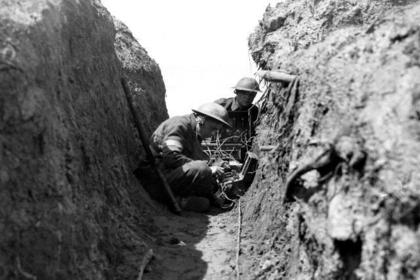
- Caption: Signals troops using a field set in a trench
-
Technology and war: Communications
- Timely information to a Brigadier General about the progress of his men could take hours and therefore the tactical situation could be, and often was, entirely different by the time new orders reached those who had to carry them out.
- Telephone wires were generally cut within the first minutes of a battle. Wireless sets were huge and unreliable, not to mention easily intercepted by the enemy. And so tactical communication in this modern war reverted to methods used for hundreds of years in some cases.
- Trench runners: All armies employed soldiers whose sole responsibility was to coney messages through the labyrinthine trench system. This was very dangerous work and required a good knowledge of the trench system, a system that could change regularly.
- Flags: Semaphore flags were used by all services. Competent signalers could spend up to 12 words a minute if visibility was uninterrupted, which was a complication by the very nature of trench warfare.
- Heliographs and lamps: Heliographs communicated Morse code by concentrating sunlight, making them useless at night. Paraffin and later battery operated lamps overcame this limitation, but were still limited by line of sight.
- Carrier pigeons: Pigeons were a remarkably reliable communication method during the war. The British had some 22,000 pigeons in service at any one time during the war and by the end had used some 100,000. Only about 2% of those released failed to return.
-
Technology and war: Machine guns
- The quintessential weapon of the industrial age, the machine gun was to mass killing as the assembly line was to mass production. Many had attempted to develop an automatically repeating weapon in the 19th century, but it was an American - Hiram Maxim - who designed a weapon that could fire up to 600 rounds a minute powered by the gas discharge from those same rounds.
- By the outbreak of hostilities in 1914 all modern armies had versions of Maxim's innovation. These were large weapons, which required a crew of four to six men to operate. Jamming and overheating were constant problems in the trying environment of trench warfare. Nevertheless, by the end of the war they could fire 1,200 rounds/min and were ranges of up to 1,000 meters. Smaller, more portable machine guns were developed such as the Lewis gun or small Vickers machine guns. These could be mounted on aircraft and carried forward in infantry assaults.
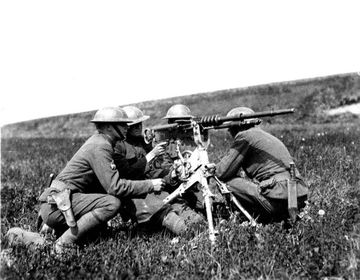
- Caption: U.S. Army soldiers operating the M1914 Hotchkiss gun in France, 1918.
-
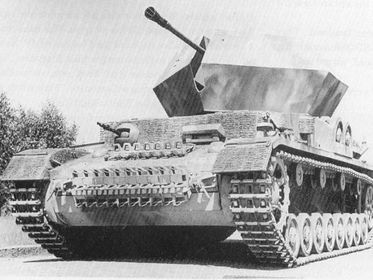
- Caption: Flakpanzer, "east wind '' with its 3.7cm Flak 43
- A vehicle that could withstand withering machine gun fire and traverse the moonscape that was no man's land could theoretically lead to the breakthrough of which both sides dreamt. On paper the tank seemed to deliver exactly this.
Information
- Description
- Aircraft, gas, communications, machine guns, tanks, submarines.
- Created by
- Zoe Wilson
- Views
- 5
- Rating