
Working Memory Model (WMM)
Slides in this set (6)
-
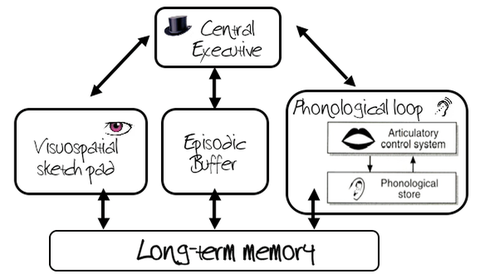
- Proposed by Baddeley & Hitch in 1974
- A representation of STM (challenges Atkinson & Shiffren's idea that STM is a unitary store)
-

- 'The boss'
- Monitors incoming data, makes decisions and allocates slave systems to tasks
- Limited processing capacity
- Modality free
- Involved in higher mental processes e.g. decision-making
- Most important component but the least understood
-
- Processes visual and spatial information in a mental space, inner eye
- E.g. allows us to visualise something we need
- Limited capacity - Baddeley in 2003 said it was 3/4 objects
- Logie in 1995 subdivided VSS into visual cache and inner scribe
- Visual Cache:
- Stores visual data
- Inner Scribe:
- Records the arrangement of objects in the visual field
-
- Caption: Helps to remember!
- Added in 2000 by Baddeley
- Temporary store for information
- Pieces information together from other stores
- Links working memory to LTM and wider cognitive processes e.g. perception
-
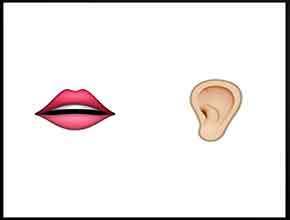
- Deals with auditory information (i.e. coding is acoustic) and preserves the order in which the information arrives
- It's subdivided into the phonological store (inner ear) and articulatory loop (inner voice)
- Phonological Store:
- Stores the words we hear
- Articulatory loop:
- Allows maintenance rehearsal (repeating sounds to keep them in working memory while they're needed). Limited capacity and limited duration of 2 seconds
-
- Strengths:
- Clinical evidence; KF case study - suffered brain damage which led to poor STM ability for verbal information but could still process visual information - suggests phonological loop had been damaged but other areas of memory were intact
- Dual-task studies; supports existence of visuo-spatial sketchpad - Baddeley et al in 1975 - participants had difficulty doing 2 visual tasks at the same time
- Outlines STM in more detail - it has the potential to answer more questions about how STM works and it can stimulate further research
- Weaknesses:
- Only focusses on STM
- Insufficient evidence of the central executive which is seen as the most important component - not a physical component and it's difficult to test
Information
- Description
- AS - Level Psychology (Memory) Slide Set on Working Memory Model (WMM), created by Amy Dean on 08/04/2016.
- Created by
- Amy Dean · Apr 2016
- Updated
- May 17, 2016
- Views
- 2
- Rating