
Biopsychology
Slides in this set (10)
-
- The Nervous System
- ·
- Specialized
- Network of Cells.
- ·
- Primary
- internal communication system.
- ·
- Two
- sub-systems:
- 1.
- Central Nervous System
- 2.
- Peripheral Nervous System
- Central Nervous System
- · Brain and Spinal Cord.
- · Brain is center of all conscious awareness.
- · Brain’s outer layer, cerebral cortex = highly developed.
- · Spinal cord responsible for reflex actions.
- · Passes messages to and from brain, connects nerves to PNS.
- Peripheral Nervous System
- · Transmits messages via neurons to and from CNS.
- · Sub-divided into:
- 1. Autonomic Nervous System - Governs vital functions i.e. breathing, heart rate, digestion, sexual arousal, stress response.
- 2. Somatic Nervous System – Controls muscle movement, receives info from sensory receptors.
-
- The Endocrine System
- ·
- Controls
- vital functions in the body.
- ·
- Instructs
- glands to release hormones.
- Gland
- ·
- An
- organ in the body that synthesizes substances such as hormones.
- ·
- Pituitary
- is Master Gland, controls release of hormones from all other endocrine glands.
- Hormones
- ·
- Chemical
- substances that circulate in the bloodstream.
- ·
- Only
- affect target organs. Very powerful effects.
- Fight of Flight
- ·
- The
- way an animal responds when stressed.
- ·
- Body
- becomes physiologically aroused, ready to fight or flee. (Sympathetic state)
- ·
- Adrenaline
- is released by adrenal gland.
-
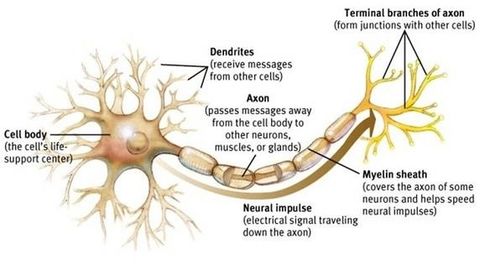
Structure and Function of Neurons
- Types of Neuron:
- Motor neurons, Sensory neurons
- and Relay
- Neurons.
- Synaptic Transmission: Neighbouring neurons
- communicate with each other by sending chemical messages across the gap that
- separates them.
- Neurotransmitter: Chemicals that diffuse across the synapse to the next neuron in the chain.
- Once there, it is taken up by the postsynaptic receptor sites (dendrites of the next neuron). The chemical message is converted back into an electrical impulse and the process begins again.
- Several neurotransmitters have been identified in brain. Each has its own molecular structure with specialist functions.
- Excitation and inhibition: Neurotransmitters have either an excitatory or inhibitory effect on the neighbouring neuron.
- Caption: Structure of a Neuron
-
Localisation of Function in the Brain.
- AO1
- Localisation vs Holistic theory:
- Are brain functions in specific areas or across the whole brain.
- Hemispheres of the brain and the cerebral cortex:
- Each hemisphere controls the opposite side of the body.
- Motor, somatosensory, visual and auditory centres:
- Each of the four lobes of the brain (frontal, parietal, occipatal and temporal lobes) is linked to different functions.
- Language center in the brain:
- Broca's related to production, Wernicke's related to understanding.
- Broca's area and Wernicke's area are in the left hemisphere in most people.
- AO3
- Brain scan evidence of localisation:
- Peterson et al. showed Broca and Wernicke's areas active.
- Neurosurgical evidence:
- Dougherty et al.: one third of OCD patients responded to cingulotomy, supports localisation.
- Case Study Evidence:
- Phineas Gage: Personality change.
- Lashley's Research:
- Rats' maze learning unaffected by removal of cortical material.
- Plasticity:
- The law of equipotentiality (Lashley)
-
- AO1
- Brain Plasticity:
- Research suggests that neural connections can change or new connections can be formed.
- Research into Plasticity:
- Maguire et al.: Hippocampus in taxi drivers changes structure after learning the knowledge.
- Draganski et al.: Changes in the hippocampus and the parietal cortex before and after exams.
- Functional recovery of the brain after trauma:
- Healthy brain areas take over functions of damaged areas.
- What happens in the brain during recovery:
- Axonal Sprouting
- Reforming of blood vessels
- Recruitment of homologous brain areas.
- AO3
- Practical Application:
- Neurorehabilitation required to maintain improvement because spontaneous recovery slows down.
- Negative Plasticity:
- Drug use may cause neural changes (Medina et al.).
- Phantom limb syndrome due to reorganization in somatosensory cortex.
- Age and Plasticity:
- Plasticity reduces with age, though Bezzola et al. showed how golf training caused neural changes in over 40s.
- Support from Animal Studies:
- Hubel and Wiesel: Pioneering research into kittens' cortical response, caused permanent damage.
-
- AO1
- Hemispheric Lateralisation:
- Left hemipshere has different functions (e.g. language)
- Split-brain Studies:
- Corpus callosum cut to prevent electrical signals crossing between hemispheres.
- Procedure:
- Images presented to one hemisphere at a time.
- Key Findings:
- Can't describe an object in left visual field.
- Can recognise with left hand.
- Composite words: Write 'key' with left hand, say 'ring'.
- Right hemisphere better at recognising faces.
- AO3
- Demonstrated lateralised brain functions:
- The left hemisphere analyses, the right hemisphere synthesises.
- Strengths of the Methodology:
- Standardised and controlled procedures to control input into each hemisphere.
- Theoretical Basis:
- Puvetti: Two minds=duality in the brain. In reality it is an integrated system.
- Issues with Generalisation:
- Small unrepresentative sample, with not control group.
- Differences in function may be overstated:
- Distinction between hemispheres is messier than the research suggests.
-
Ways of Investigating the Brain
- AO1
- FMRI:
- Detects changes in blood flow to show active areas.
- EEG:
- Measures brainwave patterns via electrodes.
- ERP:
- Types of brainwave triggered by particular events that can be extracted from EEG recordings.
- Post Mortems:
- Deficits during life correlated with brain damage after death.
- AO3
- FMRI:
- + Risk free and high spatial resolution
- - Poor temporal resolution
- EEG:
- + Good for diagnosing illness, and high temporal resolution.
- - Overly general.
- ERP:
- + Precise measurement of cognitive functions.
- - Lack of standardised method.
- Post Mortem:
- + Early Pioneering research.
- - Causation an issue, consent is difficult.
-
- AO1:
- Biological Rhythms:
- Controlled by internal body clocks (endogenous pacemakers) and external cues (exogenous zeitgebers)
- The Sleep/Wake Cycle:
- Determines sleepiness, but does free-running cycle continue in the absence of daylight.
- Siffre's Cave Study:
- His free-running rhythm extended slightly to 25 hours when deprived of daylight.
- Other Research:
- Studies by Achoff and Wever (bunker) and Folkard et al. (cave) showed longer and shorter rhythms.
- Core Body Temperature:
- Associated with improved variations in cognitive performance.
- AO3:
- Practical Application to Shift Work:
- Mistakes made when rhythms desynchronised (Boivin et al.) and poor health (Knutsson).
- Practical Application:
- Pharmacokinetics applies understanding of circadian rhythms to improve drug effectiveness.
- Use of Case studies and Small Samples:
- Lack generalisability, e.g. Siffre was over 60 and small samples.
- Poor Control in Studies:
- Dim artificial light may have reset the body clock (Czeisler et al.).
- Individual Differences:
- Sleep cycles vary between 13 and 65 hours in some cases (Czeisler et al.) and larks/owls (Duffy et al.).
-
Infradian and Ultradian Rhythms
- AO1:
- The Menstrual Cycle:
- Oestrogen regulates ovulation, progesterone readies body for pregnancy (endogenous factors).
- Research Study:
- Stern and McClintock: Evidence that menstrual cycles may synchronise through pheromones (exogenous factors).
- Seasonal Affective Disorder:
- Form of depression triggered in the winter months and regulated by melatonin, a circannual rhythm.
- Ultradian Rhythms - Stages of Sleep:
- Stages 1+2: Alpha and theta waves.
- Stages 3 + 4: Deep sleep, delta waves.
- Stage 5: REM Sleep.
- AO3:
- Evolutionary Basis of the Menstrual Cycle:
- Synchronisation may have an adaptive function because newborns cared for collectively. However, this would also produce competition for the fittest males.
- Methodological Issues in Synchronisation Studies:
- Many confounding factors not controlled, e.g. stress, diet. Small samples.
- Evidence supports the idea of distinct stages in sleep:
- Deement and Kleitman (1957) using EEG's showed how REM (dream) sleep is an important part of the sleep cycle.
- Animal Studies:
- Role of pheromones in human behaviour is unclear.
- Practical Application:
- Phototherapy for SAD, effective in 60% (Eastman et al.).
-
- AO1:
- Exogenous Zeitgebers and the Sleep/Wake Cycle:
- Entrain free-running rhythms.
- Light:
- Campbell and Murphy - shone light pad on back of knees.
- Social Cues:
- Babies' rhythms are entrained by bedtimes and mealtimes.
- Exogenous Pacemakers and the Sleep/Wake Cycle:
- The SCN:
- Receives info about light directly.
- Animal Studies and the SCN:
- DeCoursey et al.: Sleep-wake cycle disappeared when SCN destroyed.
- Ralph et al.: Mutant hampsters with 20-hour sleep cycle.
- AO3:
- Beyond the Master Clock:
- Peripheral oscillators are found in many areas of the body. Damiola et al. showed how these can act independently of the SCN.
- Ethics in Animal Studies:
- DeCoursey et al. study harmed animals, is this ethically justifiable.
- Influence of Zeitgebers May be Overstated:
- Zeitgebers may have little bearing on our internal rhythm, e.g. blind man (Miles et al.).
- Methodological Issues in Studies:
- Light pad study findings not replicated and isolating one zeitgeber may be unrealistic.
Information
- Description
- A2 Psychology Slide Set on Biopsychology, created by Tom Cooper on 15/11/2016.
- Created by
- Tom Cooper
- Views
- 6
- Rating