
Flashcards
unit 3
Cards in this deck (99)
- 13.1 The Business Strategy: Concept and ComponentsStrategy
- 2What is strategy?It is the path that the company decides to follow in order to be shifted from its current position to the desired position
- 3What is Strategy according: Mintzberg, Quinn and VoyerIt is the plan integrating the main goals and policies of an organization and establishes the coherent sequence of the actions
to be carried out - 4What is Strategy according: Jhonson and ScholesThe direction and scope of a long-term organization deploying its resources in the changing environment to meet the needs of the market and meet the expectations of the owners
- 5What is Strategy according: AnsoffThe strategy is the dialectic with its environment
- 6What is Strategy according: Robbins & Coulter (2018)The plan/s for how the organization will do
whatever is in business to do, how it will compete successfully, and how it will attract and satisfy its costumers in order to achieve its goals - 7Basic ideas of the strategy Permanent relationship between the company and its environment
It is the answer to the managers’ expectations, which are specified in the definition of the mission and long-term objectives
Decision model that establishes policies, short-term objectives, actions and the adaptation of means/ resources
System that can solve the strategic problems of the company, or combination of threats and opportunities of the environment with strengths and weaknesses of the organization - 8Strategy Components- Activity scope
- Distinctive capabilities
- Competitive advantage
- Synergistic effect - 9- Activity scopeSet of products and markets that constitute
the economic activity in which the company competes or wants to compete - 10- Distinctive capabilitiesCurrent and future set of resources
(physical, technical, financial and human)
and skills (technological, organizational,
managerial, human) that the company
possesses, and its level of development - 11- Competitive advantageUnique features of the company completely different from current and future competition allowing it to defend its competitive position in the long term (either by cost or by differentiation)
- 12- Synergistic effectSearch and exploitation of interrelations
between different activities, resources, abilities, organizational units, etc. of the company to get:
“The whole is greater than the sum
of the parts" - 133.2 Strategic ManagementThe strategic management is a way to plan, organize, lead and control the strategic problems of the company and is part of the businesses’ management aiming at formulating the strategy and
putting it into practice to get ahead and be adapted to the environment - 140. Situation AnalysisThe situation analysis phase of the strategic management model involves evaluating the current environment
- 151. Strategy FormulationThe stage of strategy formulation takes into account the firm's objectives and the
situation analysis.
Strategies are created to achieve the firm's objectives given the environmental
situation - 162. Strategy ImplementationThe application stage of the strategic management model involves the actual
implementation of the strategies - 173. Strategy EvaluationThe control stage is the final step in the strategic management model. The
purpose of this stage is to make adaptations to the strategy after the
implementation - 183.3. Strategic analysis: external and internal scopeDetermine:
- Mission
- Vision
- Objectives - 19- Mission Serving as a guide in decision making
Making the entire team understand the objectives that the company tries to achieve (in-house)
Contributing to create an atmosphere of trust, explaining the economic and social role that the company has in society (externally). - 20- Vission Realistic: It must be considered from the proper consideration and interpretation of reality.
To have a purpose beyond the business benefit.
Its design depends on the type of company.
It can be proposed with a long-term or indefinite horizon - 21- ObjectivesWhat the company commits doing during a certain term with specific results
- 22External EnvironmentEverything outside the limits of the company, it is “strange” to the company.
Set of external elements to the organization, relevant to its performance
and that affect their results.
These are elements that the company cannot control but on which
it will try to influence - 23*Variables in the external environment- Opportunities
- Threats - 24+ Types of environment- General environment
- Specific environment - 25- General EnvironmentSocio-economic system that surrounds the
company.
- political context
- economic context
- ecological context
- sociocultural context
- legal context - 26-- Analysis of the general environment The environment undergoes constant changes. These changes represent a challenge for companies.
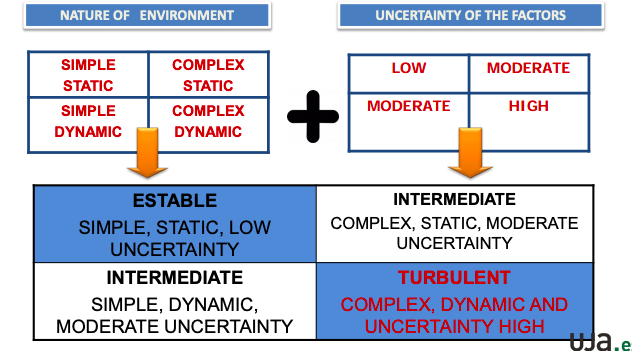
It is necessary to have some tools allowing companies to know the level of uncertainty of the environment, its
causes and its effects - 27-- Analysis of the general environment Strategic ProfileThat is, we have to identify which are the most relevant variables for the company, given that the environment is complex and
dynamic - 28-- Approaches for the Strategic profileGEOGRAPHICAL CRITERION (Three levels)
o Worldwide/global
o Economic Area
o Country (region or locality)
TYPES OF VARIABLES: PESTEL ANALYSIS - 29Types of variables: Pestel AnalysisWe identify the types of variables:
- political
- economic
- sociocultural
- technological
- ecological
- legal context - 30Types of variables: Pestel AnalysisOnce we have defined the variables to be considered in the analysis of the environment, we proceed to the elaboration of the strategic profile
In this profile, each behavior of the key factors is evaluated as follows (5-points Likert scale) - 31-- Analysis of the general environment Method of StagesIt is about identifying the most relevant factors for the company, proposing hypotheses regarding its impact and
evolution and establishing different strategies - 32- Specific EnvironmentThe specific environment is defined as the factors that uniquely affect a group
of companies with similar characteristics - 33-- Analysis of the specific environmentThe purpose of analyzing the competitive environment is to help the company decide on the most favorable location in its environment
Model of the 5 competitive forces of Porter (1980): This model indicates that the
degree of attractiveness of an industry is determined by the action of five basic
competitive forces, which together, define
the possibility of obtaining higher
incomes - 34+ Uncertainty
- 35+ Model of the 5 competitive forces of Porter (1980)
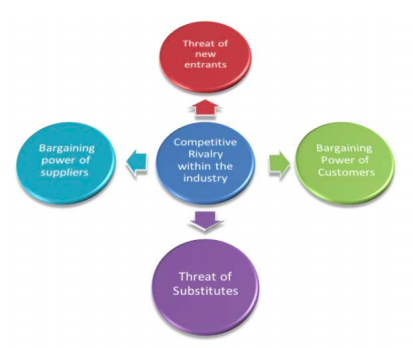
- 361. Competitive rivalry within the industryCompanies with similar
technology to cover same
needs in the same market - 371. Competitive rivalry within the industry Number of Competitors: A greater number of companies greater rivalry
Growth rate: A lesser growth rate, higher rivalry for attracting customers
Sector costs structure: the higher the fixed costs, the greater the rivalry is
and the lower the potential benefits
Product differentiation: the greater the differentiation, the lesser the rivalry level and the greater the potential benefits
Exit barriers: The greater exit barriers, the greater rivalry, and lower potential benefits - 382. Threat of new entrantsCompanies that want or are
willing to become competitors - 39*Entry BarriersAre those factors that make it difficult for
a company to access for the first time in
a sector, since they place it in a disadvantageous position with respect to
the companies that already operate in it - 40→ Scale economicsIt is defined as the decreasing relation
between the average cost of production
and the quantity produced in a given
period - 41→ Absolute costs advantages- Know-how and patents
- Experience effect
- Limited offer of productive factors - 42→ Product differentiationCompanies that are operating in an industrial sector have a
“name (reputation)" established in the market that identifies them,
differentiates them, making the consumers become loyal to the
firm/products - 43→ Access to distribution channelsa. Convincing the current distribution channels to accept their products
b. Create its own channels itself, implying additional investments and
increasing risks - 44→ Capital (fundings) needsNot only to finance production facilities, but also stocks,
credit to customers, etc.
Some businesses need a high initial investment which eliminates many competitors (becoming a entry barrier) - 45*Expected reactionNot only barriers to entry make it difficult for a company to enter into a sector, but also the reaction expected from existing organizations can stop the entry decision
- 46→ Availability of idle resourcesreducing prices
- 47→ Degree of business commitmentCompanies that have made significant
investments in equipment, resources,
etc., will try to prevent the entry of
more competitors - 48→ Sector growth rateIf the sector presents a high growth rate, it would be possible to distribute "the cake" among some more companies
- 493. Threat of SubstitutesThey cover the same need (at least perceived) but with a different
technology - 50→ The degree of substitutionWe can find substitute products that do not
perfectly cover the needs of the product they replace - 51→ The relative priceThe rise in the price of movie tickets can make many consumers decide to go bowling (the higher the price gap the lesser the real effect of the threaten)
- 524. Bargaining power of suppliers and customersWe can consider the study of the bargaining power of
consumers and suppliers jointly - 53→ SuppliersIts negotiation power is based on increasing the prices of deliveries, reducing the quality of services or being able to limit the quantities sold to a specific customer
- 54→ Suppliers most important factorsa) Degree of concentration.
b) That the product supplied by the supplier is differentiated, there being no substitutes.
c) That this product is considered essential.
d) The group of suppliers constitutes a real threat of forward integration - 55→ CustomersPut pressure on the firm/s to improve the
performance (services/features) of the products they buy or try to reduce the purchase price - 56→ Customers most important factorsa) Concentrated customer group
b) The products means a large part of the cost of the client
c) Little differentiation in products
d) Reduced costs of changing suppplier for the client
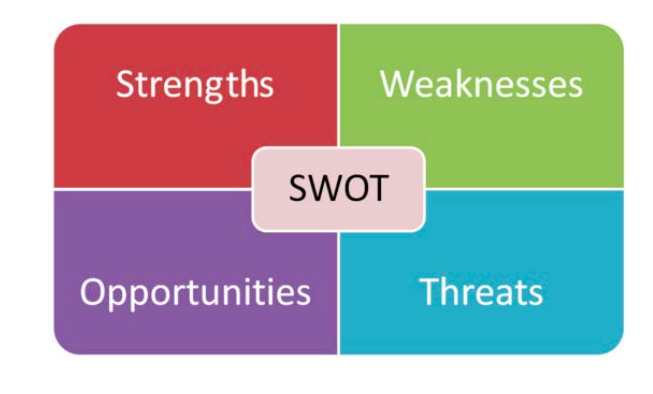
e) Clients with potential backward integration - 57Internal EnvironmentThe internal analysis of the company should allow us to detect which are the strengths and weaknesses of the company
in order to face threats and opportunities. For this we have to identify the key variables that are considered as the most relevant characteristics that should work perfectly in order to achieve all challenges - 58*Variables of the Internal Environment- Strength
- Weaknesses - 59↳ Strategic ProfileIt is a tool to develop internal analysis that tries to identify the strengths and
weaknesses through the study and analysis of the functional areas of the
company - 60- Process of the Strategic Profile1. List of key variables grouped by functional areas
2. Valuation using a Likert scale (1-5)
3. Drawing the strategic profile
4. Comparison with the competitors
5. Drawing the ideal profile that the company should have - 61↳ Value ChainThe value chain of a product is formed by the activities that a company must carry out in order to sell a product or service.
Each activity incorporates a part of the value that is associated with the final product and represents a part of the total cost of the product. We distinguish 2 groups: - 62◆ Primary ActivitiesPrimary activities relate directly to the physical creation, sale, maintenance and
support of a product or service. They consist of the following - 63 Inbound logisticsThese are all the processes related to receiving, storing, and
distributing inputs internally - 64 OperationsThese are the transformation activities that change inputs into outputs that are sold to customers. Here, your operational systems create value
- 65 Outbound logisticsThese activities deliver your product or service to your customer. These are things like collection, storage, and distribution systems, and they may be internal or external to your organization
- 66 Marketing and salesThese are the processes you use to persuade clients to
purchase your product instead of that of your competitors. The benefits you
offer, and how well you communicate them, are sources of value here - 67 ServiceThese are the activities related to maintaining the value of your product or service to your customers, once it's been purchased
- 68◆ Support ActivitiesThese activities support the primary functions above. In our diagram, the dotted lines show that each support, or secondary, activity can play a role in each primary activity
- 69 InfrastructureThese are a company's support systems, and the functions allowing it to
maintain daily operation - 70 Procurement (purchasing)This is what the organization does to get the resources needed to operate
- 71 Human resource managementThis is how well a company recruits, hires, trains, motivates, rewards, and retains its workers
- 72 Technological developmentThese activities relate to the purchase, manage and information, as well as protecting a company's knowledge base
- 73↳ BenchmarkingObjective: Evaluate if the way in which the company is acting is the best in the whole industry.
Process:
) Compare the activities carried out by the company with the correct
performance of these by the competition
) Try to imitate or improve such practices - 74↳ SWOT Analysis
- 753.4 Formulation of Strategies+ Levels of strategy
+ Types of strategies
+ Revisions to the Porter model - 76+ Levels of strategy- Corporate strategy
- Business strategy
- Functional strategy - 77- Corporate strategyIt is about determining what the orientation of the company will be at a global level
- 78- Business strategyNeed to define the Strategic Business Units. When there is only one business line or not diversification, it is the same as the corporate one
- 79- Functional strategyHow will the resources be allocated within each functional area, in each activity or each strategic unit to maximize the productivity of said resources?
- 80+ Types of strategiesCompetitive
Cost leadership
Market segmentation
Differentiation
Lifecycle
Growth
Stability and survival - 81↻ LifecycleEnsure the growth and the survival of the company
- 82↻ CompetitiveALLOW SUCCESSFUL
FULFILLMENT TO THE
FIVE COMPETING
FORCES OF PORTER - 83 Cost leadershipConsists on manufacturing one or several products incurring in lower costs than those of the competitors of an industrial sector
- 84 Market segmentation It is the result to apply one of the previous strategies but in a specific and chosen segment/ nich
It consists in focusing on a specific group of clients.
The criteria for carrying out the segmentation can be very varied: type of product, type of buyer, distribution
channels or geographical area. - 85 DifferentiationThis strategy allows obtaining higher yields than those average of the sector, creating a protection against the five competitive forces.
The company can isolate itself from competitive rivalry due to customer
loyalty and at the lowest price sensitivity (inelastic demand) - 86+ Revisions to the Porter modelThe idea raises that leadership in costs and differentiation are not as mutually exclusive as Porter said and therefore to describe the attractiveness of these companies, the expression "very good value for money" is often used. STRATEGIC
CLOCK - 873.5. Implementation of strategy and control+ Evaluation and selection of strategies
+ Implementation of the strategy
+ Control and evaluation of the strategy - 88+ Evaluation and selection of strategiesAdapting the strategy to the situation identified in the strategic analysis
Feasibility: degree to which the strategy will work in practice
Acceptability: try to assess if the consequences derived from each strategy
are acceptable: profitability, risk - 89+ Implementation of the strategyIncludes a set of actions and decisions necessary to implement the strategies
designed - 90 StrategyIt is the plan of action, or the roadmap or the blueprint by way of which an organization gains a competitive advantage or a leadership edge
- 91 StructureThis refers to organizational structure or the reporting pattern
- 92 SystemsThis includes the day to day activities in which the staff members involve themselves for ensuring the completion of their assigned tasks
- 93 Shared ValuesThe superordinate goals or the core values which get reflected within the organizational culture or influence the ethical code
- 94 StyleThis puts emphasis on the leadership style and how it influences the strategic decisions, people motivation and organizational performance
- 95 StaffThe general staff or the capabilities of the employees
- 96 SkillsThe core competencies or the key skills of the employees play a vital role
in defining the organizational success - 97+ Control and evaluation of the strategy It is about adapting the general control function to the strategic direction
Strategic control consists of two dimensions: - 98¬ Control of the implementation processReview and follow-up of the process (are the actions, plans and budgets being properly carried out and are they leading to the expected results?)
- 99¬ The control of the strategyReview and follow up of the
formulated strategy
Information
- Description
- Administración de Empresas Flashcards on unit 3, created by Danny M. Garcia on 23/06/2020.
- Created by
- Danny M. Garcia
- Views
- 0
- Rating