
Flashcards
Memory AQA Psych

Cards in this deck (14)
- 1Multi-store model of memory (MSM)
- 2Sensory registerTakes in all information
Theoretically infinite capacity
5 different types of information based on each sense
Passes info to STM if attention is paid
Only in MSM - 3Short term memory (STM)duration - up to 18 seconds
Capacity - 7 +/- 2 letters (later chunks)
coding - acoustic - 4Long term memory (LTM)Duration - after 48 years 70% accurate
Coding - semantic
Capacity - theoretically infinite/impossible to test - 5Types of LTMEpisodic - time stamped memories
Semantic - general knowledge that isn't time stamped, like what a word means or what an object is
Procedural - memory for actions or skills, often also called muscle memory - 6Working memory model
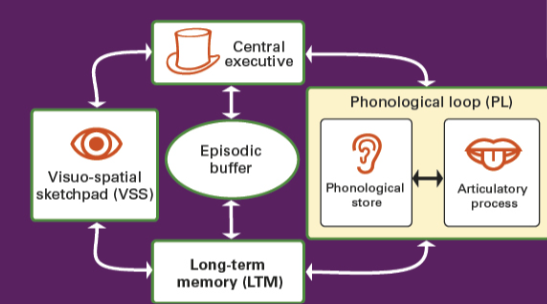
- 7Phonological loopDeals with all auditory information
Both listing and articulating - 8Visuo-spatial sketchpadDeals with all visual information
Both new information (from eyes) and older information (from long term memory and being able to visualise the scene in your mind) - 9Episodic bufferA temporary store for information to maintain time sequencing for then use of storing in LTM (episodic)
- 10Central executiveA supervisory role
Monitors incoming data, and how to divide focus
Does not store information
Even creator of the model is not exactly sure what it does - 11Interference explanation for forgettingProactive - new information that is similar messes with old information recall
Retroactive - old information that is similar messes with new information recall - 12Retrieval failure explanation for forgettingWhen you learn information there are cues (e.g.. the weather or sate you are in) that are attached to the information, being not in those cues causes the inability of recall from LTM to STM
- 13Factors affecting eyewitness testimony (EWT)Misleading information
Leading questions
Post-event discussion
Anxiety - 14Improving EWTThe cognitive interview - a specific trained interview for police to collect better data:
1. Encourage the witness to include every detail
2. Keep the context of the event in their mind
3. Change the order of events to prevent testimony of expected events
4. Change the perspective of the event, again reducing expectation reporting rather than real events