
Flashcards
Business Objectives

Cards in this deck (15)
- 1What is a stakeholder?Groups who have an interest in the activity and performance outcomes of a business.
- 2Give 3 likely objectives for an owner or shareholder1) Higher profits
2) Higher share prices
3) Higher dividends - 3Give 3 likely objectives for directors and managers1) New markets / market share
2) Higher sales
3) Career development - 4What is organisational theory?Assuming that a firm is a coalition of different groups that will have different objectives

- 5Name the 3 conditions that profit satisficing will tend to occur in1) High market power levels
2) Divorce of ownership from control
3) Low levels of contestability - 6How is Profit maximising shown on a diagram? What conditions need to be met for this to be possible?Producing at the output where MC = MR
-Owners control the management of the business
- Assumes sufficient and accurate knowledge of costs and revenue so that MC and MR can be found
- 7How is revenue maximisation shown on a diagram?Where MR = 0
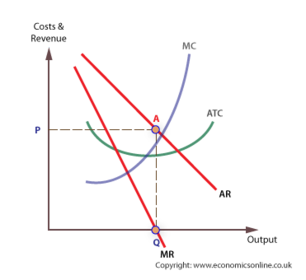
- 8What was William Baumol's theory regarding the objective of revenue maximisation?That manager-controlled firms would be more likely to aim for revenue as the larger the size of the firm, the higher the likely pay and benefits would be for the mangers.

- 9How is sales maximisation shown on a diagram?Where AC = AR
Means that only normal profit is made
- 10Why might firms be aiming for sales maximisation?To gain market share
Maximise long run profit
(may be a limit pricing strategy) - 11How is allocative efficiency shown on a diagram?AC = MC
- 12What is "satisficing"?Making just enough profit to keep stakeholders happy, allowing for other motives to be pursued.
- 13What are 4 examples of pricing strategies to gain market share or increase profitability?1) Predatory Pricing
2) Limit Pricing
3) Price wars
4) Price Discrimination
- 14What are 4 disadvantages of predatory pricing?1) Making a loss in the short run
2) Risky as it doesn't always push competition out of the industry
3) Illegal so risks fines
4) Dependant on the ability to cross-subsidise
- 15What are 7 examples of non-pricing strategies?1) Branding
2) Advertising
3) New Product Development
4) New production methods
5) Product quality and differentiation
6) Mergers/takeovers
7) Collusion
Information
- Description
- A level Economics (Unit 3) Flashcards on Business Objectives, created by Sophie Knight on 18/02/2017.
- Created by
- Sophie Knight · Feb 2017
- Updated
- Feb 19, 2017
- Views
- 19
- Tags
- Rating