
Mind map
Capacity, Duration and Encoding
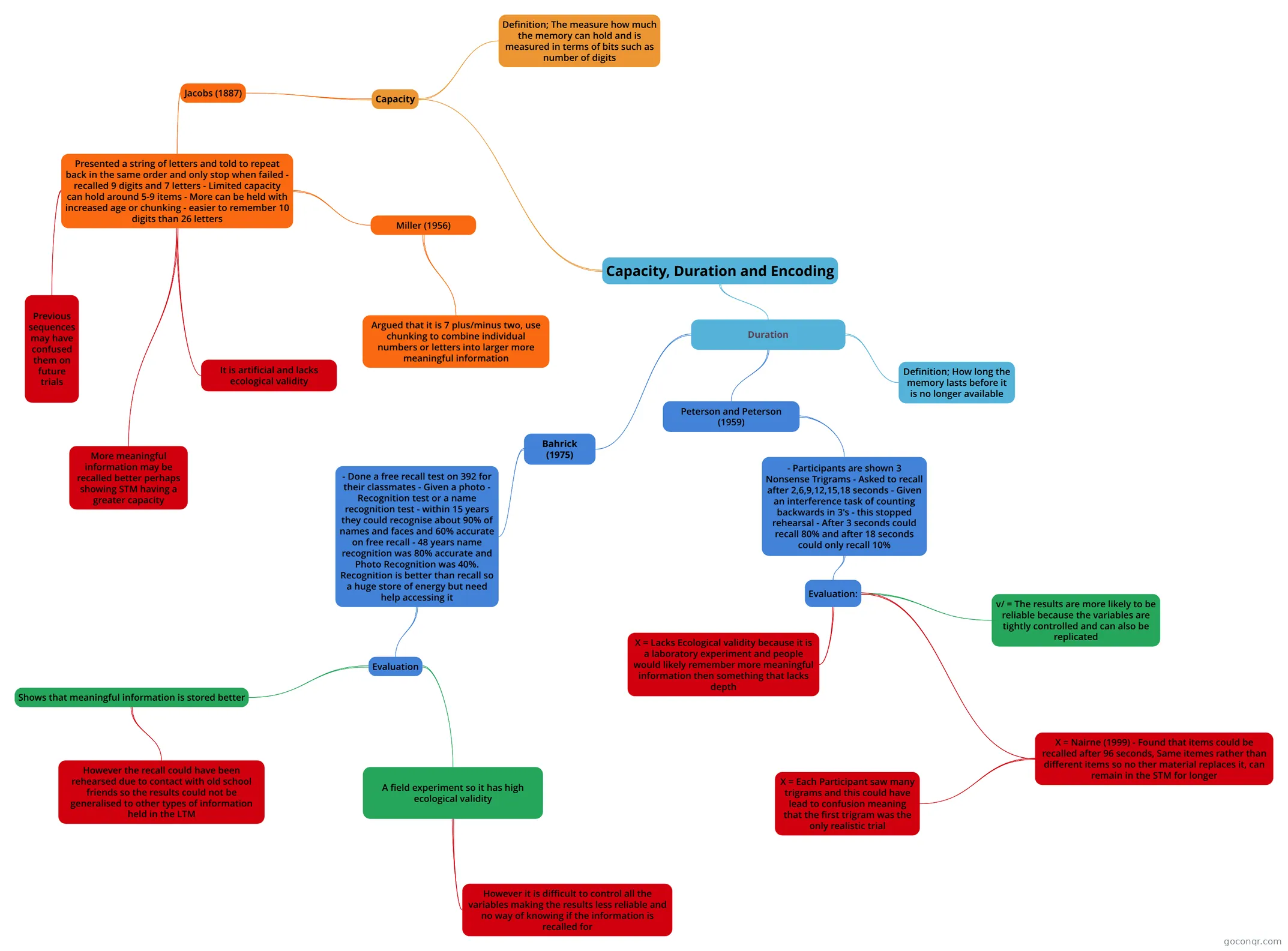
Mind map: Capacity, duration and encoding
Map content
Capacity, Duration and Encoding
Duration
- Definition; How long the memory lasts before it is no longer available
- Peterson and Peterson (1959)
- - Participants are shown 3 Nonsense Trigrams - Asked to recall after 2,6,9,12,15,18 seconds - Given an interference task of counting backwards in 3's - this stopped rehearsal - After 3 seconds could recall 80% and after 18 seconds could only recall 10%
- Evaluation:
- X = Lacks Ecological validity because it is a laboratory experiment and people would likely remember more meaningful information then something that lacks depth
- X = Nairne (1999) - Found that items could be recalled after 96 seconds, Same itemes rather than different items so no ther material replaces it, can remain in the STM for longer
- X = Each Participant saw many trigrams and this could have lead to confusion meaning that the first trigram was the only realistic trial
- v/ = The results are more likely to be reliable because the variables are tightly controlled and can also be replicated
- Evaluation:
- - Participants are shown 3 Nonsense Trigrams - Asked to recall after 2,6,9,12,15,18 seconds - Given an interference task of counting backwards in 3's - this stopped rehearsal - After 3 seconds could recall 80% and after 18 seconds could only recall 10%
- Bahrick (1975)
- - Done a free recall test on 392 for their classmates - Given a photo - Recognition test or a name recognition test - within 15 years they could recognise about 90% of names and faces and 60% accurate on free recall - 48 years name recognition was 80% accurate and Photo Recognition was 40%. Recognition is better than recall so a huge store of energy but need help accessing it
- Evaluation
- A field experiment so it has high ecological validity
- However it is difficult to control all the variables making the results less reliable and no way of knowing if the information is recalled for
- Shows that meaningful information is stored better
- However the recall could have been rehearsed due to contact with old school friends so the results could not be generalised to other types of information held in the LTM
- A field experiment so it has high ecological validity
- Evaluation
- - Done a free recall test on 392 for their classmates - Given a photo - Recognition test or a name recognition test - within 15 years they could recognise about 90% of names and faces and 60% accurate on free recall - 48 years name recognition was 80% accurate and Photo Recognition was 40%. Recognition is better than recall so a huge store of energy but need help accessing it
Capacity
- Definition; The measure how much the memory can hold and is measured in terms of bits such as number of digits
- Jacobs (1887)
- Presented a string of letters and told to repeat back in the same order and only stop when failed - recalled 9 digits and 7 letters - Limited capacity can hold around 5-9 items - More can be held with increased age or chunking - easier to remember 10 digits than 26 letters
- Miller (1956)
- Argued that it is 7 plus/minus two, use chunking to combine individual numbers or letters into larger more meaningful information
- It is artificial and lacks ecological validity
- More meaningful information may be recalled better perhaps showing STM having a greater capacity
- Previous sequences may have confused them on future trials
- Miller (1956)
- Presented a string of letters and told to repeat back in the same order and only stop when failed - recalled 9 digits and 7 letters - Limited capacity can hold around 5-9 items - More can be held with increased age or chunking - easier to remember 10 digits than 26 letters