
Mind map
Piaget's Theory of Cognitive Development
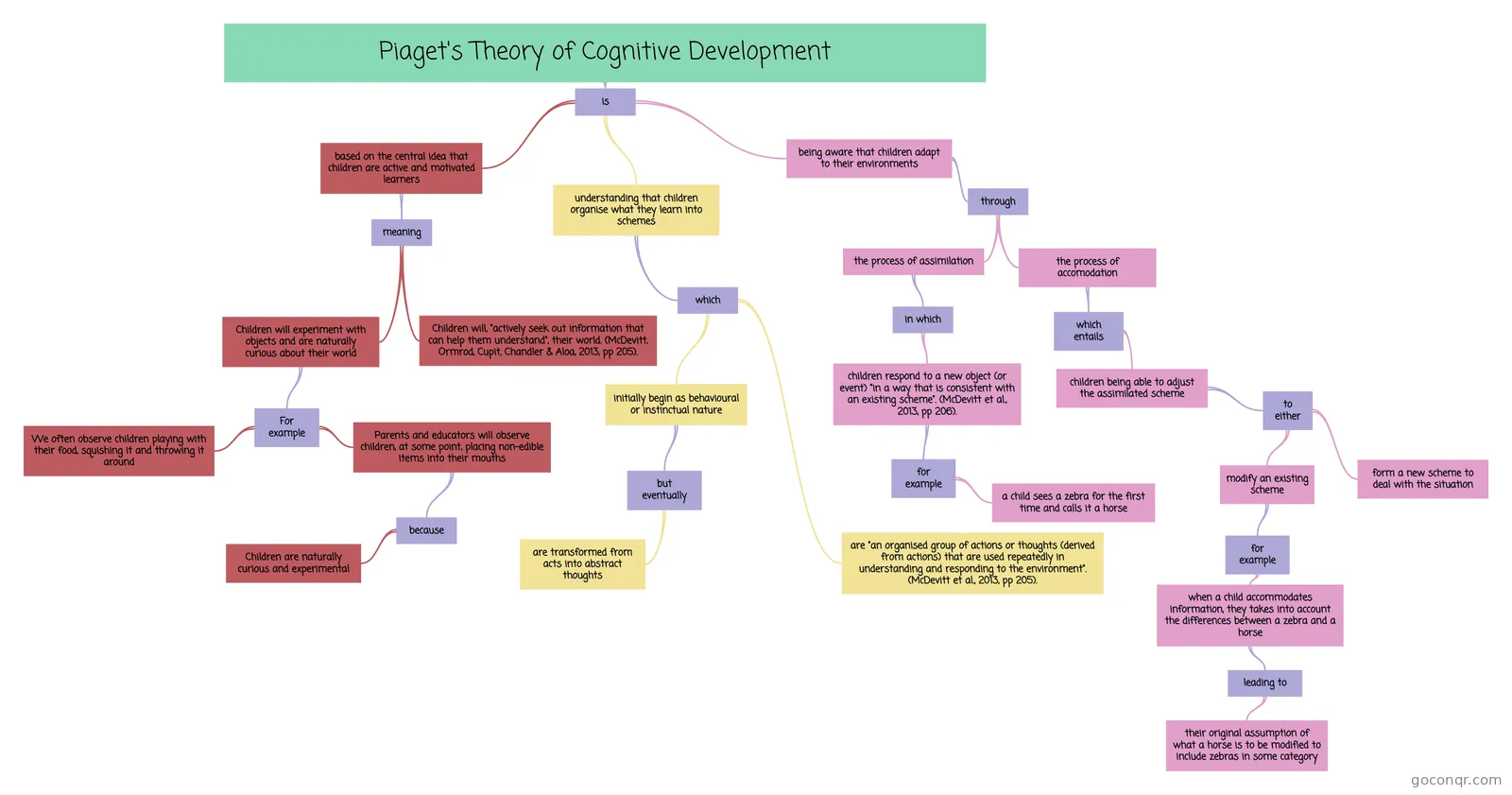
Mind map: Piaget's theory of cognitive development
Map content
Piaget's Theory of Cognitive Development
is
- based on the central idea that children are active and motivated learners
- meaning
- Children will experiment with objects and are naturally curious about their world
- For example
- We often observe children playing with their food, squishing it and throwing it around
- Parents and educators will observe children, at some point, placing non-edible items into their mouths
- because
- Children are naturally curious and experimental
- because
- For example
- Children will, "actively seek out information that can help them understand", their world. (McDevitt, Ormrod, Cupit, Chandler & Aloa, 2013, pp 205).
- Children will experiment with objects and are naturally curious about their world
- meaning
- understanding that children organise what they learn into schemes
- which
- are "an organised group of actions or thoughts (derived from actions) that are used repeatedly in understanding and responding to the environment". (McDevitt et al., 2013, pp 205).
- initially begin as behavioural or instinctual nature
- but eventually
- are transformed from acts into abstract thoughts
- but eventually
- which
- being aware that children adapt to their environments
- through
- the process of assimilation
- in which
- children respond to a new object (or event) "in a way that is consistent with an existing scheme". (McDevitt et al., 2013, pp 206).
- for example
- a child sees a zebra for the first time and calls it a horse
- for example
- children respond to a new object (or event) "in a way that is consistent with an existing scheme". (McDevitt et al., 2013, pp 206).
- in which
- the process of accomodation
- which entails
- children being able to adjust the assimilated scheme
- to either
- modify an existing scheme
- for example
- when a child accommodates information, they takes into account the differences between a zebra and a horse
- leading to
- their original assumption of what a horse is to be modified to include zebras in some category
- leading to
- when a child accommodates information, they takes into account the differences between a zebra and a horse
- for example
- form a new scheme to deal with the situation
- modify an existing scheme
- to either
- children being able to adjust the assimilated scheme
- which entails
- the process of assimilation
- through
- based on the central idea that children are active and motivated learners