
Mind map
DNA structure and replication
Map content
DNA structure and replication
The Watson and Crick model suggested semi-conservative replication
- DNA structure suggested replication mechanism
- knowledge of DNA structure
- molecular modelling by Linus Pauling
- X-ray diffraction patterns by Rosalind Franklin
- DNA helix tightly packed
- bases fit together; strands not too far apart
- base composition studies by Erwin Chargaff
- their 1st model - sugar-phosphate strands wrapped around one another with nitrogen bases facing outwards
- Rosalind Franklin countered this
- nitrogen bases more hydrophobic than sugar-phosphate backbone, so would face inwards
- tightly packed if:
- pyrimidine paired with purine
- bases 'upside down' in relation to one another
- adenine and thymine both structurally and electrically (charges) compatible
- adenine and guanine paired; 3 hydrogen bonds = structural stability
- model of complementary base pairing lead to theory
The role of nucleosomes in DNA packing
- help supercoil DNA
- Nucelosomes - structures of DNA packaged by histones
- central core of 8 histone proteins (octane) with DNA coiled around them
- 2 copies of 4 diff types of histones
- connected by 'linker' DNA
- bound to core by histone molecule, H1
- bind to form 30nm fiber; assists packing
- bound to core by histone molecule, H1
- facilitates packing of large genomes of eukaryotes
- central core of 8 histone proteins (octane) with DNA coiled around them
- association of histones contributes to supercoiling pattern
- supercoiling allows great length of DNA to be packed in small space in nucleus
The leading strand and the lagging strand
- leading
- continuous replication
- continuously following the fork
- lagging
- discontinuous replication
- fragments moving away from the replication fork
- Okazaki fragements - new fragments created on lagging strand as fork exposed more template strand
- arranged in anti-parallel fashion
- leading
Proteins involved in replication
- replication carried out by complex enzyme system
- helicase unwinds DNA at the fork
- topoisomerase releases strain that develops ahead of helicase
- replication
- formation and movement of replication fork
- synthesis of leading and lagging strands
- single stranded binding proteins keep strands apart long enough for template strand to be copied
- RNA primer needed to start replication
- created by DNA primase
- necessary to initiate DNA polymerase activity
- many primers on lagging strand; only one on leading strand
- DNA polymerase
- responsible for covalently linking deoxyribonucleotide monophosphate for the 3' end of the growing strand
- diff. kinds with diff. functions
- proof-reading
- polymerization
- removal or RNA primers once not needed
- DNA ligase connects the gaps between the fragments
- replication carried out by complex enzyme system
The direction of replication
- DNA polymerase can only add nucleotides to the 3' end of the primer
- begins at site called origin of replication
- occurs in both directions away from origin
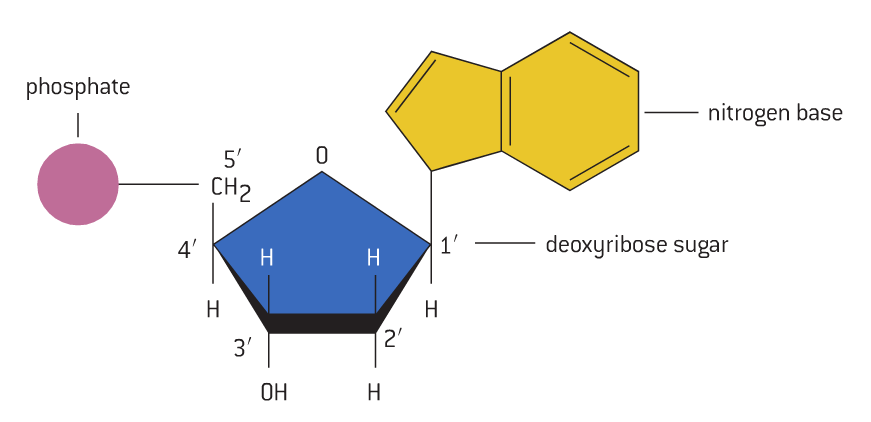
- five carbons of deoxyribose sugar have a number
- phosphate group added to 3' of the deoxyribose of the nucleotide at the end of the chain
- replications occurs in a 5' to 3' direction
Non-coding regions of DNA have important functions
- cellular machinery operates according to genetic code
- coding sequeneces - DNA sequences used to produce polypeptides
- used as guide to produce tRNA and rRNA
- enhancers and silencers regulate gene expression
- most genome non-coding in eukaryotes
- repetitive sequences common
- moderately
- highly
- satellite DNA
- 5-60% (60% in humans)
- one occurs on the ends of eukaryotic chromosomes; telomere
- protects cells from losing genes that cannot replicate during interphase
Images and files in the map
Information
- Description
- Mind Map of Topic 7.1 DNA Structure and Replication of IB Biology Chapter 7 Nucelic Acids (AHL)
- Created by
- tiasabs
- Views
- 298
- Tags
- Rating