
Mind map
PSYCHODYNAMIC
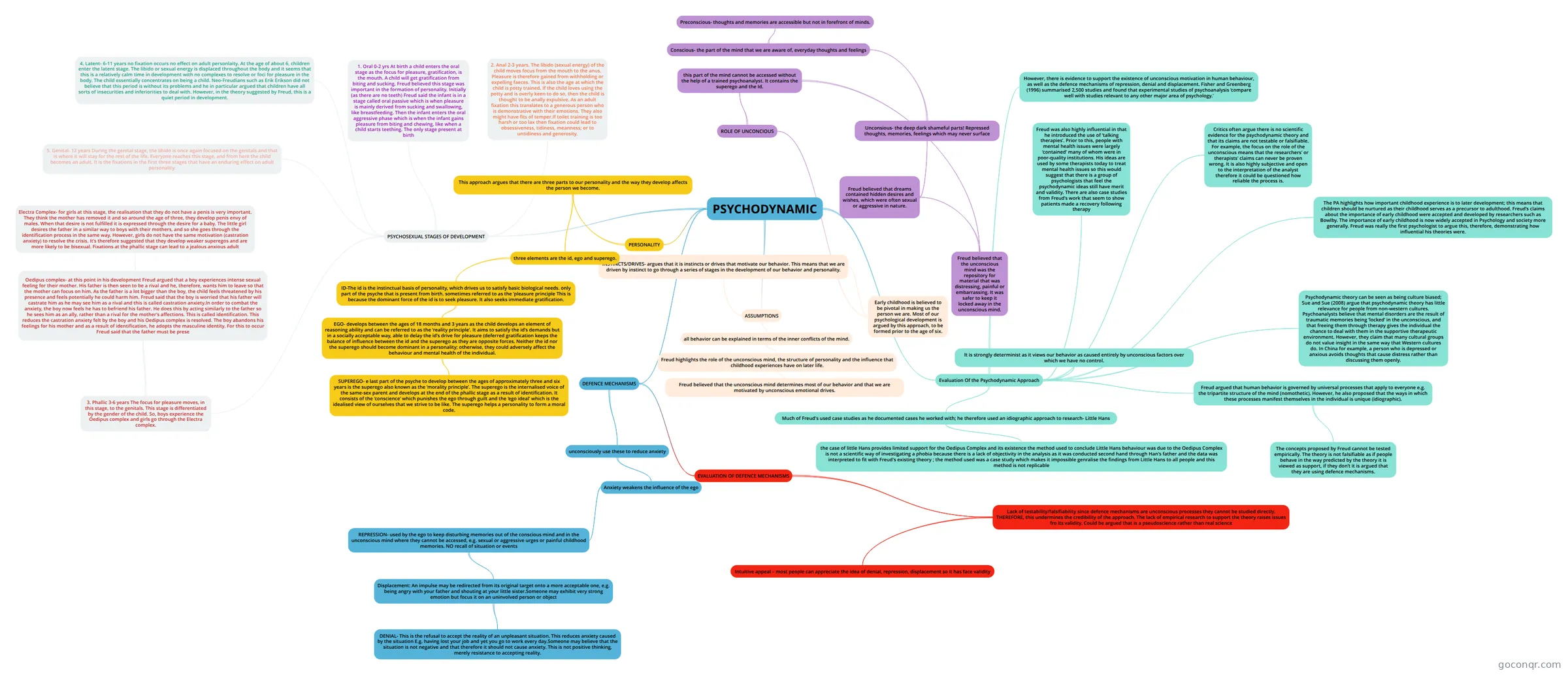
Mind map: psychodynamic approach
Map content
PSYCHODYNAMIC
ASSUMPTIONS
- all behavior can be explained in terms of the inner conflicts of the mind.
- Freud highlights the role of the unconscious mind, the structure of personality and the influence that childhood experiences have on later life.
- Freud believed that the unconscious mind determines most of our behavior and that we are motivated by unconscious emotional drives.
- Freud highlights the role of the unconscious mind, the structure of personality and the influence that childhood experiences have on later life.
- INSTINCTS/DRIVES- argues that it is instincts or drives that motivate our behavior. This means that we are driven by instinct to go through a series of stages in the development of our behavior and personality.
- Early childhood is believed to be pivotal in making us the person we are. Most of our psychological development is argued by this approach, to be formed prior to the age of six.
- ROLE OF UNCONCIOUS
- this part of the mind cannot be accessed without the help of a trained psychoanalyst. It contains the superego and the Id.
- Freud believed that the unconscious mind was the repository for material that was distressing, painful or embarrassing. It was safer to keep it locked away in the unconscious mind.
- Freud believed that dreams contained hidden desires and wishes, which were often sexual or aggressive in nature.
- Unconsious- the deep dark shameful parts! Repressed thoughts, memories, feelings which may never surface
- Conscious- the part of the mind that we are aware of, everyday thoughts and feelings
- Preconscious- thoughts and memories are accessible but not in forefront of minds.
- Conscious- the part of the mind that we are aware of, everyday thoughts and feelings
- Unconsious- the deep dark shameful parts! Repressed thoughts, memories, feelings which may never surface
- Freud believed that dreams contained hidden desires and wishes, which were often sexual or aggressive in nature.
- Freud believed that the unconscious mind was the repository for material that was distressing, painful or embarrassing. It was safer to keep it locked away in the unconscious mind.
- this part of the mind cannot be accessed without the help of a trained psychoanalyst. It contains the superego and the Id.
- ROLE OF UNCONCIOUS
- Early childhood is believed to be pivotal in making us the person we are. Most of our psychological development is argued by this approach, to be formed prior to the age of six.
- all behavior can be explained in terms of the inner conflicts of the mind.
PERSONALITY
- This approach argues that there are three parts to our personality and the way they develop affects the person we become.
- three elements are the id, ego and superego.
- ID-The id is the instinctual basis of personality, which drives us to satisfy basic biological needs. only part of the psyche that is present from birth. sometimes referred to as the ‘pleasure principle This is because the dominant force of the id is to seek pleasure. It also seeks immediate gratification.
- EGO- develops between the ages of 18 months and 3 years as the child develops an element of reasoning ability and can be referred to as the ‘reality principle’. It aims to satisfy the id’s demands but in a socially acceptable way, able to delay the id’s drive for pleasure (deferred gratification keeps the balance of influence between the id and the superego as they are opposite forces. Neither the id nor the superego should become dominant in a personality; otherwise, they could adversely affect the behaviour and mental health of the individual.
- SUPEREGO- e last part of the psyche to develop between the ages of approximately three and six years is the superego also known as the ‘morality principle’. The superego is the internalised voice of the same-sex parent and develops at the end of the phallic stage as a result of identification. It consists of the ‘conscience’ which punishes the ego through guilt and the ‘ego ideal’ which is the idealised view of ourselves that we strive to be like. The superego helps a personality to form a moral code.
- EGO- develops between the ages of 18 months and 3 years as the child develops an element of reasoning ability and can be referred to as the ‘reality principle’. It aims to satisfy the id’s demands but in a socially acceptable way, able to delay the id’s drive for pleasure (deferred gratification keeps the balance of influence between the id and the superego as they are opposite forces. Neither the id nor the superego should become dominant in a personality; otherwise, they could adversely affect the behaviour and mental health of the individual.
- ID-The id is the instinctual basis of personality, which drives us to satisfy basic biological needs. only part of the psyche that is present from birth. sometimes referred to as the ‘pleasure principle This is because the dominant force of the id is to seek pleasure. It also seeks immediate gratification.
- three elements are the id, ego and superego.
- This approach argues that there are three parts to our personality and the way they develop affects the person we become.
DEFENCE MECHANISMS
- unconsciously use these to reduce anxiety
- Anxiety weakens the influence of the ego
- REPRESSION- used by the ego to keep disturbing memories out of the conscious mind and in the unconscious mind where they cannot be accessed, e.g. sexual or aggressive urges or painful childhood memories. NO recall of situation or events
- Displacement: An impulse may be redirected from its original target onto a more acceptable one, e.g. being angry with your father and shouting at your little sister.Someone may exhibit very strong emotion but focus it on an uninvolved person or object
- DENIAL- This is the refusal to accept the reality of an unpleasant situation. This reduces anxiety caused by the situation E.g. having lost your job and yet you go to work every day.Someone may believe that the situation is not negative and that therefore it should not cause anxiety. This is not positive thinking, merely resistance to accepting reality.
- Displacement: An impulse may be redirected from its original target onto a more acceptable one, e.g. being angry with your father and shouting at your little sister.Someone may exhibit very strong emotion but focus it on an uninvolved person or object
- REPRESSION- used by the ego to keep disturbing memories out of the conscious mind and in the unconscious mind where they cannot be accessed, e.g. sexual or aggressive urges or painful childhood memories. NO recall of situation or events
- Anxiety weakens the influence of the ego
- EVALUATION OF DEFENCE MECHANISMS
- Lack of testability/falsifiability since defence mechanisms are unconscious processes they cannot be studied directly. THEREFORE, this undermines the credibility of the approach. The lack of empirical research to support the theory raises issues fro its validity. Could be argued that is a pseudoscience rather than real science
- Intuitive appeal – most people can appreciate the idea of denial, repression, displacement so it has face validity
- Lack of testability/falsifiability since defence mechanisms are unconscious processes they cannot be studied directly. THEREFORE, this undermines the credibility of the approach. The lack of empirical research to support the theory raises issues fro its validity. Could be argued that is a pseudoscience rather than real science
- unconsciously use these to reduce anxiety
Evaluation Of the Psychodynamic Approach
- Much of Freud's used case studies as he documented cases he worked with; he therefore used an idiographic approach to research- Little Hans
- the case of little Hans provides limited support for the Oedipus Complex and its existence the method used to conclude Little Hans behaviour was due to the Oedipus Complex is not a scientific way of investigating a phobia because there is a lack of objectivity in the analysis as it was conducted second hand through Han's father and the data was interpreted to fit with Freud's existing theory ; the method used was a case study which makes it impossible genralise the findings from Little Hans to all people and this method is not replicable
- The PA highlights how important childhood experience is to later development; this means that children should be nurtured as their childhood serves as a precursor to adulthood. Freud’s claims about the importance of early childhood were accepted and developed by researchers such as Bowlby. The importance of early childhood is now widely accepted in Psychology and society more generally. Freud was really the first psychologist to argue this, therefore, demonstrating how influential his theories were.
- Freud was also highly influential in that he introduced the use of ‘talking therapies’. Prior to this, people with mental health issues were largely ‘contained’ many of whom were in poor-quality institutions. His ideas are used by some therapists today to treat mental health issues so this would suggest that there is a group of psychologists that feel the psychodynamic ideas still have merit and validity. There are also case studies from Freud’s work that seem to show patients made a recovery following therapy
- Critics often argue there is no scientific evidence for the psychodynamic theory and that its claims are not testable or falsifiable. For example, the focus on the role of the unconscious means that the researchers’ or therapists’ claims can never be proven wrong. It is also highly subjective and open to the interpretation of the analyst therefore it could be questioned how reliable the process is.
- However, there is evidence to support the existence of unconscious motivation in human behaviour, as well as the defence mechanisms of repression, denial and displacement. Fisher and Greenberg (1996) summarised 2,500 studies and found that experimental studies of psychoanalysis ‘compare well with studies relevant to any other major area of psychology.’
- Psychodynamic theory can be seen as being culture biased; Sue and Sue (2008) argue that psychodynamic theory has little relevance for people from non-western cultures. Psychoanalysts believe that mental disorders are the result of traumatic memories being ‘locked’ in the unconscious, and that freeing them through therapy gives the individual the chance to deal with them in the supportive therapeutic environment. However, they claim that many cultural groups do not value insight in the same way that Western cultures do. In China for example, a person who is depressed or anxious avoids thoughts that cause distress rather than discussing them openly.
- It is strongly determinist as it views our behavior as caused entirely by unconscious factors over which we have no control.
- Freud argued that human behavior is governed by universal processes that apply to everyone e.g. the tripartite structure of the mind (nomothetic). However, he also proposed that the ways in which these processes manifest themselves in the individual is unique (idiographic).
- The concepts proposed by Freud cannot be tested empirically. The theory is not falsifiable as if people behave in the way predicted by the theory it is viewed as support, if they don’t it is argued that they are using defence mechanisms.
- Much of Freud's used case studies as he documented cases he worked with; he therefore used an idiographic approach to research- Little Hans
PSYCHOSEXUAL STAGES OF DEVELOPMENT
- 1. Oral 0-2 yrs At birth a child enters the oral stage as the focus for pleasure, gratification, is the mouth. A child will get gratification from biting and sucking. Freud believed this stage was important in the formation of personality. Initially (as there are no teeth) Freud said the infant is in a stage called oral passive which is when pleasure is mainly derived from sucking and swallowing, like breastfeeding. Then the infant enters the oral aggressive phase which is when the infant gains pleasure from biting and chewing, like when a child starts teething. The only stage present at birth
- 2. Anal 2-3 years. The libido (sexual energy) of the child moves focus from the mouth to the anus. Pleasure is therefore gained from withholding or expelling faeces. This is also the age at which the child is potty trained. If the child loves using the potty and is overly keen to do so, then the child is thought to be anally expulsive. As an adult fixation this translates to a generous person who is demonstrative with their emotions. They also might have fits of temper.If toilet training is too harsh or too lax then fixation could lead to obsessiveness, tidiness, meanness; or to untidiness and generosity.
- 3. Phallic 3-6 years The focus for pleasure moves, in this stage, to the genitals. This stage is differentiated by the gender of the child. So, boys experience the Oedipus complex and girls go through the Electra complex.
- Oedipus complex- at this point in his development Freud argued that a boy experiences intense sexual feeling for their mother. His father is then seen to be a rival and he, therefore, wants him to leave so that the mother can focus on him. As the father is a lot bigger than the boy, the child feels threatened by his presence and feels potentially he could harm him. Freud said that the boy is worried that his father will castrate him as he may see him as a rival and this is called castration anxiety.In order to combat the anxiety, the boy now feels he has to befriend his father. He does this by acting similarly to the father so he sees him as an ally, rather than a rival for the mother’s affections. This is called identification. This reduces the castration anxiety felt by the boy and his Oedipus complex is resolved. The boy abandons his feelings for his mother and as a result of identification, he adopts the masculine identity. For this to occur Freud said that the father must be prese
- Electra Complex- for girls at this stage, the realisation that they do not have a penis is very important. They think the mother has removed it and so around the age of three, they develop penis envy of males. When that desire is not fulfilled it is expressed through the desire for a baby. The little girl desires the father in a similar way to boys with their mothers, and so she goes through the identification process in the same way. However, girls do not have the same motivation (castration anxiety) to resolve the crisis. It’s therefore suggested that they develop weaker superegos and are more likely to be bisexual. Fixations at the phallic stage can lead to a jealous anxious adult
- 4. Latent- 6-11 years no fixation occurs no effect on adult personlaity. At the age of about 6, children enter the latent stage. The libido or sexual energy is displaced throughout the body and it seems that this is a relatively calm time in development with no complexes to resolve or foci for pleasure in the body. The child essentially concentrates on being a child. Neo-Freudians such as Erik Erikson did not believe that this period is without its problems and he in particular argued that children have all sorts of insecurities and inferiorities to deal with. However, in the theory suggested by Freud, this is a quiet period in development.
- 5. Genital- 12 years During the genital stage, the libido is once again focused on the genitals and that is where it will stay for the rest of the life. Everyone reaches this stage, and from here the child becomes an adult. It is the fixations in the first three stages that have an enduring effect on adult personality.
Information
- Description
- Mind Map on PSYCHODYNAMIC, created by Faiza Hussain on 26/11/2022.
- Created by
- Faiza Hussain
- Views
- 0
- Rating