
Mind map
Models of Memory
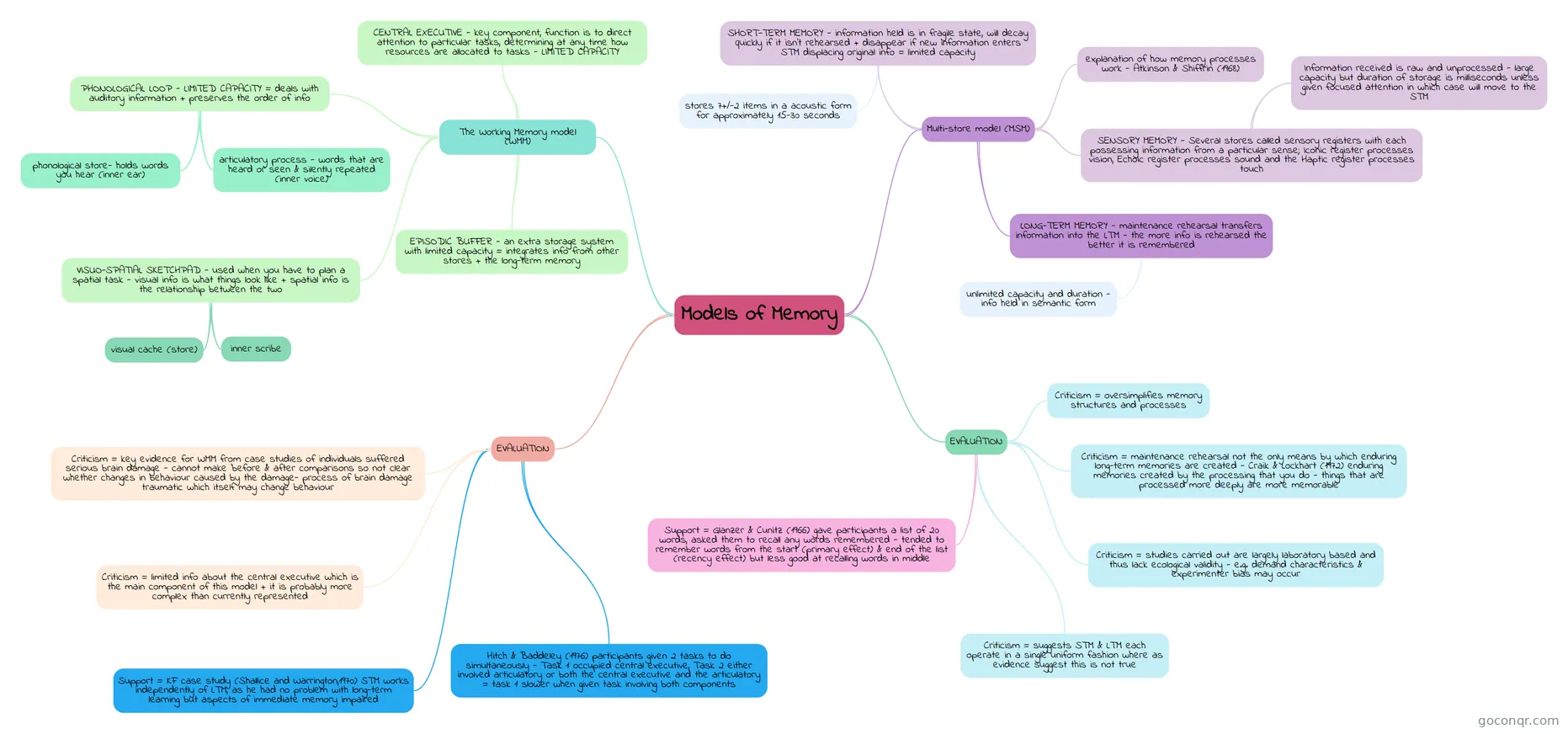
Mind map: Models of memory
Map content
Models of Memory
Multi-store model (MSM)
- explanation of how memory processes work - Atkinson & Shiffrin (1968)
- SENSORY MEMORY - Several stores called sensory registers with each possessing information from a particular sense; Iconic register processes vision, Echoic register processes sound and the Haptic register processes touch
- Information received is raw and unprocessed - large capacity but duration of storage is milliseconds unless given focused attention in which case will move to the STM
- SHORT-TERM MEMORY - information held is in fragile state, will decay quickly if it isn't rehearsed + disappear if new information enters STM displacing original info = limited capacity
- stores 7+/-2 items in a acoustic form for approximately 15-30 seconds
- LONG-TERM MEMORY - maintenance rehearsal transfers information into the LTM - the more info is rehearsed the better it is remembered
- unlimited capacity and duration - info held in semantic form
The Working Memory model (WMM)
- CENTRAL EXECUTIVE - key component, function is to direct attention to particular tasks, determining at any time how resources are allocated to tasks - LIMITED CAPACITY
- PHONOLOGICAL LOOP - LIMITED CAPACITY = deals with auditory information + preserves the order of info
- phonological store- holds words you hear (inner ear)
- articulatory process - words that are heard or seen & silently repeated (inner voice)
- VISUO-SPATIAL SKETCHPAD - used when you have to plan a spatial task - visual info is what things look like + spatial info is the relationship between the two
- visual cache (store)
- inner scribe
- EPISODIC BUFFER - an extra storage system with limited capacity = integrates info from other stores + the long-term memory
EVALUATION
- Criticism = oversimplifies memory structures and processes
- Support = Glanzer & Cunitz (1966) gave participants a list of 20 words, asked them to recall any words remembered - tended to remember words from the start (primary effect) & end of the list (recency effect) but less good at recalling words in middle
- Criticism = maintenance rehearsal not the only means by which enduring long-term memories are created - Craik & Lockhart (1972) enduring memories created by the processing that you do - things that are processed more deeply are more memorable
- Criticism = studies carried out are largely laboratory based and thus lack ecological validity - e.g. demand characteristics & experimenter bias may occur
- Criticism = suggests STM & LTM each operate in a single uniform fashion where as evidence suggest this is not true
EVALUATION
- Criticism = key evidence for WMM from case studies of individuals suffered serious brain damage - cannot make 'before & after comparisons so not clear whether changes in behaviour caused by the damage- process of brain damage traumatic which itself may change behaviour
- Criticism = limited info about the central executive which is the main component of this model + it is probably more complex than currently represented
- Support = KF case study (Shallice and Warrington,1970) STM works independently of LTM, as he had no problem with long-term learning but aspects of immediate memory impaired
- Hitch & Baddeley (1976) participants given 2 tasks to do simultaneously - Task 1 occupied central executive, Task 2 either involved articulatory or both the central executive and the articulatory = task 1 slower when given task involving both components
Information
- Description
- A-Level Psychology Mind Map on Models of Memory, created by Enxhi Tahiraj on 19/11/2015.
- Created by
- Enxhi Tahiraj
- Views
- 0
- Rating