
Mind map
Question 11(1)
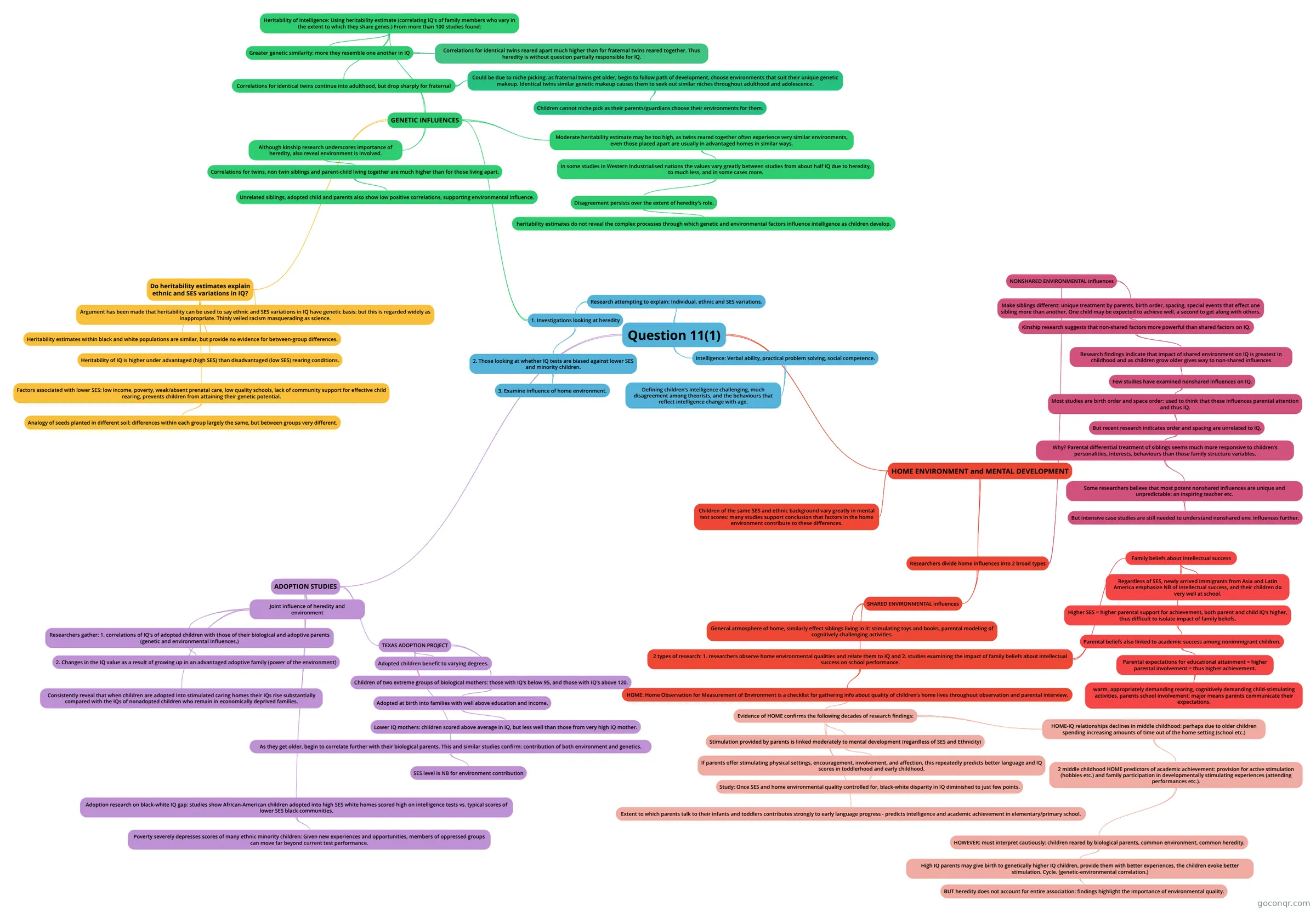
Mind map: Intelligence research: heredity and environment
Map content
Question 11(1)
Research attempting to explain: Individual, ethnic and SES variations.
- 1. Investigations looking at heredity
- 2. Those looking at whether IQ tests are biased against lower SES and minority children.
- 3. Examine influence of home environment.
- GENETIC INFLUENCES
- Heritability of intelligence: Using heritability estimate (correlating IQ's of family members who vary in the extent to which they share genes.) From more than 100 studies found:
- Greater genetic similarity: more they resemble one another in IQ
- Correlations for identical twins reared apart much higher than for fraternal twins reared together. Thus heredity is without question partially responsible for IQ.
- Correlations for identical twins continue into adulthood, but drop sharply for fraternal
- Could be due to niche picking: as fraternal twins get older, begin to follow path of development, choose environments that suit their unique genetic makeup. Identical twins similar genetic makeup causes them to seek out similar niches throughout adulthood and adolescence.
- Children cannot niche pick as their parents/guardians choose their environments for them.
- Could be due to niche picking: as fraternal twins get older, begin to follow path of development, choose environments that suit their unique genetic makeup. Identical twins similar genetic makeup causes them to seek out similar niches throughout adulthood and adolescence.
- Greater genetic similarity: more they resemble one another in IQ
- Although kinship research underscores importance of heredity, also reveal environment is involved.
- Correlations for twins, non twin siblings and parent-child living together are much higher than for those living apart.
- Unrelated siblings, adopted child and parents also show low positive correlations, supporting environmental influence.
- Correlations for twins, non twin siblings and parent-child living together are much higher than for those living apart.
- Moderate heritability estimate may be too high, as twins reared together often experience very similar environments, even those placed apart are usually in advantaged homes in similar ways.
- In some studies in Western Industrialised nations the values vary greatly between studies from about half IQ due to heredity, to much less, and in some cases more.
- Disagreement persists over the extent of heredity's role.
- heritability estimates do not reveal the complex processes through which genetic and environmental factors influence intelligence as children develop.
- Disagreement persists over the extent of heredity's role.
- In some studies in Western Industrialised nations the values vary greatly between studies from about half IQ due to heredity, to much less, and in some cases more.
- Do heritability estimates explain ethnic and SES variations in IQ?
- Argument has been made that heritability can be used to say ethnic and SES variations in IQ have genetic basis: but this is regarded widely as inappropriate. Thinly veiled racism masquerading as science.
- Heritability estimates within black and white populations are similar, but provide no evidence for between-group differences.
- Heritability of IQ is higher under advantaged (high SES) than disadvantaged (low SES) rearing conditions.
- Factors associated with lower SES: low income, poverty, weak/absent prenatal care, low quality schools, lack of community support for effective child rearing, prevents children from attaining their genetic potential.
- Analogy of seeds planted in different soil: differences within each group largely the same, but between groups very different.
- Heritability of intelligence: Using heritability estimate (correlating IQ's of family members who vary in the extent to which they share genes.) From more than 100 studies found:
- 2. Those looking at whether IQ tests are biased against lower SES and minority children.
- 1. Investigations looking at heredity
Intelligence: Verbal ability, practical problem solving, social competence.
- Defining children's intelligence challenging, much disagreement among theorists, and the behaviours that reflect intelligence change with age.
ADOPTION STUDIES
- Joint influence of heredity and environment
- Researchers gather: 1. correlations of IQ's of adopted children with those of their biological and adoptive parents (genetic and environmental influences.)
- 2. Changes in the IQ value as a result of growing up in an advantaged adoptive family (power of the environment)
- Consistently reveal that when children are adopted into stimulated caring homes their IQs rise substantially compared with the IQs of nonadopted children who remain in economically deprived families.
- Researchers gather: 1. correlations of IQ's of adopted children with those of their biological and adoptive parents (genetic and environmental influences.)
- TEXAS ADOPTION PROJECT
- Adopted children benefit to varying degrees.
- Children of two extreme groups of biological mothers: those with IQ's below 95, and those with IQ's above 120.
- Adopted at birth into families with well above education and income.
- Lower IQ mothers: children scored above average in IQ, but less well than those from very high IQ mother.
- Adopted at birth into families with well above education and income.
- As they get older, begin to correlate further with their biological parents. This and similar studies confirm: contribution of both environment and genetics.
- SES level is NB for environment contribution
- Adoption research on black-white IQ gap: studies show African-American children adopted into high SES white homes scored high on intelligence tests vs. typical scores of lower SES black communities.
- Poverty severely depresses scores of many ethnic minority children: Given new experiences and opportunities, members of oppressed groups can move far beyond current test performance.
- Joint influence of heredity and environment
HOME ENVIRONMENT and MENTAL DEVELOPMENT
- Children of the same SES and ethnic background vary greatly in mental test scores: many studies support conclusion that factors in the home environment contribute to these differences.
- Researchers divide home influences into 2 broad types
- NONSHARED ENVIRONMENTAL influences
- Make siblings different: unique treatment by parents, birth order, spacing, special events that effect one sibling more than another. One child may be expected to achieve well, a second to get along with others.
- Kinship research suggests that non-shared factors more powerful than shared factors on IQ.
- Research findings indicate that impact of shared environment on IQ is greatest in childhood and as children grow older gives way to non-shared influences
- Few studies have examined nonshared influences on IQ.
- Most studies are birth order and space order: used to think that these influences parental attention and thus IQ.
- But recent research indicates order and spacing are unrelated to IQ.
- Why? Parental differential treatment of siblings seems much more responsive to children's personalities, interests, behaviours than those family structure variables.
- Some researchers believe that most potent nonshared influences are unique and unpredictable: an inspiring teacher etc.
- But intensive case studies are still needed to understand nonshared env. influences further.
- Some researchers believe that most potent nonshared influences are unique and unpredictable: an inspiring teacher etc.
- Why? Parental differential treatment of siblings seems much more responsive to children's personalities, interests, behaviours than those family structure variables.
- But recent research indicates order and spacing are unrelated to IQ.
- Most studies are birth order and space order: used to think that these influences parental attention and thus IQ.
- Few studies have examined nonshared influences on IQ.
- Research findings indicate that impact of shared environment on IQ is greatest in childhood and as children grow older gives way to non-shared influences
- Kinship research suggests that non-shared factors more powerful than shared factors on IQ.
- Make siblings different: unique treatment by parents, birth order, spacing, special events that effect one sibling more than another. One child may be expected to achieve well, a second to get along with others.
- SHARED ENVIRONMENTAL influences
- General atmosphere of home, similarly effect siblings living in it: stimulating toys and books, parental modeling of cognitively challenging activities.
- 2 types of research: 1. researchers observe home environmental qualities and relate them to IQ and 2. studies examining the impact of family beliefs about intellectual success on school performance.
- HOME: Home Observation for Measurement of Environment is a checklist for gathering info about quality of children's home lives throughout observation and parental interview.
- Evidence of HOME confirms the following decades of research findings:
- Stimulation provided by parents is linked moderately to mental development (regardless of SES and Ethnicity)
- If parents offer stimulating physical settings, encouragement, involvement, and affection, this repeatedly predicts better language and IQ scores in toddlerhood and early childhood.
- Study: Once SES and home environmental quality controlled for, black-white disparity in IQ diminished to just few points.
- If parents offer stimulating physical settings, encouragement, involvement, and affection, this repeatedly predicts better language and IQ scores in toddlerhood and early childhood.
- Extent to which parents talk to their infants and toddlers contributes strongly to early language progress - predicts intelligence and academic achievement in elementary/primary school.
- HOME-IQ relationships declines in middle childhood: perhaps due to older children spending increasing amounts of time out of the home setting (school etc.)
- 2 middle childhood HOME predictors of academic achievement: provision for active stimulation (hobbies etc.) and family participation in developmentally stimulating experiences (attending performances etc.).
- HOWEVER: must interpret cautiously: children reared by biological parents, common environment, common heredity.
- High IQ parents may give birth to genetically higher IQ children, provide them with better experiences, the children evoke better stimulation. Cycle. (genetic-environmental correlation.)
- BUT heredity does not account for entire association: findings highlight the importance of environmental quality.
- High IQ parents may give birth to genetically higher IQ children, provide them with better experiences, the children evoke better stimulation. Cycle. (genetic-environmental correlation.)
- HOWEVER: must interpret cautiously: children reared by biological parents, common environment, common heredity.
- 2 middle childhood HOME predictors of academic achievement: provision for active stimulation (hobbies etc.) and family participation in developmentally stimulating experiences (attending performances etc.).
- Stimulation provided by parents is linked moderately to mental development (regardless of SES and Ethnicity)
- Evidence of HOME confirms the following decades of research findings:
- Family beliefs about intellectual success
- Regardless of SES, newly arrived immigrants from Asia and Latin America emphasize NB of intellectual success, and their children do very well at school.
- Higher SES = higher parental support for achievement, both parent and child IQ's higher, thus difficult to isolate impact of family beliefs.
- Parental beliefs also linked to academic success among nonimmigrant children.
- Parental expectations for educational attainment = higher parental involvement = thus higher achievement.
- warm, appropriately demanding rearing, cognitively demanding child-stimulating activities, parents school involvement: major means parents communicate their expectations.
- Parental expectations for educational attainment = higher parental involvement = thus higher achievement.
- Parental beliefs also linked to academic success among nonimmigrant children.
- HOME: Home Observation for Measurement of Environment is a checklist for gathering info about quality of children's home lives throughout observation and parental interview.
- NONSHARED ENVIRONMENTAL influences
Information
- Description
- Honours Psychology Mind Map on Question 11(1), created by Debbie R on 30/01/2016.
- Created by
- Debbie R
- Views
- 0
- Rating