
Mind map
Perception
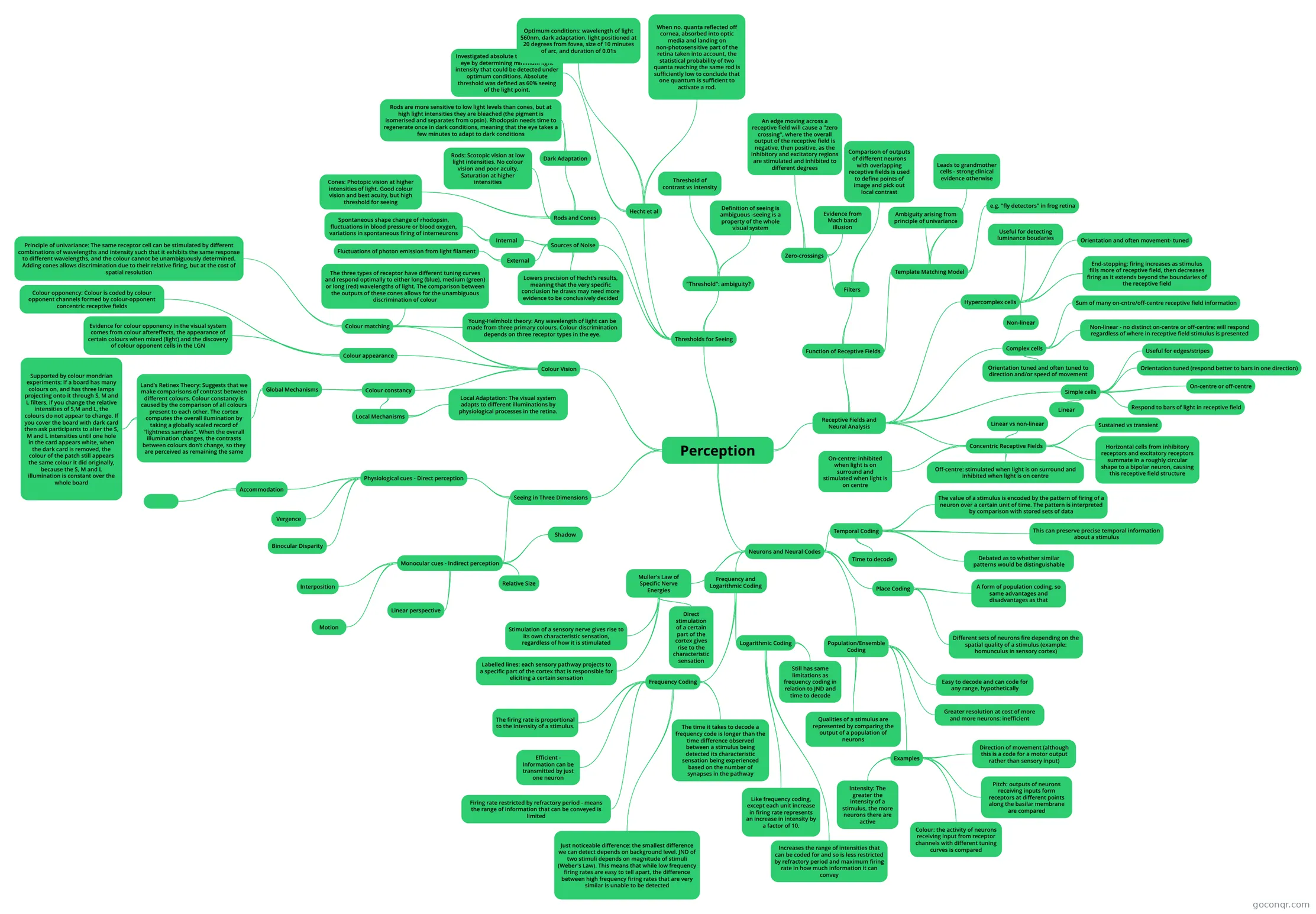
Mind map: Perception
Map content
Perception
Neurons and Neural Codes
- Muller's Law of Specific Nerve Energies
- Stimulation of a sensory nerve gives rise to its own characteristic sensation, regardless of how it is stimulated
- Labelled lines: each sensory pathway projects to a specific part of the cortex that is responsible for eliciting a certain sensation
- Direct stimulation of a certain part of the cortex gives rise to the characteristic sensation
- Frequency and Logarithmic Coding
- Frequency Coding
- The firing rate is proportional to the intensity of a stimulus.
- Efficient - Information can be transmitted by just one neuron
- Firing rate restricted by refractory period - means the range of information that can be conveyed is limited
- Just noticeable difference: the smallest difference we can detect depends on background level. JND of two stimuli depends on magnitude of stimuli (Weber's Law). This means that while low frequency firing rates are easy to tell apart, the difference between high frequency firing rates that are very similar is unable to be detected
- The time it takes to decode a frequency code is longer than the time difference observed between a stimulus being detected its characteristic sensation being experienced based on the number of synapses in the pathway
- Logarithmic Coding
- Like frequency coding, except each unit increase in firing rate represents an increase in intensity by a factor of 10.
- Increases the range of intensities that can be coded for and so is less restricted by refractory period and maximum firing rate in how much information it can convey
- Still has same limitations as frequency coding in relation to JND and time to decode
- Frequency Coding
- Population/Ensemble Coding
- Qualities of a stimulus are represented by comparing the output of a population of neurons
- Examples
- Intensity: The greater the intensity of a stimulus, the more neurons there are active
- Colour: the activity of neurons receiving input from receptor channels with different tuning curves is compared
- Pitch: outputs of neurons receiving inputs form receptors at different points along the basilar membrane are compared
- Direction of movement (although this is a code for a motor output rather than sensory input)
- Greater resolution at cost of more and more neurons: inefficient
- Easy to decode and can code for any range, hypothetically
- Place Coding
- Different sets of neurons fire depending on the spatial quality of a stimulus (example: homunculus in sensory cortex)
- A form of population coding, so same advantages and disadvantages as that
- Temporal Coding
- The value of a stimulus is encoded by the pattern of firing of a neuron over a certain unit of time. The pattern is interpreted by comparison with stored sets of data
- This can preserve precise temporal information about a stimulus
- Debated as to whether similar patterns would be distinguishable
- Time to decode
- Muller's Law of Specific Nerve Energies
Receptive Fields and Neural Analysis
- Concentric Receptive Fields
- On-centre: inhibited when light is on surround and stimulated when light is on centre
- Off-centre: stimulated when light is on surround and inhibited when light is on centre
- Horizontal cells from inhibitory receptors and excitatory receptors summate in a roughly circular shape to a bipolar neuron, causing this receptive field structure
- Sustained vs transient
- Linear vs non-linear
- Simple cells
- Respond to bars of light in receptive field
- On-centre or off-centre
- Orientation tuned (respond better to bars in one direction)
- Linear
- Useful for edges/stripes
- Complex cells
- Orientation tuned and often tuned to direction and/or speed of movement
- Non-linear - no distinct on-centre or off-centre: will respond regardless of where in receptive field stimulus is presented
- Sum of many on-cntre/off-centre receptive field information
- Hypercomplex cells
- End-stopping: firing increases as stimulus fills more of receptive field, then decreases firing as it extends beyond the boundaries of the receptive field
- Non-linear
- Orientation and often movement- tuned
- Useful for detecting luminance boudaries
- Function of Receptive Fields
- Template Matching Model
- e.g. "fly detectors" in frog retina
- Leads to grandmother cells - strong clinical evidence otherwise
- Ambiguity arising from principle of univariance
- Filters
- Comparison of outputs of different neurons with overlapping receptive fields is used to define points of image and pick out local contrast
- Zero-crossings
- Evidence from Mach band illusion
- An edge moving across a receptive field will cause a "zero crossing", where the overall output of the receptive field is negative, then positive, as the inhibitory and excitatory regions are stimulated and inhibited to different degrees
- Template Matching Model
- Concentric Receptive Fields
Thresholds for Seeing
- Rods and Cones
- Dark Adaptation
- Rods are more sensitive to low light levels than cones, but at high light intensities they are bleached (the pigment is isomerised and separates from opsin). Rhodopsin needs time to regenerate once in dark conditions, meaning that the eye takes a few minutes to adapt to dark conditions
- Rods: Scotopic vision at low light intensities. No colour vision and poor acuity. Saturation at higher intensities
- Cones: Photopic vision at higher intensities of light. Good colour vision and best acuity, but high threshold for seeing
- Dark Adaptation
- Hecht et al
- Investigated absolute threshold of the eye by determining minimum light intensity that could be detected under optimum conditions. Absolute threshold was defined as 60% seeing of the light point.
- Optimum conditions: wavelength of light 560nm, dark adaptation, light positioned at 20 degrees from fovea, size of 10 minutes of arc, and duration of 0.01s
- When no. quanta reflected off cornea, absorbed into optic media and landing on non-photosensitive part of the retina taken into account, the statistical probability of two quanta reaching the same rod is sufficiently low to conclude that one quantum is sufficient to activate a rod.
- "Threshold": ambiguity?
- Threshold of contrast vs intensity
- Definition of seeing is ambiguous -seeing is a property of the whole visual system
- Sources of Noise
- Internal
- Spontaneous shape change of rhodopsin, fluctuations in blood pressure or blood oxygen, variations in spontaneous firing of interneurons
- External
- Fluctuations of photon emission from light filament
- Lowers precision of Hecht's results, meaning that the very specific conclusion he draws may need more evidence to be conclusively decided
- Internal
- Rods and Cones
Colour Vision
- Colour matching
- Young-Helmholz theory: Any wavelength of light can be made from three primary colours. Colour discrimination depends on three receptor types in the eye.
- The three types of receptor have different tuning curves and respond optimally to either long (blue), medium (green) or long (red) wavelengths of light. The comparison between the outputs of these cones allows for the unambiguous discrimination of colour
- Principle of univariance: The same receptor cell can be stimulated by different combinations of wavelengths and intensity such that it exhibits the same response to different wavelengths, and the colour cannot be unambiguously determined. Adding cones allows discrimination due to their relative firing, but at the cost of spatial resolution
- Colour appearance
- Colour opponency: Colour is coded by colour opponent channels formed by colour-opponent concentric receptive fields
- Evidence for colour opponency in the visual system comes from colour aftereffects, the appearance of certain colours when mixed (light) and the discovery of colour opponent cells in the LGN
- Colour constancy
- Global Mechanisms
- Land's Retinex Theory: Suggests that we make comparisons of contrast between different colours. Colour constancy is caused by the comparison of all colours present to each other. The cortex computes the overall ilumination by taking a globally scaled record of "lightness samples". When the overall illumination changes, the contrasts between colours don't change, so they are perceived as remaining the same
- Supported by colour mondrian experiments: If a board has many colours on, and has three lamps projecting onto it through S, M and L filters, if you change the relative intensities of S,M and L, the colours do not appear to change. If you cover the board with dark card then ask participants to alter the S, M and L intensities until one hole in the card appears white, when the dark card is removed, the colour of the patch still appears the same colour it did originally, because the S, M and L illumination is constant over the whole board
- Land's Retinex Theory: Suggests that we make comparisons of contrast between different colours. Colour constancy is caused by the comparison of all colours present to each other. The cortex computes the overall ilumination by taking a globally scaled record of "lightness samples". When the overall illumination changes, the contrasts between colours don't change, so they are perceived as remaining the same
- Local Mechanisms
- Local Adaptation: The visual system adapts to different illuminations by physiological processes in the retina.
- Global Mechanisms
- Colour matching
Seeing in Three Dimensions
- Physiological cues - Direct perception
- Accommodation
- Vergence
- Binocular Disparity
- Accommodation
- Monocular cues - Indirect perception
- Interposition
- Shadow
- Motion
- Linear perspective
- Relative Size
- Physiological cues - Direct perception
Information
- Description
- Mind Map on Perception, created by otaku96 on 29/02/2016.
- Created by
- otaku96
- Views
- 8
- Rating