
Mind map
Factors Influencing
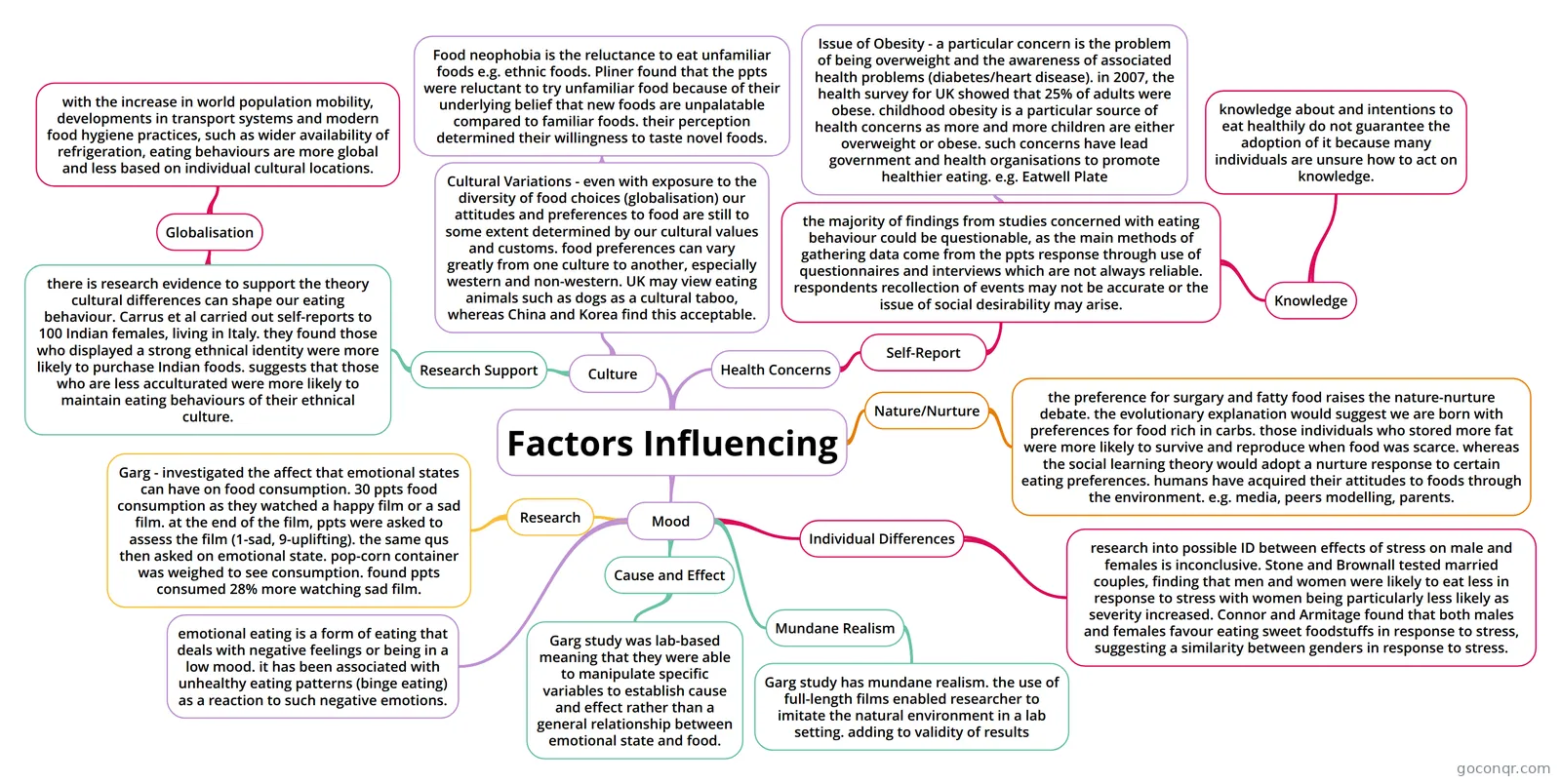
Mind map: Factors influencing eating behaviour
Map content
Factors Influencing
Culture
- Cultural Variations - even with exposure to the diversity of food choices (globalisation) our attitudes and preferences to food are still to some extent determined by our cultural values and customs. food preferences can vary greatly from one culture to another, especially western and non-western. UK may view eating animals such as dogs as a cultural taboo, whereas China and Korea find this acceptable.
- Food neophobia is the reluctance to eat unfamiliar foods e.g. ethnic foods. Pliner found that the ppts were reluctant to try unfamiliar food because of their underlying belief that new foods are unpalatable compared to familiar foods. their perception determined their willingness to taste novel foods.
- Research Support
- there is research evidence to support the theory cultural differences can shape our eating behaviour. Carrus et al carried out self-reports to 100 Indian females, living in Italy. they found those who displayed a strong ethnical identity were more likely to purchase Indian foods. suggests that those who are less acculturated were more likely to maintain eating behaviours of their ethnical culture.
- Globalisation
- with the increase in world population mobility, developments in transport systems and modern food hygiene practices, such as wider availability of refrigeration, eating behaviours are more global and less based on individual cultural locations.
- Globalisation
- there is research evidence to support the theory cultural differences can shape our eating behaviour. Carrus et al carried out self-reports to 100 Indian females, living in Italy. they found those who displayed a strong ethnical identity were more likely to purchase Indian foods. suggests that those who are less acculturated were more likely to maintain eating behaviours of their ethnical culture.
- Cultural Variations - even with exposure to the diversity of food choices (globalisation) our attitudes and preferences to food are still to some extent determined by our cultural values and customs. food preferences can vary greatly from one culture to another, especially western and non-western. UK may view eating animals such as dogs as a cultural taboo, whereas China and Korea find this acceptable.
Health Concerns
- Self-Report
- the majority of findings from studies concerned with eating behaviour could be questionable, as the main methods of gathering data come from the ppts response through use of questionnaires and interviews which are not always reliable. respondents recollection of events may not be accurate or the issue of social desirability may arise.
- Issue of Obesity - a particular concern is the problem of being overweight and the awareness of associated health problems (diabetes/heart disease). in 2007, the health survey for UK showed that 25% of adults were obese. childhood obesity is a particular source of health concerns as more and more children are either overweight or obese. such concerns have lead government and health organisations to promote healthier eating. e.g. Eatwell Plate
- Knowledge
- knowledge about and intentions to eat healthily do not guarantee the adoption of it because many individuals are unsure how to act on knowledge.
- the majority of findings from studies concerned with eating behaviour could be questionable, as the main methods of gathering data come from the ppts response through use of questionnaires and interviews which are not always reliable. respondents recollection of events may not be accurate or the issue of social desirability may arise.
- Self-Report
Mood
- emotional eating is a form of eating that deals with negative feelings or being in a low mood. it has been associated with unhealthy eating patterns (binge eating) as a reaction to such negative emotions.
- Research
- Garg - investigated the affect that emotional states can have on food consumption. 30 ppts food consumption as they watched a happy film or a sad film. at the end of the film, ppts were asked to assess the film (1-sad, 9-uplifting). the same qus then asked on emotional state. pop-corn container was weighed to see consumption. found ppts consumed 28% more watching sad film.
- Mundane Realism
- Garg study has mundane realism. the use of full-length films enabled researcher to imitate the natural environment in a lab setting. adding to validity of results
- Cause and Effect
- Garg study was lab-based meaning that they were able to manipulate specific variables to establish cause and effect rather than a general relationship between emotional state and food.
- Individual Differences
- research into possible ID between effects of stress on male and females is inconclusive. Stone and Brownall tested married couples, finding that men and women were likely to eat less in response to stress with women being particularly less likely as severity increased. Connor and Armitage found that both males and females favour eating sweet foodstuffs in response to stress, suggesting a similarity between genders in response to stress.
Nature/Nurture
- the preference for surgary and fatty food raises the nature-nurture debate. the evolutionary explanation would suggest we are born with preferences for food rich in carbs. those individuals who stored more fat were more likely to survive and reproduce when food was scarce. whereas the social learning theory would adopt a nurture response to certain eating preferences. humans have acquired their attitudes to foods through the environment. e.g. media, peers modelling, parents.
Information
- Description
- A-Level Psychology (Printed) Mind Map on Factors Influencing, created by Sophie Edroff on 12/04/2016.
- Created by
- Sophie Edroff
- Views
- 1
- Rating