
Mind map
Close relationships
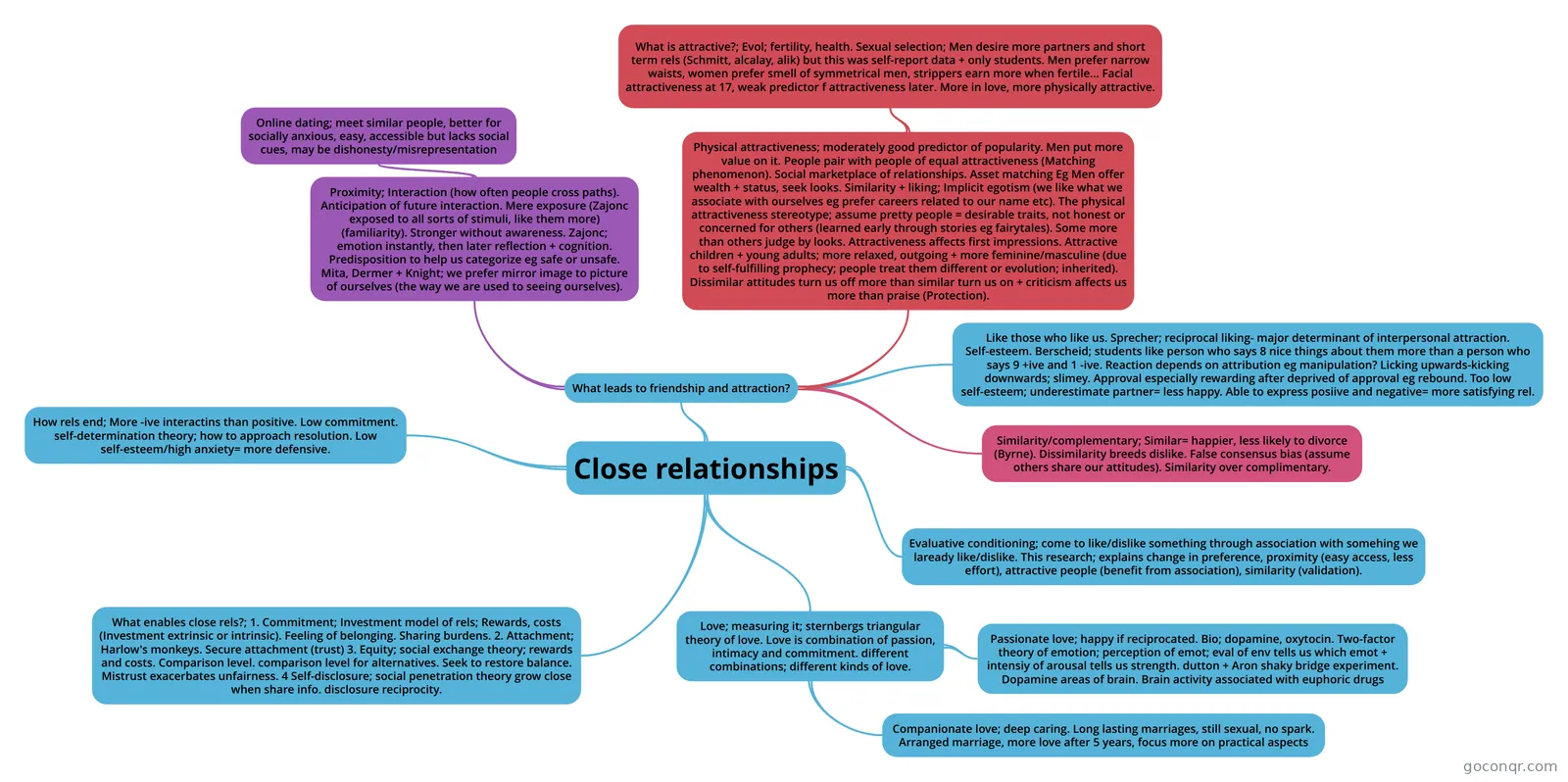
Mind map: Close relationships
Map content
Close relationships
What leads to friendship and attraction?
- Proximity; Interaction (how often people cross paths). Anticipation of future interaction. Mere exposure (Zajonc exposed to all sorts of stimuli, like them more) (familiarity). Stronger without awareness. Zajonc; emotion instantly, then later reflection + cognition. Predisposition to help us categorize eg safe or unsafe. Mita, Dermer + Knight; we prefer mirror image to picture of ourselves (the way we are used to seeing ourselves).
- Online dating; meet similar people, better for socially anxious, easy, accessible but lacks social cues, may be dishonesty/misrepresentation
- Physical attractiveness; moderately good predictor of popularity. Men put more value on it. People pair with people of equal attractiveness (Matching phenomenon). Social marketplace of relationships. Asset matching Eg Men offer wealth + status, seek looks. Similarity + liking; Implicit egotism (we like what we associate with ourselves eg prefer careers related to our name etc). The physical attractiveness stereotype; assume pretty people = desirable traits, not honest or concerned for others (learned early through stories eg fairytales). Some more than others judge by looks. Attractiveness affects first impressions. Attractive children + young adults; more relaxed, outgoing + more feminine/masculine (due to self-fulfilling prophecy; people treat them different or evolution; inherited). Dissimilar attitudes turn us off more than similar turn us on + criticism affects us more than praise (Protection).
- What is attractive?; Evol; fertility, health. Sexual selection; Men desire more partners and short term rels (Schmitt, alcalay, alik) but this was self-report data + only students. Men prefer narrow waists, women prefer smell of symmetrical men, strippers earn more when fertile... Facial attractiveness at 17, weak predictor f attractiveness later. More in love, more physically attractive.
- Similarity/complementary; Similar= happier, less likely to divorce (Byrne). Dissimilarity breeds dislike. False consensus bias (assume others share our attitudes). Similarity over complimentary.
- Like those who like us. Sprecher; reciprocal liking- major determinant of interpersonal attraction. Self-esteem. Berscheid; students like person who says 8 nice things about them more than a person who says 9 +ive and 1 -ive. Reaction depends on attribution eg manipulation? Licking upwards-kicking downwards; slimey. Approval especially rewarding after deprived of approval eg rebound. Too low self-esteem; underestimate partner= less happy. Able to express posiive and negative= more satisfying rel.
- Proximity; Interaction (how often people cross paths). Anticipation of future interaction. Mere exposure (Zajonc exposed to all sorts of stimuli, like them more) (familiarity). Stronger without awareness. Zajonc; emotion instantly, then later reflection + cognition. Predisposition to help us categorize eg safe or unsafe. Mita, Dermer + Knight; we prefer mirror image to picture of ourselves (the way we are used to seeing ourselves).
Evaluative conditioning; come to like/dislike something through association with somehing we laready like/dislike. This research; explains change in preference, proximity (easy access, less effort), attractive people (benefit from association), similarity (validation).
Love; measuring it; sternbergs triangular theory of love. Love is combination of passion, intimacy and commitment. different combinations; different kinds of love.
- Passionate love; happy if reciprocated. Bio; dopamine, oxytocin. Two-factor theory of emotion; perception of emot; eval of env tells us which emot + intensiy of arousal tells us strength. dutton + Aron shaky bridge experiment. Dopamine areas of brain. Brain activity associated with euphoric drugs
- Companionate love; deep caring. Long lasting marriages, still sexual, no spark. Arranged marriage, more love after 5 years, focus more on practical aspects
What enables close rels?; 1. Commitment; Investment model of rels; Rewards, costs (Investment extrinsic or intrinsic). Feeling of belonging. Sharing burdens. 2. Attachment; Harlow's monkeys. Secure attachment (trust) 3. Equity; social exchange theory; rewards and costs. Comparison level. comparison level for alternatives. Seek to restore balance. Mistrust exacerbates unfairness. 4 Self-disclosure; social penetration theory grow close when share info. disclosure reciprocity.
How rels end; More -ive interactins than positive. Low commitment. self-determination theory; how to approach resolution. Low self-esteem/high anxiety= more defensive.
Information
- Description
- Degree Psychology (Second year psychology degree) Mind Map on Close relationships, created by *Ellie* on 03/05/2016.
- Created by
- *Ellie*
- Views
- 0
- Rating
More on Relationship formation and attraction