
Mind map
Ancient Egypt
Map content
Ancient Egypt
The Power of Pharaohs
- Pharaohs were the most powerful people in Ancient Egypt.
- Pharaohs were thought to be and were treated like Gods.
- The Pharaoh had many duties that he had to fulfil which were sometimes out of his control.
- Duties out of his control were, making sure the Nile flooded each year and seeing that the Gods looked kindly on the Egyptian people
- Duties in his control were, making sure there was enough food for everyone, Egypt's army would defeat any enemies and that the Egyptians were truthful.
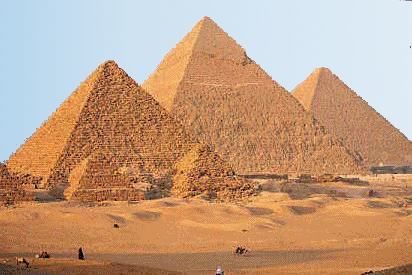
- The Pharaohs were so important that when they died they were buried in large structures known as the 'Pyramids'
- Even children became pharaohs because Ancient Egypt needed and pharaoh in order to thrive.
- When the Pharaoh died he even had his pets mummified, and put in his tomb with him.
Religion/Beliefs
- Ancient Egyptian Religion is polytheism because it had many Gods.
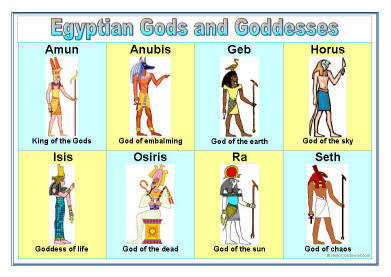
- The most important Gods were: Osiris (God of the dead, ruler of the underworld), Horus (God of the sky, ruler and protector of Egypt), Ra (Sun God), Anubis (Watched over the dead), Isis (Protective Goddess) and Hathor (Protective Goddess, Goddess of love and joy).
- A way the Ancient Egyptians worshiped their gods was to make offerings in a temple
- Temples were sacred places of prayer and worship to the Gods and the Pharaoh.
- A way the Ancient Egyptians worshiped their gods was to make offerings in a temple
- The most important Gods were: Osiris (God of the dead, ruler of the underworld), Horus (God of the sky, ruler and protector of Egypt), Ra (Sun God), Anubis (Watched over the dead), Isis (Protective Goddess) and Hathor (Protective Goddess, Goddess of love and joy).
- The Ancient Egyptians worshiped cats because they believed that they were the earthly feline goddess Sekhmet.
- The Ancient Egyptians believed that the Gods controlled every aspect of their daily lives, as well as the afterlife.
- The Gods could interfere with the world, so the Ancient Egyptians had to follow religious teachings to keep the Gods pleased.
- Ancient Egyptian Religion is polytheism because it had many Gods.
Society
- Social Hierarchy.
- The higher you were the less of you there were and you had more power, rights and freedom.
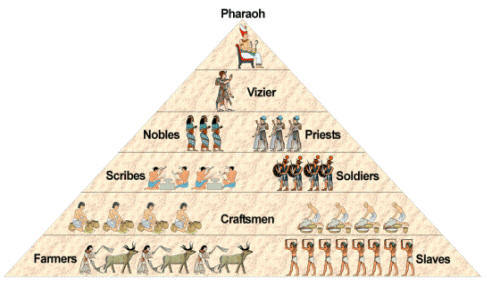
- These are some of the social classes (they are ordered in descending order): the Pharaoh, Vizier, Nobles, Priests, Soldiers, Scribes, Craftsmen, Farmers and then Slaves.
- In Ancient Egypt they had definite social classes which were determined by the person's profession, this was called the Social Hierarchy. These social classes were ordered in hierarchy.
- The higher you were the less of you there were and you had more power, rights and freedom.
- Social Hierarchy.
Geography
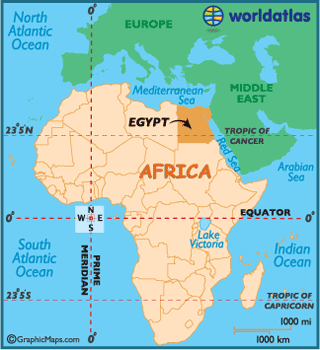
- Egypt is located in North-East Africa.
- Ancient Egypt was dependent on the Nile and the Nile Delta because Egypt was a desert so they desperately needed a reliable water source.
- Most of the settlements in Ancient Egypt were along the Nile or near the Nile Delta for the reason above.
Contact with other ancient societies
- Ancient Egypt traded with the people in Punt and Sinai.
- From trade Ancient Egypt gained animals, slaves, honey, oil, incense, olives and things or objects they needed.
- Ancient Egypt was at war with Hyksos.
- Ancient Egypt's army became stronger and made better weapons and tactics.
- The Sumerians immigrated to Ancient Egypt.
- Ancient Egypt were told about the wheel and digging canals to let water flow from the Nile.
- Ancient Egypt was invaded by Nubia, Syria and Palestine.
- From this Ancient Egypt gained natural resources.
- Ancient Egypt traded with the people in Punt and Sinai.
By Elsie Johnson
Images and files in the map
Information
- Description
- Year 9 History Mind Map on Ancient Egypt, created by Elsie Johnson on 27/03/2014.
- Created by
- Elsie Johnson
- Views
- 26
- Tags
- Rating