
Ancient Egypt
1,299 resources created by 986 users
This Ancient Egypt page on GoConqr gathers community-made mind maps, flashcards, quizzes and notes, from the Nile and the pharaohs to gods, mummification and the Eighteenth Dynasty. It's built for school students revising the topic, and for teachers after ready-made material, with a few resources suited to primary pupils. There are over 1,100 resources here, including more than 100 quizzes and over 700 mind maps. Pick a topic, try a quiz to find your gaps, then build your own revision sets.
Top Ancient Egypt resources
-
122 cardsAncient - Half Yearlies - NKE + Akhenaten Role of the pharaoh
-
 Mind map Grapes of Ancient Egypt Mind map on Ancient Egypt
-
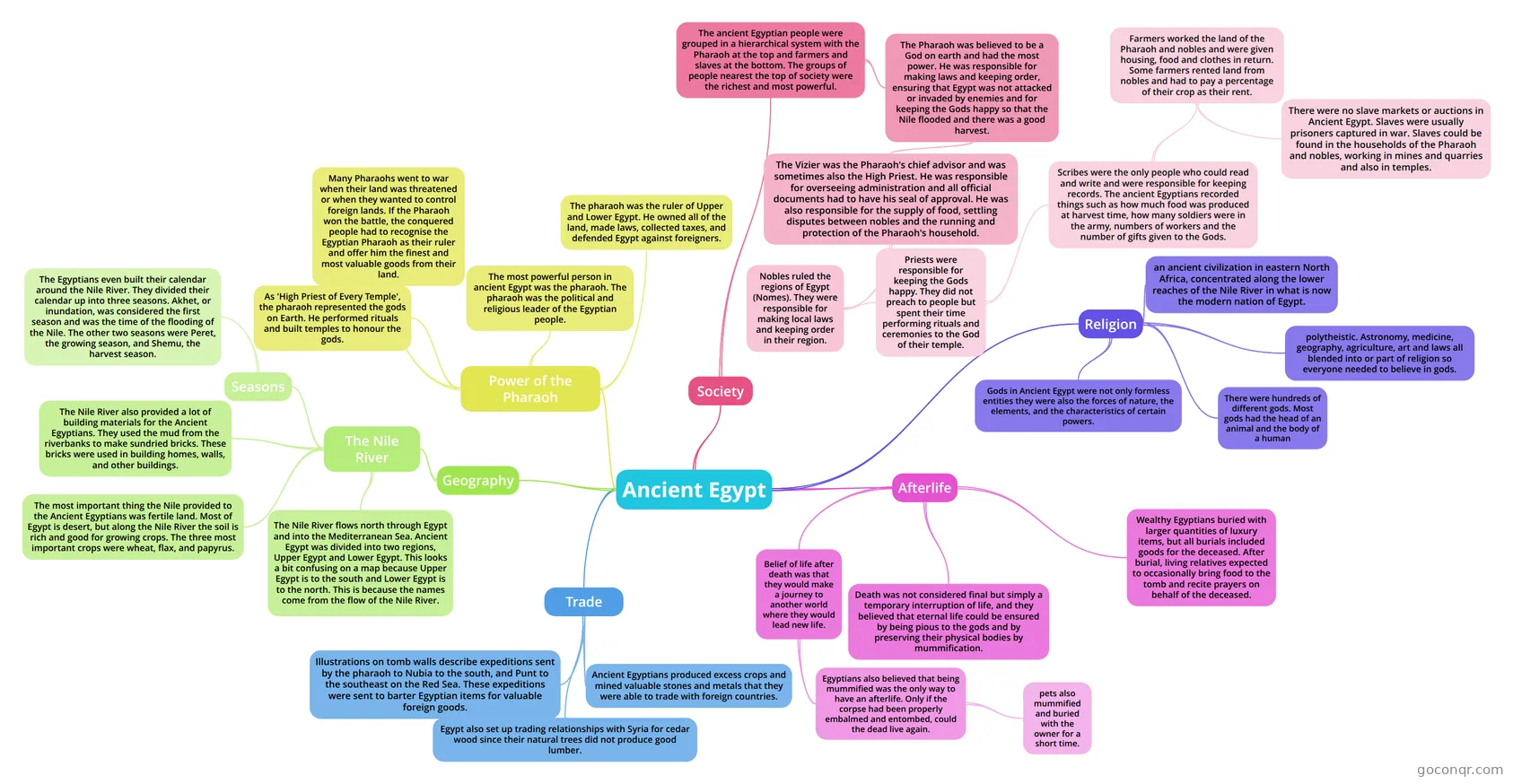 Mind map Ancient Egypt
-
Mind map ANCIENT EGYPT
-
24 cardsAncient Egypt Exam
-
11 cardsprocess of mummification this shows all 10 steps of mummification i hope it helps with the upcoming exam.
-
15 cardsChapter 5; Ancient Egypt and Kush (Study Guide) Who was the first great engineer who built the pyramids?
-
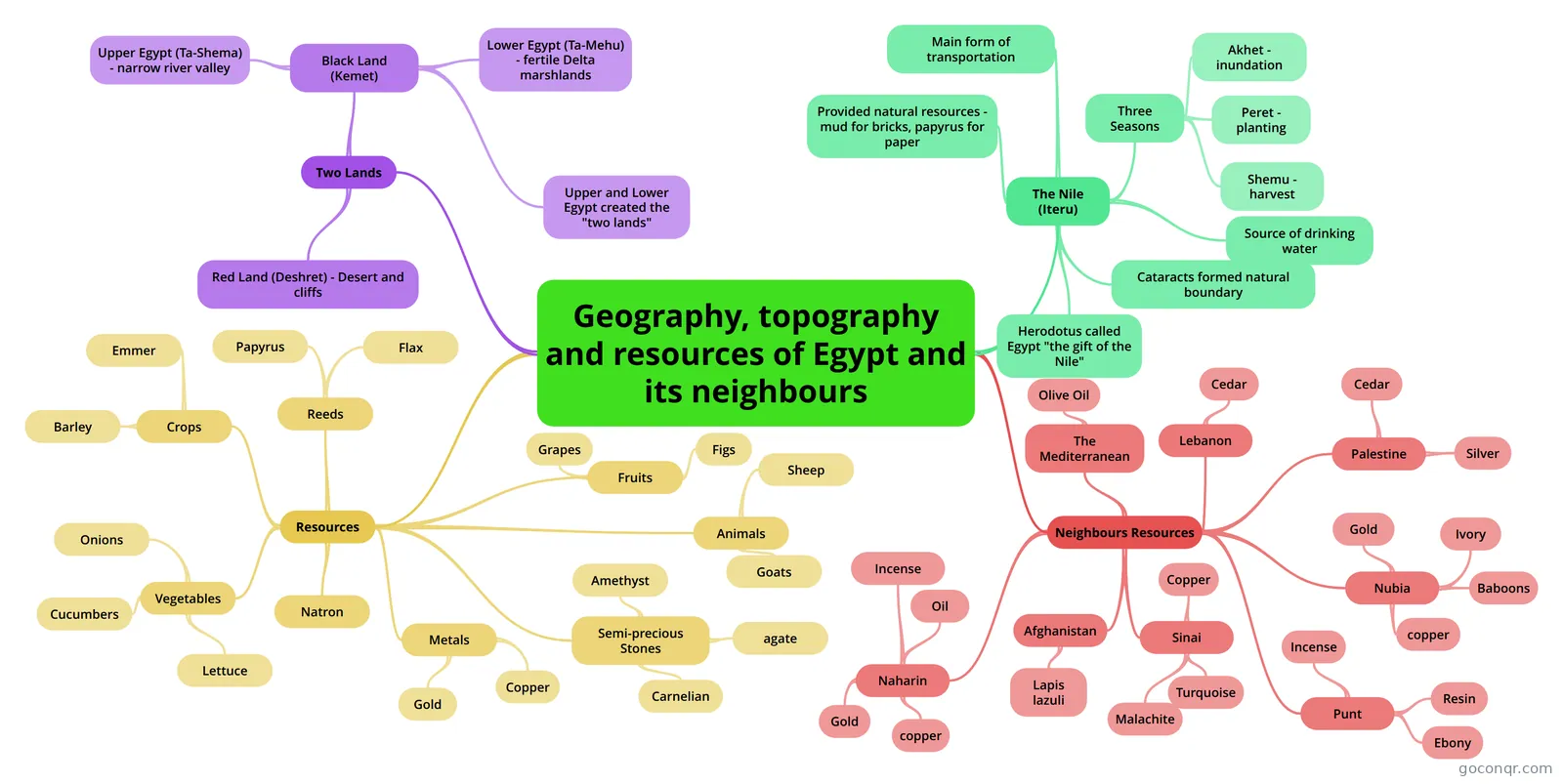 Mind map Geography, topography and resources of Egypt and its neighbours
Quizzes
See all 132 quizzes-
19 questionsAncient Pharaohs a test on 5 important pharaohs
-
60 questionsWorld History Egypt The desert was beneficial to the Egyptians because it protected them from invaders
-
53 questionsSS 5.3 Review for Test
-
50 questionsAncient Egypt - QUIZ What were the temples, according to the Egyptians?
-
21 questions2.2 Practice Quiz: Egypt's Old Kingdom~Religion & Pyramids Why did the Egyptians willingly serve the pharaoh?
-
29 questionsAP World History Chtp 3/2 Egypt
-
35 questionsHistory Quiz What did Hatshepsut achieve?
-
35 questionsAdvanced World History Test 3 - Egypt What is the gift of the Nile?
Mind maps
See all 844 mind maps-
Grapes of Ancient Egypt Mind map on Ancient Egypt
-
Ancient Egypt
-
ANCIENT EGYPT
-
Geography, topography and resources of Egypt and its neighbours
-
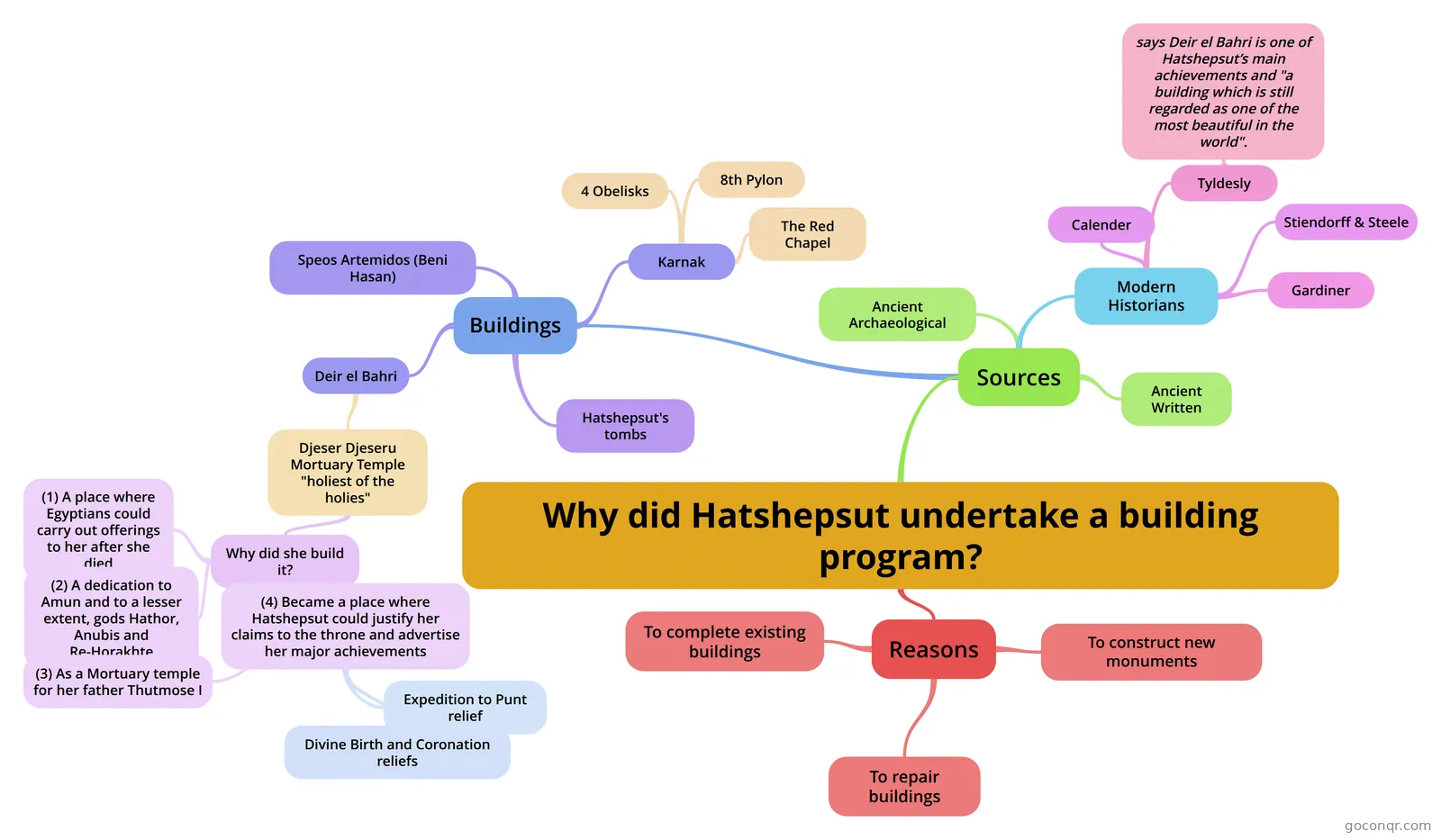 Why did Hatshepsut undertake a building program?
-
UNIIIIIIT 5: Ancient Egyptian Gods Mind map on some of the Ancient Egyptian gods.
-
Historical overview of the Eighteenth Dynasty
-
Ancient Egypt mindmap Year 7
Flashcards
See all 257 flashcards-
122 cardsAncient - Half Yearlies - NKE + Akhenaten Role of the pharaoh
-
24 cardsAncient Egypt Exam
-
11 cardsprocess of mummification this shows all 10 steps of mummification i hope it helps with the upcoming exam.
-
15 cardsChapter 5; Ancient Egypt and Kush (Study Guide) Who was the first great engineer who built the pyramids?
-
8 cardsAncient Egypt -ANCIENT EGYPT- The Pharaohs
-
10 cardsAncient Egypt
-
10 cardsHOW THE EGYPTIANS LIVE was life in ancient Egypt traditional or non traditional ?
-
3 cardsHatshepsut Study Notes Who was Sequenenre and how did he aid Hatshepsut?
Flowcharts
See all 12 flowchartsNotes
See all 35 notes-
The Reign of Amenhotep III - created from Mind Map Religious Policy: maintenance and development of Amun as chief state God - temple of Amun at Luxor; claims direct descent from Amun in divine birth scenes - Luxor temple; increased emphasis on solar deities - Nekhbet,...
-
Untitled -Nile River- river was a major source of aquatic life flooding was predictable was a symbol of god and life had to control flooding with irrigation/dams/drainage once you build your crops ( all examples of communal an...
-
egypt old kingdom(3100-2181)BCmiddle kingdom(2055-1795)BCnew kingdom(1550-1069)BCptolemaic kingdom(715-31)BCfinally, in 31 BC, egypt was annexed by the romans and disappeared as a civilisationthe egyptian leader used the ti...
-
History-Ancient Egypt - created from Mind Map Jobs Upper Class Middle Class Lower Class Pharaoh Pharaoh's Family Scribes Government Priests Ranking Soldiers Artists Farmers Soldiers Jewelry makers Sculptures Servants Slaves Religion Gods life after death Amun Re ...
-
Egypt beyond the pyramids - created from Mind Map material culture human response to the enviroment development of states and empires
-
Ancient Egypt_1 River Nile called gift because it provided egyptions with food and water and was names it by the greek Herodus the Delta is parts of the river that split into different parts provided them with fish, duck, geese, oxen...
-
The Amarna ‘Revolution’: Religion, Kingship, Akhetaten (Tel el-Amarna) - created from Mind Map Religion Kingship Akhetaten
-
Egypt Bentley Notes pt.2 City Names Vague Locations Dates/Times Names Historical Evidence/Relations Similar to Mesopotamia, densely populated cities introduced the idea of a specialized labor force in early African agricultural ...
Slides
See all 19 slidesTopics in Ancient Egypt
More History topics
About Ancient Egypt
GoConqr OriginalWhat the page covers
The resources here run from the big picture to close detail. Several mind maps work as overviews, such as Ancient Egypt and Ancient Egypt's Social Classes, which sort out religion, society, geography, the power of the pharaoh, trade and the afterlife. Others go deeper. Geography, topography and resources of Egypt and its neighbours covers the Nile, the three seasons of inundation, planting and harvest, and the cataracts.
People, gods and rulers
For rulers, look at Historical overview of the Eighteenth Dynasty, The Reign of Amenhotep III and Hatshepsut Study Notes. The mind map on why Hatshepsut undertook a building program sets out reasons and the modern historians who discuss them. The Amarna mind map looks at religion, kingship and Akhetaten. For religion, UNIIIIIIT 5: Ancient Egyptian Gods covers Amun, Amun-Ra and Anubis, and the deck process of mummification walks through the steps.
Where to start
- Open a general mind map to see the main themes.
- Move to the Nile and geography map, since the river shapes much of what follows.
- Work through the pharaohs, gods and mummification resources.
- Finish with flashcards and quizzes on the topics that felt shaky.
The deck Chapter 5; Ancient Egypt and Kush (Study Guide) is a handy question-and-answer set on pyramids, capitals and envoys. Some decks and quizzes refer to AP World History, and some of the Eighteenth Dynasty material suits older school students studying Ancient History.
Using quizzes and maps together
Read a map first, then take a quiz such as Ancient Pharaohs, Pyramids or The Journey to the afterlife. Wrong answers show you which branch of the map to revisit. Then flip through a flashcard deck to fix the terms in your memory. Teachers can set a map as a starter and a quiz as a quick check.
Where this unit sits
Ancient Egypt belongs to the strand Foundations and the Ancient World in History. Choose a resource that matches your question, and see how far it takes you.
Frequently asked questions
Where should I start with Ancient Egypt?
Start with one of the general mind maps called Ancient Egypt. They split the topic into religion, society, geography, the pharaoh, trade and the afterlife. Once you know the shape of the topic, move to a focused map, then test yourself with a quiz.
Which quizzes are on this page?
There are more than 100 quizzes, covering pharaohs, pyramids, the Nile, gods, mummification and the afterlife. Examples include Ancient Pharaohs, Pyramids, Nile River and The Journey to the afterlife. Try one after reading a map to see what you remember.
Are the resources free to use?
Yes. Every resource listed here is free to open, study and take, with no account needed. They were made by GoConqr users, not by GoConqr itself, so styles and depth vary. Check a few and use the ones that suit how you revise.
Which exams or levels do they suit?
Most resources are aimed at school students, and a smaller share suits primary pupils. Some mention AP World History, and others cover Eighteenth Dynasty topics in detail. Look at the titles and excerpts to judge which fit your course.
What do the mind maps on pharaohs cover?
They cover the role of the pharaoh, Maat and the Sed Festival, and the Eighteenth Dynasty's social, political and military structure. Others look at Hatshepsut's building program and the reign of Amenhotep III. They suit anyone building a timeline of rulers.
What if I cannot find what I need?
You can make your own. A free account saves your quiz scores and lets you create quizzes, mind maps, flashcards and notes on any gap you spot, such as a particular pharaoh or ritual.