
Mind map
Short- & Long-Term Memory
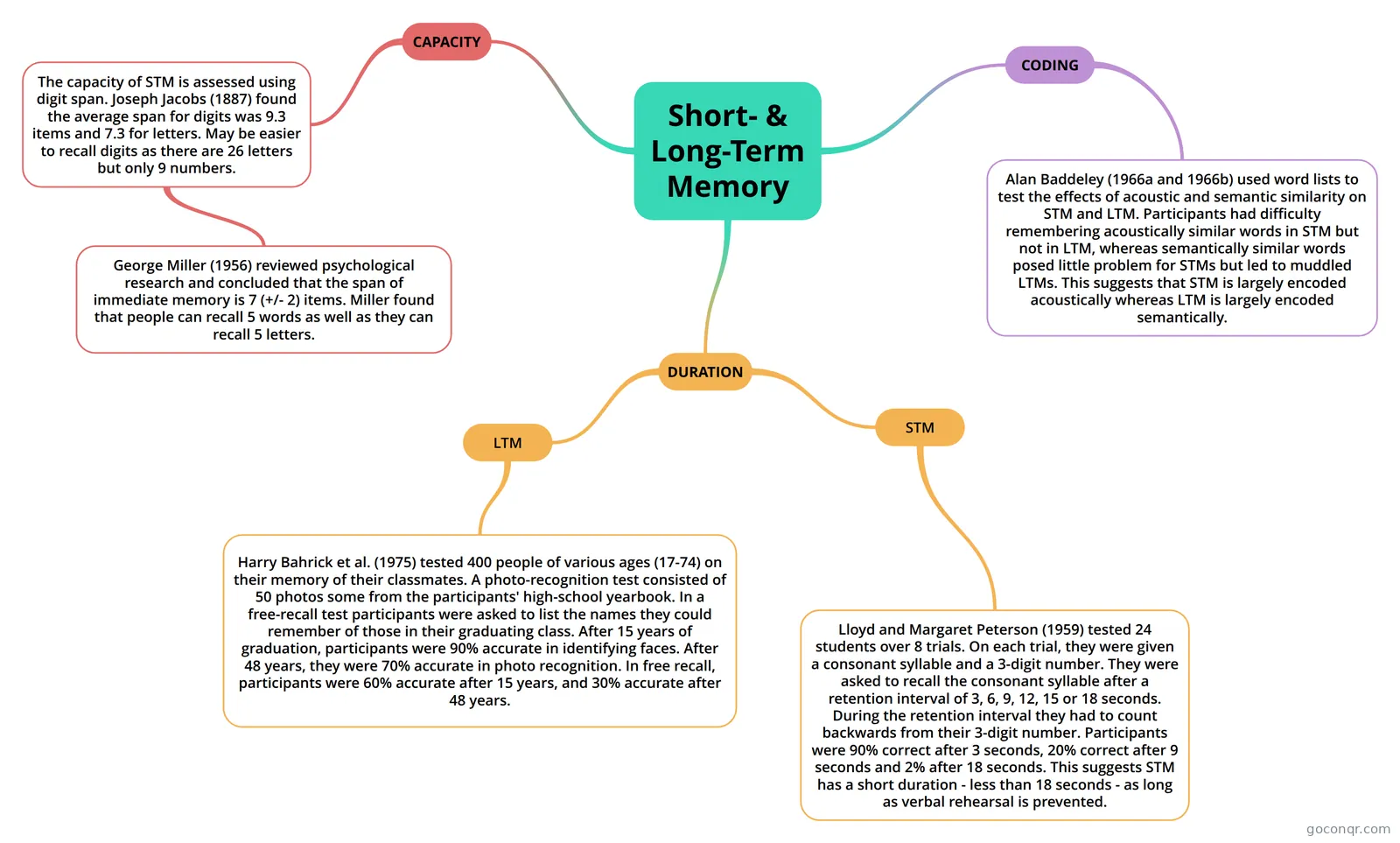
Mind map: Short- & Long-Term Memory
Map content
Short- & Long-Term Memory
CAPACITY
- The capacity of STM is assessed using digit span. Joseph Jacobs (1887) found the average span for digits was 9.3 items and 7.3 for letters. May be easier to recall digits as there are 26 letters but only 9 numbers.
- George Miller (1956) reviewed psychological research and concluded that the span of immediate memory is 7 (+/- 2) items. Miller found that people can recall 5 words as well as they can recall 5 letters.
- The capacity of STM is assessed using digit span. Joseph Jacobs (1887) found the average span for digits was 9.3 items and 7.3 for letters. May be easier to recall digits as there are 26 letters but only 9 numbers.
DURATION
- LTM
- Harry Bahrick et al. (1975) tested 400 people of various ages (17-74) on their memory of their classmates. A photo-recognition test consisted of 50 photos some from the participants' high-school yearbook. In a free-recall test participants were asked to list the names they could remember of those in their graduating class. After 15 years of graduation, participants were 90% accurate in identifying faces. After 48 years, they were 70% accurate in photo recognition. In free recall, participants were 60% accurate after 15 years, and 30% accurate after 48 years.
- STM
- Lloyd and Margaret Peterson (1959) tested 24 students over 8 trials. On each trial, they were given a consonant syllable and a 3-digit number. They were asked to recall the consonant syllable after a retention interval of 3, 6, 9, 12, 15 or 18 seconds. During the retention interval they had to count backwards from their 3-digit number. Participants were 90% correct after 3 seconds, 20% correct after 9 seconds and 2% after 18 seconds. This suggests STM has a short duration - less than 18 seconds - as long as verbal rehearsal is prevented.
- LTM
CODING
- Alan Baddeley (1966a and 1966b) used word lists to test the effects of acoustic and semantic similarity on STM and LTM. Participants had difficulty remembering acoustically similar words in STM but not in LTM, whereas semantically similar words posed little problem for STMs but led to muddled LTMs. This suggests that STM is largely encoded acoustically whereas LTM is largely encoded semantically.
Information
- Description
- A level Psychology (Memory) Mind Map on Short- & Long-Term Memory, created by Jade Ellison on 23/10/2017.
- Created by
- Jade Ellison
- Views
- 0
- Rating