
Mind map
Cognitive Development
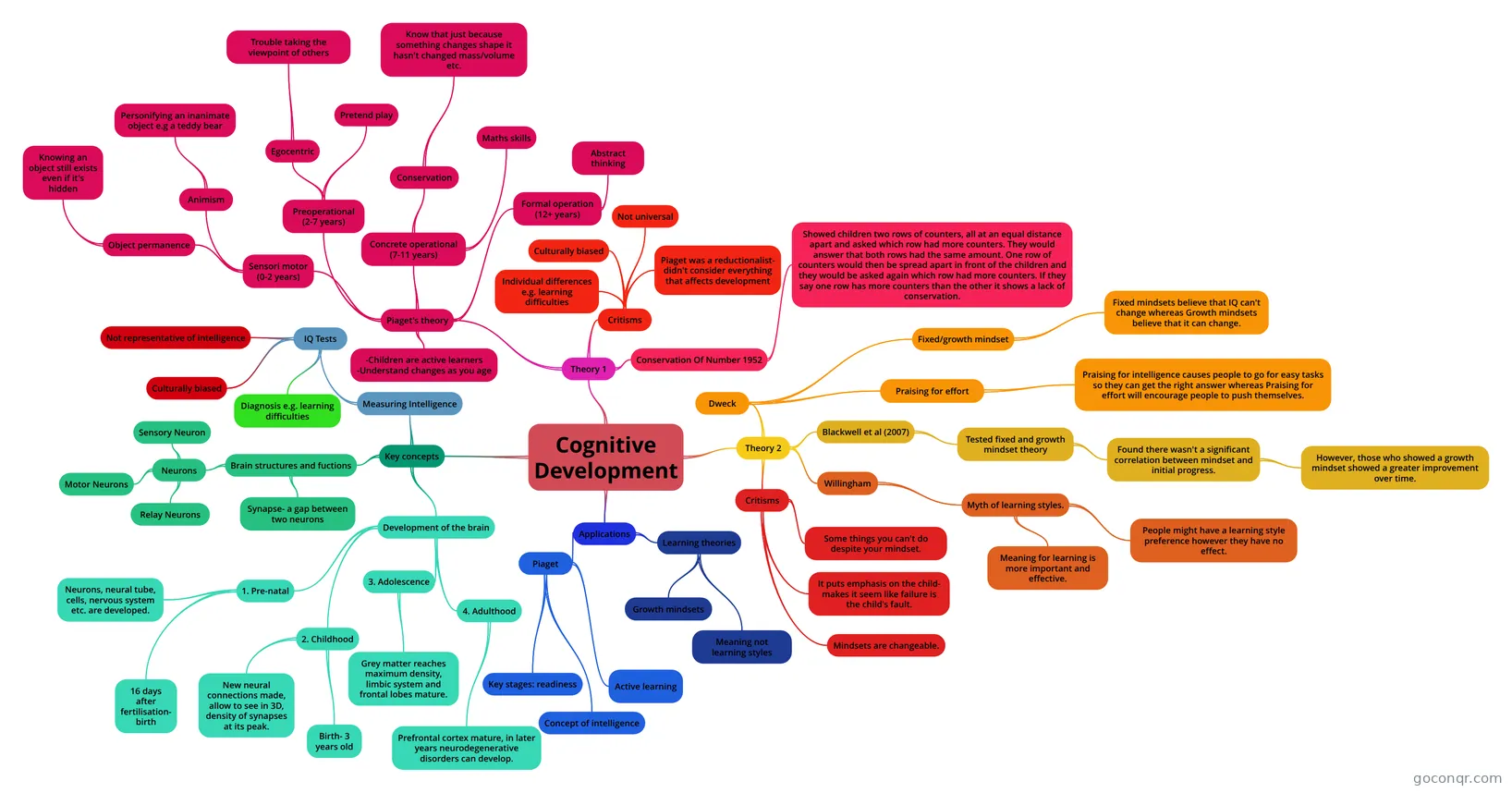
Mind map: Cognitive Development: Theories and Concepts
Map content
Cognitive Development
Key concepts
- Brain structures and fuctions
- Synapse- a gap between two neurons
- Neurons
- Sensory Neuron
- Motor Neurons
- Relay Neurons
- Development of the brain
- 1. Pre-natal
- Neurons, neural tube, cells, nervous system etc. are developed.
- 16 days after fertilisation- birth
- 2. Childhood
- New neural connections made, allow to see in 3D, density of synapses at its peak.
- Birth- 3 years old
- 3. Adolescence
- Grey matter reaches maximum density, limbic system and frontal lobes mature.
- 4. Adulthood
- Prefrontal cortex mature, in later years neurodegenerative disorders can develop.
- 1. Pre-natal
- Measuring Intelligence
- IQ Tests
- Not representative of intelligence
- Culturally biased
- Diagnosis e.g. learning difficulties
- IQ Tests
- Brain structures and fuctions
Theory 1
- Piaget's theory
- -Children are active learners -Understand changes as you age
- Sensori motor (0-2 years)
- Object permanence
- Knowing an object still exists even if it's hidden
- Animism
- Personifying an inanimate object e.g a teddy bear
- Object permanence
- Preoperational (2-7 years)
- Egocentric
- Trouble taking the viewpoint of others
- Pretend play
- Egocentric
- Concrete operational (7-11 years)
- Conservation
- Know that just because something changes shape it hasn't changed mass/volume etc.
- Maths skills
- Conservation
- Formal operation (12+ years)
- Abstract thinking
- Critisms
- Culturally biased
- Not universal
- Individual differences e.g. learning difficulties
- Piaget was a reductionalist- didn't consider everything that affects development
- Conservation Of Number 1952
- Showed children two rows of counters, all at an equal distance apart and asked which row had more counters. They would answer that both rows had the same amount. One row of counters would then be spread apart in front of the children and they would be asked again which row had more counters. If they say one row has more counters than the other it shows a lack of conservation.
- Piaget's theory
Theory 2
- Dweck
- Fixed/growth mindset
- Fixed mindsets believe that IQ can't change whereas Growth mindsets believe that it can change.
- Praising for effort
- Praising for intelligence causes people to go for easy tasks so they can get the right answer whereas Praising for effort will encourage people to push themselves.
- Fixed/growth mindset
- Blackwell et al (2007)
- Tested fixed and growth mindset theory
- Found there wasn't a significant correlation between mindset and initial progress.
- However, those who showed a growth mindset showed a greater improvement over time.
- Found there wasn't a significant correlation between mindset and initial progress.
- Tested fixed and growth mindset theory
- Willingham
- Myth of learning styles.
- People might have a learning style preference however they have no effect.
- Meaning for learning is more important and effective.
- Myth of learning styles.
- Critisms
- Some things you can't do despite your mindset.
- It puts emphasis on the child- makes it seem like failure is the child's fault.
- Mindsets are changeable.
- Dweck
Applications
- Piaget
- Key stages: readiness
- Active learning
- Concept of intelligence
- Learning theories
- Growth mindsets
- Meaning not learning styles
- Piaget
Information
- Description
- Mind Map on Cognitive Development, created by Taylor Hartung on 06/11/2017.
- Created by
- Taylor Hartung
- Views
- 14
- Rating