
Mind map
Cognitive Development
Map content
Cognitive Development
Vygotzy's Theory
- Development occurs in a social environment: we learn our cognitions through social interactions (behaviourist-like learning)
- Children initially respond to their environment through actions which are later given meaning by society (*TRUE POINT EXAMPLE)
- e.g.: 1. Child tries to reach for object and fails. 2. Mother (or main carer) sees this attempt and interprets movement as a point (towards whatever object is grabbing child's attention) 3. Mother labels movement as 'point' through language. 4. Meaning in social context is learned and child will learn that this movement is more effective the more refined it is > development of mental association of action + meaning
- Children initially respond to their environment through actions which are later given meaning by society (*TRUE POINT EXAMPLE)
- Suggests children learn through internalisation
- Interpersonal interactions are INTERNALISED, thus becoming INTRApersonal (internal debate)
- Child develops meaning of actions through language/internal dialogue
- Language = great importance: internal dialogue relies heavily upon it, it converges with thought as child becomes more proficient and internalises language, and without it, we would have no internal dialogue
- Suggest children are apprentices that acquire skills through collaboration (Unlike Piaget who suggests the child is an explorer)
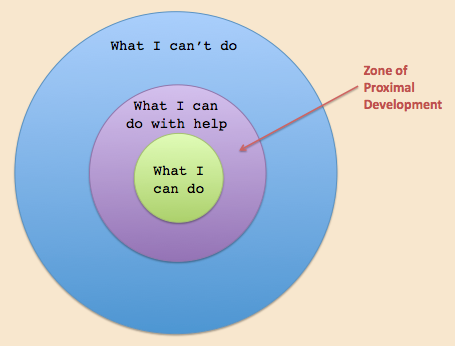
- ZPD - Zone of Proximal Development
- Represents what the child can do with guidance, and what it will thus be able to do thereafter
- V suggests that ZPD is very important as it shows child's potential cognitive development and is a prospective measure of development (Unlike Piaget who only focuses on what the child has mastered)
- Major implications for education: e.g. two 8 year olds: with same cognitive skills when tested separate;y: when given guidance, one completes tasks at mental age of ZPD +4yrs (12), and the other ZPD+1yr (9) > are they considered to have the same level of intelligence?
- V thus suggests that not just adults who can guide a child, one of the most effective ways to encourage collaborative learning was with the help of more advanced children
- Due to conflict between the west and USSR, Vygotzy's work wasn't recognised until the 1960s, so we cannot be sure that he conducted well-designed experiments ...however
- Research by Wood et al (75) showed the most effective learning took place when a child's mother showed contingency depending on how much help a child needed (different levels are offered until the child can complete the task independently) These levels of help are known as scaffolding
- Norman-Jackson (82) study of low-income black families showed that children who easily grasped reading were more likely to have older siblings who had taught them through "playing school"
- Roazzi and Bryant (98) paired 4-5 year olds with older and more cognitively advanced children with the task of working out how many sweets in a box, against a control group of independent young children. They found that the control group had poor estimates + strategies when it came to solving the task, whilst the other group were able to master and independently complete it after being prompted and guided by the older more advanced children.
- Other types of collaborative work: Co-operative group work amongst peers with similar ages + abilities. Bennet and Dune (89) found that this was effective in encouraging active participation, children in groups were more likely to show logical thinking in comparison to those who worked independently. > implication: suggests that working with those who think differently to yourself stimulates cognitive development
- CONTRA: Brown and Palinscar (89) stated that there are individual differences between children, which will determine the effectiveness of collaborative work. e.g.: social status, ability, personality, type of information and the way it is processed from person to person > all important variables
- Other types of collaborative work: Co-operative group work amongst peers with similar ages + abilities. Bennet and Dune (89) found that this was effective in encouraging active participation, children in groups were more likely to show logical thinking in comparison to those who worked independently. > implication: suggests that working with those who think differently to yourself stimulates cognitive development
- However, these were observational studies and didn't have full control of the variables (showing sibling guidance)
- Roazzi and Bryant (98) paired 4-5 year olds with older and more cognitively advanced children with the task of working out how many sweets in a box, against a control group of independent young children. They found that the control group had poor estimates + strategies when it came to solving the task, whilst the other group were able to master and independently complete it after being prompted and guided by the older more advanced children.
- Norman-Jackson (82) study of low-income black families showed that children who easily grasped reading were more likely to have older siblings who had taught them through "playing school"
- Research by Wood et al (75) showed the most effective learning took place when a child's mother showed contingency depending on how much help a child needed (different levels are offered until the child can complete the task independently) These levels of help are known as scaffolding
- Due to conflict between the west and USSR, Vygotzy's work wasn't recognised until the 1960s, so we cannot be sure that he conducted well-designed experiments ...however
- V thus suggests that not just adults who can guide a child, one of the most effective ways to encourage collaborative learning was with the help of more advanced children
- Major implications for education: e.g. two 8 year olds: with same cognitive skills when tested separate;y: when given guidance, one completes tasks at mental age of ZPD +4yrs (12), and the other ZPD+1yr (9) > are they considered to have the same level of intelligence?
- V suggests that ZPD is very important as it shows child's potential cognitive development and is a prospective measure of development (Unlike Piaget who only focuses on what the child has mastered)
- Represents what the child can do with guidance, and what it will thus be able to do thereafter
- ZPD - Zone of Proximal Development
- Suggest children are apprentices that acquire skills through collaboration (Unlike Piaget who suggests the child is an explorer)
- Language = great importance: internal dialogue relies heavily upon it, it converges with thought as child becomes more proficient and internalises language, and without it, we would have no internal dialogue
- Child develops meaning of actions through language/internal dialogue
- Interpersonal interactions are INTERNALISED, thus becoming INTRApersonal (internal debate)
- Development occurs in a social environment: we learn our cognitions through social interactions (behaviourist-like learning)
Piaget's Theory
- Suggests cognitive development occurs through the child ACTIVELY exploring their environment via play
- Child constructs an understanding of reality through interaction w/ environment (discovery learning)
- Considers children to be independent explorers/scientists that engage/'experiment' with world in order to understand it. > This understanding cannot be 'taught' nor 'given' to the child
- This understanding is made through the use and storage of mental processes based on what the child encounters. (these are stored in the child's memory until it is necessary for it to be used)
- Suggests that through the maturation of these mental processes cognitive development occurs.
- Basic unit of thinking (mental units/blocks): schema (pl. schemata) = mental representations of everything a child knows about different actions, objects or situations
- -Helps to make the world more understandable and predictable (an innate craving)
- -Become true schemata the more child interacts with its environment over time
- OVER TIME: These schemata mature through adaptation which involves both assimilation and accommodation. (modifying existing schemata)
- E.g. Biscuit lid: Encountering a biscuit tin with a 'pull' lid, knowing how to do so and thus being able to successfully apply this schema to different tins with the same lid. The child will add this new object to their list of schematic list of objects that can be operated this way, thus their schemata is expanding without changing
- This is known as Assimilation - The process of fitting new scenarios into existing schemata
- E.g. cont. If the child comes across a 'screw on' lid, the use of its existing schema for this object will be unsuccessful (not wholly, there may be some grasping of the tin and using another hand to manipulate the lid) The child will thus have to use trial and error (experimentation) in order to complete the task
- This is known as Accommodation - The modification of existing schemata as a result of new info that cannot be assimilated
- P suggest that we have an innate drive to be able to cope with our environment. When in a situation where a child can cope, they are said to be in a state of equilibrium
- Equilibrium - A balance between mental structures and the environment
- When a child is unable to cope with their environment, they are said to be in a state of disequilibrium
- Disequilibrium - When a child's existing schemata cannot cope with their environment
- P states that this state is not pleasant to be in, and thus the child will do what it can in order to return to a state of equilibrium through active exploration and accommodation
- This is known as Equilibration - The drive to return to a state of equilibrium
- In middle childhood, P states that operations are required. Operations - Mental structures which allow the child to see the relationships between different schemata in order to understand more complex rules and situations, thus manipulate stored information more effectively
- P thus suggested that in order to develop both schemata and operations (understanding of the relationship between different schemata), children must go through four clear stages.
- This is known as an Invariant Developmental Sequence - A universally applicable set of four clear and distinct time-sensitive stages that are characterised by specific thought processes and behaviours
- States that they cannot be missed, nor can a child return to a previous stage that they've already completed. Suggests that all children go through the same stages, around the same time, at roughly the same speed.
- -Partially based on biological maturation (age and physical development), and partly influenced by the availability of learning experiences
- Development of the four stages
- Working with scientists who developed intelligence tests for the French Government > for the children
- Observed the 'mistakes' children of different ages made on these tests
- 'Mistakes' were then perceived as symptoms of different ways children of varying ages saw and thought about the world, and thus began to study his own children and others in local schools with the use of formal and informal interviews, experimental-type tasks and naturalistic observations.
- Familial bias, cannot say that it is universally applicable, lacks ecological validity
- Already looking at what children cannot do, rather than their actual cognitive abilities
- 'Mistakes' were then perceived as symptoms of different ways children of varying ages saw and thought about the world, and thus began to study his own children and others in local schools with the use of formal and informal interviews, experimental-type tasks and naturalistic observations.
- Observed the 'mistakes' children of different ages made on these tests
- The Stages
- The Pre-operational Stage
- The Sensori-Motor Stage
- This is the primary stage: lasting from birth to approximately 18 months/2 yrs old
- The child is learning to make sense of copious amount of sensory info they receive each second, whilst also learning to co-ordinate their motor movements in order to interact with their environment
- As a new-born, the child has innate reflexes which gradually become more refined through adaptation, thus becoming actions which are deliberately initiated by the child (e.g, from grasping to grabbing toys)
- For the first half of this stage, P suggests that the child is completely egocentric, meaning that the child is unaware of anything in their environment except from themselves, and sees all objects and people as extensions of themselves.
- The child is said to have no concept of object permanence as they (mentally) cannot grasp the idea that an object continues to exist if they cannot see/hear nor touch it.
- This understanding is said to be achieved around 10 months (before the end of the stage)
- The end of this stage is marked by an explosion of language (symbolic thought), which thus allows the child to form mental representations of concepts, as well as manipulate ideas of the physical world
- The child is said to have no concept of object permanence as they (mentally) cannot grasp the idea that an object continues to exist if they cannot see/hear nor touch it.
- For the first half of this stage, P suggests that the child is completely egocentric, meaning that the child is unaware of anything in their environment except from themselves, and sees all objects and people as extensions of themselves.
- As a new-born, the child has innate reflexes which gradually become more refined through adaptation, thus becoming actions which are deliberately initiated by the child (e.g, from grasping to grabbing toys)
- The child is learning to make sense of copious amount of sensory info they receive each second, whilst also learning to co-ordinate their motor movements in order to interact with their environment
- This is the primary stage: lasting from birth to approximately 18 months/2 yrs old
- The Formal Operation Stage
- This is the final stage, lasting from 11 yrs through to adulthood
- -Child can now deal with abstract concepts, as well as concrete ones .e.g. grasp concept of algebra and intangible things such as justice, morality.
- -Can solve problems through development of scientific deductive reasoning, mental consideration of hypotheses (situations and consequences) e.g. the likely response a parent would give to a specific request
- -Can mentally apply whatever they have learnt to a completely new situation and effectively cope without the use of trial and error
- -Can solve problems through development of scientific deductive reasoning, mental consideration of hypotheses (situations and consequences) e.g. the likely response a parent would give to a specific request
- -Child can now deal with abstract concepts, as well as concrete ones .e.g. grasp concept of algebra and intangible things such as justice, morality.
- This is the final stage, lasting from 11 yrs through to adulthood
- Working with scientists who developed intelligence tests for the French Government > for the children
- Development of the four stages
- -Partially based on biological maturation (age and physical development), and partly influenced by the availability of learning experiences
- States that they cannot be missed, nor can a child return to a previous stage that they've already completed. Suggests that all children go through the same stages, around the same time, at roughly the same speed.
- This is known as an Invariant Developmental Sequence - A universally applicable set of four clear and distinct time-sensitive stages that are characterised by specific thought processes and behaviours
- P thus suggested that in order to develop both schemata and operations (understanding of the relationship between different schemata), children must go through four clear stages.
- In middle childhood, P states that operations are required. Operations - Mental structures which allow the child to see the relationships between different schemata in order to understand more complex rules and situations, thus manipulate stored information more effectively
- This is known as Equilibration - The drive to return to a state of equilibrium
- P states that this state is not pleasant to be in, and thus the child will do what it can in order to return to a state of equilibrium through active exploration and accommodation
- Disequilibrium - When a child's existing schemata cannot cope with their environment
- When a child is unable to cope with their environment, they are said to be in a state of disequilibrium
- Equilibrium - A balance between mental structures and the environment
- P suggest that we have an innate drive to be able to cope with our environment. When in a situation where a child can cope, they are said to be in a state of equilibrium
- This is known as Accommodation - The modification of existing schemata as a result of new info that cannot be assimilated
- E.g. Biscuit lid: Encountering a biscuit tin with a 'pull' lid, knowing how to do so and thus being able to successfully apply this schema to different tins with the same lid. The child will add this new object to their list of schematic list of objects that can be operated this way, thus their schemata is expanding without changing
- OVER TIME: These schemata mature through adaptation which involves both assimilation and accommodation. (modifying existing schemata)
- -Become true schemata the more child interacts with its environment over time
- -Helps to make the world more understandable and predictable (an innate craving)
- Basic unit of thinking (mental units/blocks): schema (pl. schemata) = mental representations of everything a child knows about different actions, objects or situations
- Suggests that through the maturation of these mental processes cognitive development occurs.
- Child constructs an understanding of reality through interaction w/ environment (discovery learning)
- Suggests cognitive development occurs through the child ACTIVELY exploring their environment via play
Images and files in the map
Information
- Description
- Mind Map on Cognitive Development, created by Jay Emm on 02/04/2018.
- Created by
- Jay Emm
- Views
- 1
- Rating