
Mind map
Memory!
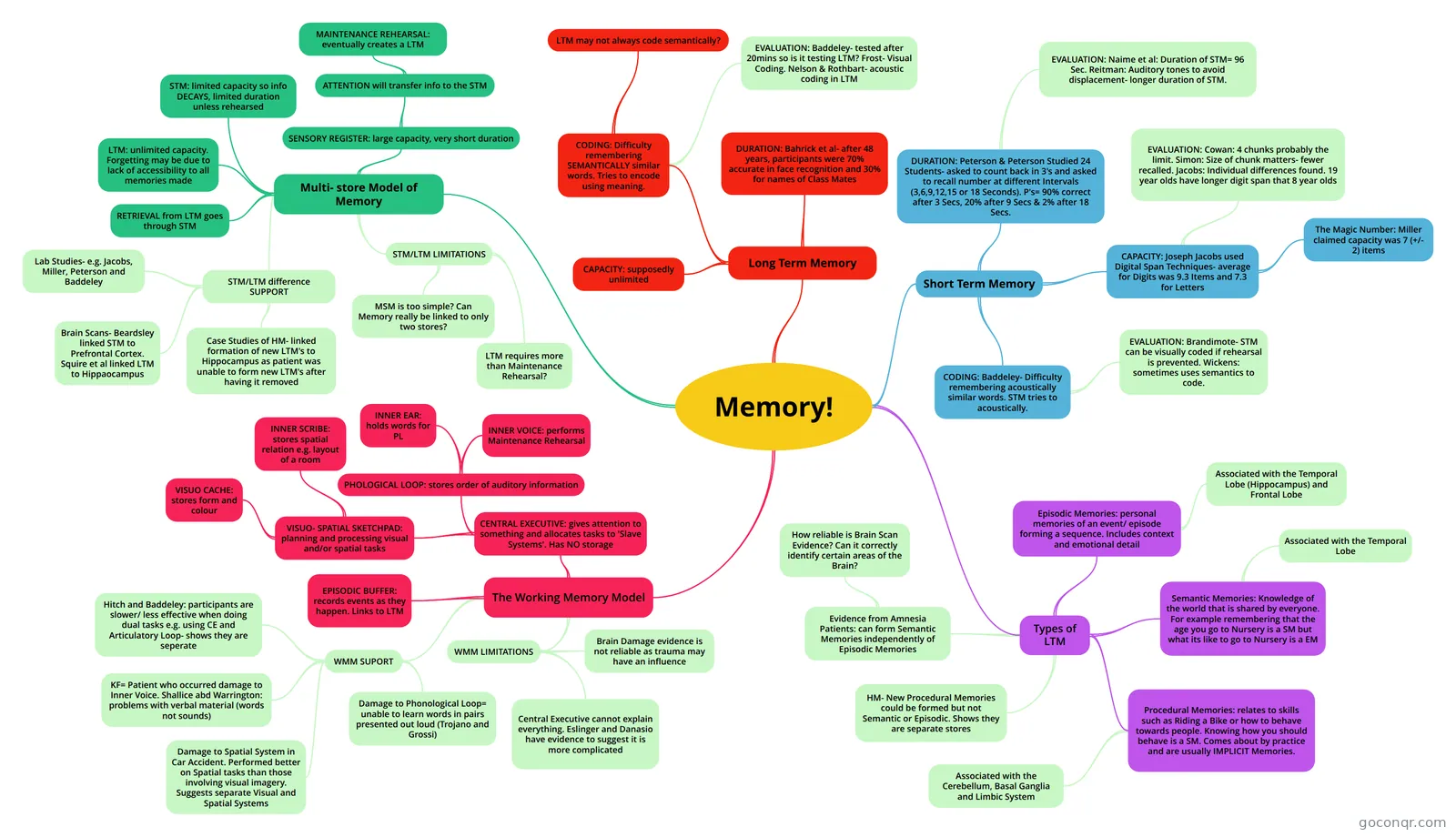
Mind map: Memory
Map content
Memory!
Short Term Memory
- CAPACITY: Joseph Jacobs used Digital Span Techniques- average for Digits was 9.3 Items and 7.3 for Letters
- The Magic Number: Miller claimed capacity was 7 (+/- 2) items
- EVALUATION: Cowan: 4 chunks probably the limit. Simon: Size of chunk matters- fewer recalled. Jacobs: Individual differences found. 19 year olds have longer digit span that 8 year olds
- DURATION: Peterson & Peterson Studied 24 Students- asked to count back in 3's and asked to recall number at different Intervals (3,6,9,12,15 or 18 Seconds). P's= 90% correct after 3 Secs, 20% after 9 Secs & 2% after 18 Secs.
- EVALUATION: Naime et al: Duration of STM= 96 Sec. Reitman: Auditory tones to avoid displacement- longer duration of STM.
- CODING: Baddeley- Difficulty remembering acoustically similar words. STM tries to acoustically.
- EVALUATION: Brandimote- STM can be visually coded if rehearsal is prevented. Wickens: sometimes uses semantics to code.
- CAPACITY: Joseph Jacobs used Digital Span Techniques- average for Digits was 9.3 Items and 7.3 for Letters
Long Term Memory
- CAPACITY: supposedly unlimited
- DURATION: Bahrick et al- after 48 years, participants were 70% accurate in face recognition and 30% for names of Class Mates
- CODING: Difficulty remembering SEMANTICALLY similar words. Tries to encode using meaning.
- EVALUATION: Baddeley- tested after 20mins so is it testing LTM? Frost- Visual Coding. Nelson & Rothbart- acoustic coding in LTM
- LTM may not always code semantically?
Multi- store Model of Memory
- SENSORY REGISTER: large capacity, very short duration
- ATTENTION will transfer info to the STM
- MAINTENANCE REHEARSAL: eventually creates a LTM
- ATTENTION will transfer info to the STM
- STM: limited capacity so info DECAYS, limited duration unless rehearsed
- LTM: unlimited capacity. Forgetting may be due to lack of accessibility to all memories made
- RETRIEVAL from LTM goes through STM
- STM/LTM difference SUPPORT
- Lab Studies- e.g. Jacobs, Miller, Peterson and Baddeley
- Brain Scans- Beardsley linked STM to Prefrontal Cortex. Squire et al linked LTM to Hippaocampus
- Case Studies of HM- linked formation of new LTM's to Hippocampus as patient was unable to form new LTM's after having it removed
- STM/LTM LIMITATIONS
- MSM is too simple? Can Memory really be linked to only two stores?
- LTM requires more than Maintenance Rehearsal?
- SENSORY REGISTER: large capacity, very short duration
The Working Memory Model
- CENTRAL EXECUTIVE: gives attention to something and allocates tasks to 'Slave Systems'. Has NO storage
- PHOLOGICAL LOOP: stores order of auditory information
- INNER EAR: holds words for PL
- INNER VOICE: performs Maintenance Rehearsal
- VISUO- SPATIAL SKETCHPAD: planning and processing visual and/or spatial tasks
- VISUO CACHE: stores form and colour
- INNER SCRIBE: stores spatial relation e.g. layout of a room
- PHOLOGICAL LOOP: stores order of auditory information
- EPISODIC BUFFER: records events as they happen. Links to LTM
- WMM SUPORT
- Hitch and Baddeley: participants are slower/ less effective when doing dual tasks e.g. using CE and Articulatory Loop- shows they are seperate
- KF= Patient who occurred damage to Inner Voice. Shallice abd Warrington: problems with verbal material (words not sounds)
- Damage to Phonological Loop= unable to learn words in pairs presented out loud (Trojano and Grossi)
- Damage to Spatial System in Car Accident. Performed better on Spatial tasks than those involving visual imagery. Suggests separate Visual and Spatial Systems
- WMM LIMITATIONS
- Brain Damage evidence is not reliable as trauma may have an influence
- Central Executive cannot explain everything. Eslinger and Danasio have evidence to suggest it is more complicated
- CENTRAL EXECUTIVE: gives attention to something and allocates tasks to 'Slave Systems'. Has NO storage
Types of LTM
- Episodic Memories: personal memories of an event/ episode forming a sequence. Includes context and emotional detail
- Associated with the Temporal Lobe (Hippocampus) and Frontal Lobe
- Semantic Memories: Knowledge of the world that is shared by everyone. For example remembering that the age you go to Nursery is a SM but what its like to go to Nursery is a EM
- Associated with the Temporal Lobe
- Procedural Memories: relates to skills such as Riding a Bike or how to behave towards people. Knowing how you should behave is a SM. Comes about by practice and are usually IMPLICIT Memories.
- Associated with the Cerebellum, Basal Ganglia and Limbic System
- HM- New Procedural Memories could be formed but not Semantic or Episodic. Shows they are separate stores
- Evidence from Amnesia Patients: can form Semantic Memories independently of Episodic Memories
- How reliable is Brain Scan Evidence? Can it correctly identify certain areas of the Brain?
- Episodic Memories: personal memories of an event/ episode forming a sequence. Includes context and emotional detail
Information
- Description
- A-Level Psychology Mind Map on Memory!, created by Emma-Leigh Forman on 15/01/2016.
- Created by
- Emma-Leigh Forman
- Views
- 0
- Rating