
Mind map
Psychology: Illusions (2)
Map content
Psychology: Illusions (2)
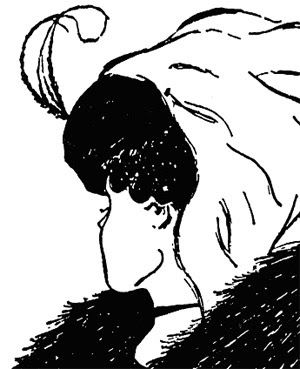
Leeper's 1935 experiment
- *Leeper showed participants a picture of a young or old face, followed by the Leeper's lady illusion. *Leeper found that the picture that they had already seen (the young or old face) affected their perception of the illusion. *If they had seen the old face, they saw the old woman first. *If they had seen the young face, they saw the young woman first.
Petersons 1994 experiment
- Aim
- Peterson conducted an experiment to see which we do first when we look at an image: *Recognise the object OR *Divide the stimulus into figure and ground
- Procedure
- The participants saw images black and white images and then judged whether the black or white area was the figure. She tested them again with the image upside down to make recognising the objects more difficult.
- Findings
- She found that participants were much slower to judge which area was the figure when the images were upside down.
- Conclusion
- This shows that they were recognising the object before they recognised their perception into figure and ground.
- Aim
Gestalt theory of illusions description
- Gestalt theory of illusions suggests that we use Gestalt laws such as figure-ground and continuity when we shouldn't, which creates illusions. To explain ambiguous figures , the Gestalt law of figure-ground is used. This means that we can perceive two different interpretations of the image because there are two possible figures (which we can switch between) and two possible grounds. For example, Leeper's Lady or Rubins Vase. In Rubins Vase, the two possible figures are the vase and silohouettes.
Strengths and Weaknesses of Gestalt
- Strengths
- Strength 1: Gestalt theory provides a good explanation of ambiguous figures and can explain more of these than Gregory's theory can. It uses figure-ground as there are two possible figures and two possible grounds. Strength 2: Gestalt theory explains fiction illusions well and can explain more of these than Gregory's theory can. Kanizsa Triangle explanation.
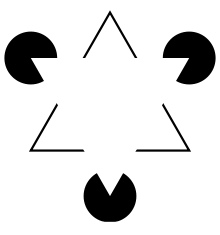
- Kanizsa Triangle
- FICTION ILLUSION - Because of bitten circles, we can see an incomplete (white) triangle. We use closure to complete the edges so that we see a white triangle. This white triangle then becomes the figure in the stimulus. Everything else (bitten circles and arrowheads) becomes the ground.
- Weaknesses
- Weakness 1: There is a problem when explaining the Kanizsa Triangle. if we use the law of closure to complete the figure, we should join the bitten circles to the arrowheads. if we do this, we should see a six-pointed star. But we don't, we see two triangles. The way the Gestalt theory explains it doesn't seem to be accurate.
- Weakness 2: Gestalt theory can only explain the Muller-Lyer illusion and not any other distortions. Gregory's theory of illusions would be better for explaining all distortions.
- Strengths
Gregory's theory
- Description
- - Gregory suggested illusions trick us because we perceive linear perspective from parallel lines and so we use size constancy when we shouldn't. 1. First of all, we find the linear perspective which are two parallel lines. 2. Afterwards, we use linear perspective to interpret which objects are close to us and which are further away in the illusion. 3. We know an object is close to us if the lines are far apart; an object is far away if the lines are close together. 4. We use size constancy to make objects normal size.
- 5.The object closer to us is scaled down to make it seem normal rather than big. 6. The object further away is scaled up to make it seem normal rather than small. 7.This creates the illusion we think the object further away is bigger than the one closer to us even though they are the same size.
- Evaluation
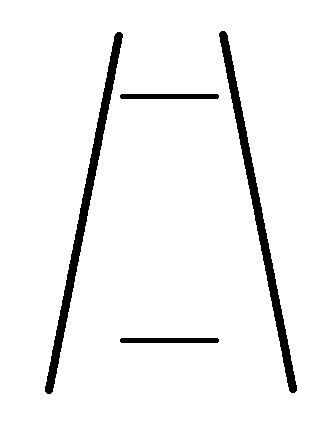
- Gregory's theory contains both strengths and weaknesses. A strength is that the theory is able to explain distortion illusions well and more of these than the Gestalt theory. For example: the PONZO illusion demonstrates this. From this, we know that the bottom line is closer to us than the top line because the parallel lines are further apart. As the bottom line is closer to us, we scale it down and make it smaller using size constancy.
- As the top line is far away, we scale it up and make it bigger using size constancy. this creates the illusion that we think the top line is bigger than the bottom line even though they are the same size.
- On the other hand, a weakness is that the theory cannot explain the circle version of the Muller-Lyer illusion. When they are circles instead of arrow heads, we have no linear perspective because there are no angled lines to misinterpret. Therefore, we shouldn't use size constancy and the illusion shouldn't work. Since it does, it is a weakness.
- Description
Definitions
- Visual illusion
- A conflict between reality and what we perceive.
- Fiction
- An illusion caused when a figure is perceived even though it is not present in the stimulus.
- Illusory contour
- A boundary (edge) that is perceived in a figure but it is not present in the stimulus.
- After-effects
- Colour
- An illusion caused by focusing on a coloured stimulus and perceiving opposite colours immediately afterwards.
- Motion
- An illusion caused by paying attention to movement in one direction and perceiving movement in the opposite direction immediately afterwards.
- Colour
- Ambiguous figures
- A stimulus with two possible interpretations in which it is only possible to see one of the alternatives at any time.
- Distortions
- Where our perception is deceived by some aspect of the stimulus. This can affect the shape or size or an object. For example, a distortion can make a figure seem bigger and smaller than it really is.
- Visual illusion
illusions
- Ponzo
- Are the two bars the same length?
- Gregory's theory
- 1. The two diagonal lines create linear perspective. 2. From this, we know that B is closer to us than A because the lines are further apart. 3. As B is close to us we scale it down and make it smaller using size constancy. 4. As A is far away, we scale it up and make it bigger using size constancy. 5. This creates the illusion, we think A is bigger than B, even though they are the same size.
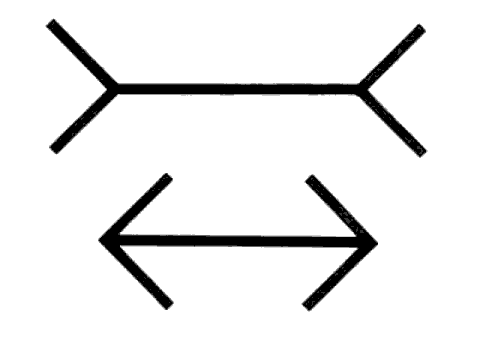
- Müller-Lyer
- Are the two vertical lines the same?
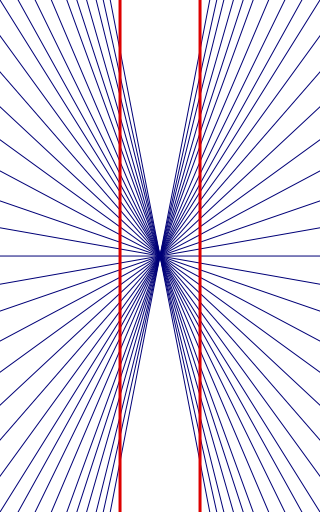
- Hering
- Are the two blue lines straight?
- Ebbinghaus
- Are the two central circles the same size?
- Ponzo
Images and files in the map

Information
- Description
- GCSE Psychology Mind Map on Psychology: Illusions (2), created by Millie Carless on 17/03/2016.
- Created by
- Millie Carless
- Views
- 7
- Rating