
Mind map
Unit 3: Eating Behaviours-Psychological
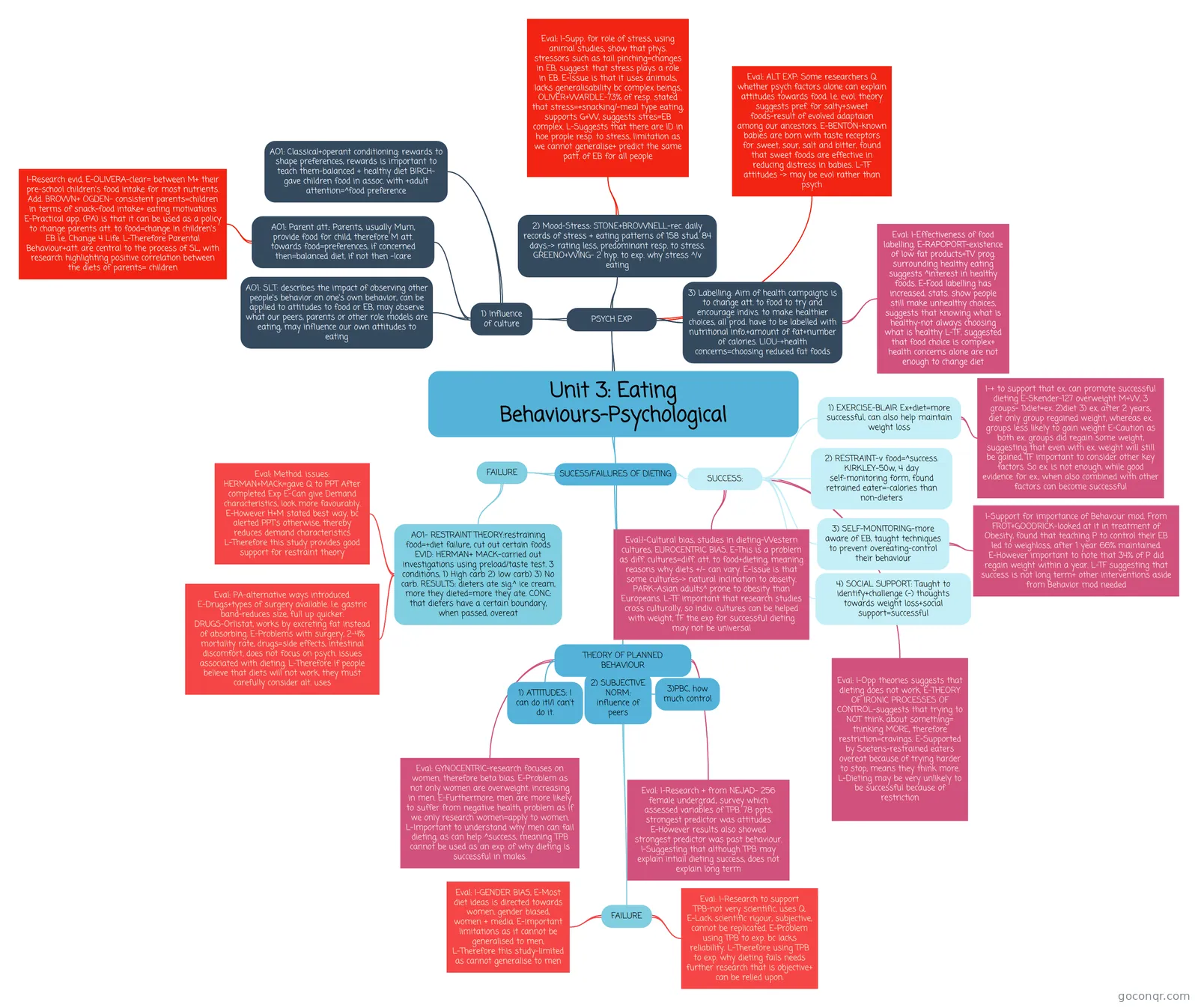
Mind map: Eating behaviours psychology
Map content
Unit 3: Eating Behaviours-Psychological
PSYCH EXP
- 1) Influence of culture
- AO1: SLT: describes the impact of observing other people's behavior on one's own behavior, can be applied to attitudes to food or EB, may observe what our peers, parents or other role models are eating, may influence our own attitudes to eating
- AO1: Parent att.: Parents, usually Mum, provide food for child, therefore M att. towards food=preferences, if concerned then=balanced diet, if not then -lcare
- I-Research evid. E-OLIVERA-clear= between M+ their pre-school children's food intake for most nutrients. Add. BROWN+ OGDEN- consistent parents=children in terms of snack-food intake+ eating motivations E-Practical app. (PA) is that it can be used as a policy to change parents att. to food=change in children's EB i.e. Change 4 Life. L-Therefore Parental Behaviour+att. are central to the process of SL, with research highlighting positive correlation between the diets of parents= children
- AO1: Classical+operant conditioning: rewards to shape preferences, rewards is important to teach them-balanced + healthy diet BIRCH- gave children food in assoc. with +adult attention=^food preference
- 2) Mood-Stress: STONE+BROWNELL-rec. daily records of stress + eating patterns of 158 stud. 84 days.-> rating less, predominant resp. to stress. GREENO+WING- 2 hyp. to exp. why stress ^/v eating
- Eval: I-Supp. for role of stress, using animal studies, show that phys. stressors such as tail pinching=changes in EB, suggest. that stress plays a role in EB. E-Issue is that it uses animals, lacks generalisability bc complex beings, OLIVER+WARDLE-73% of resp. stated that stress=+snacking/-meal type eating, supports G+W, suggests stres=EB complex. L-Suggests that there are ID in hoe prople resp. to stress, limitation as we cannot generalise+ predict the same patt. of EB for all people
- 3) Labelling: Aim of health campaigns is to change att. to food to try and encourage indivs. to make healthier choices, all prod. have to be labelled with nutritional info.+amount of fat+number of calories. LIOU-+health concerns=choosing reduced fat foods
- Eval: I-Effectiveness of food labelling. E-RAPOPORT-existence of low fat products+TV prog. surrounding healthy eating suggests ^interest in healthy foods. E-Food labelling has increased, stats. show people still make unhealthy choices, suggests that knowing what is healthy-not always choosing what is healthy L-TF, suggested that food choice is complex+ health concerns alone are not enough to change diet
- Eval: ALT EXP: Some researchers Q whether psych factors alone can explain attitudes towards food. I.e. evol. theory suggests pref. for salty+sweet foods-result of evolved adaptaion among our ancestors. E-BENTON-known babies are born with taste receptors for sweet, sour, salt and bitter, found that sweet foods are effective in reducing distress in babies. L-TF attitudes -> may be evol rather than psych
- 1) Influence of culture
SUCESS/FAILURES OF DIETING
- SUCCESS:
- 1) EXERCISE-BLAIR Ex+diet=more successful, can also help maintain weight loss
- I-+ to support that ex. can promote successful dieting E-Skender-127 overweight M+W, 3 groups- 1)diet+ex. 2)diet 3) ex, after 2 years, diet only group regained weight, whereas ex. groups less likely to gain weight E-Caution as both ex. groups did regain some weight, suggesting that even with ex. weight will still be gained, TF important to consider other key factors. So ex. is not enough, while good evidence for ex., when also combined with other factors can become successful
- 2) RESTRAINT-v food=^success. KIRKLEY-50w, 4 day self-monitoring form, found retrained eater=-calories than non-dieters
- 3) SELF-MONITORING-more aware of EB, taught techniques to prevent overeating-control their behaviour
- I-Support for importance of Behavour mod. From FROT+GOODRICK-looked at it in treatment of Obesity, found that teaching P to control their EB led to weighloss, after 1 year 66% maintained. E-However important to note that 34% of P did regain weight within a year. L-TF suggesting that success is not long term+ other interventions aside from Behavior mod needed
- 4) SOCIAL SUPPORT: Taught to identify+challenge (-) thoughts towards weight loss+social support=successful
- Eval: I-Opp theories suggests that dieting does not work. E-THEORY OF IRONIC PROCESSES OF CONTROL-suggests that trying to NOT think about something= thinking MORE, therefore restriction=cravings. E-Supported by Soetens-restrained eaters overeat because of trying harder to stop, means they think more. L-Dieting may be very unlikely to be successful because of restriction
- Eval:I-Cultural bias, studies in dieting-Western cultures, EUROCENTRIC BIAS. E-This is a problem as diff. cultures=diff. att. to food+dieting, meaning reasons why diets +/- can vary. E-Issue is that some cultures-> natural inclination to obseity. PARK-Asian adults^ prone to obesity than Europeans. L-TF important that research studies cross culturally, so indiv. cultures can be helped with weight, TF the exp for successful dieting may not be universal
- 1) EXERCISE-BLAIR Ex+diet=more successful, can also help maintain weight loss
- THEORY OF PLANNED BEHAVIOUR
- 1) ATTITUDES: I can do it!/I can't do it.
- 2) SUBJECTIVE NORM: influence of peers
- 3)PBC, how much control
- Eval: I-Research + from NEJAD- 256 female undergrad., survey which assessed variables of TPB. 78 ppts, strongest predictor was attitudes E-However results also showed strongest predictor was past behaviour. l-Suggesting that although TPB may explain intiail dieting success, does not explain long term
- Eval: GYNOCENTRIC-research focuses on women, therefore beta bias. E-Problem as not only women are overweight, increasing in men. E-Furthermore, men are more likely to suffer from negative health, problem as if we only research women=apply to women. L-Important to understand why men can fail dieting, as can help ^success, meaning TPB cannot be used as an exp. of why dieting is successful in males.
- FAILURE
- Eval: I-GENDER BIAS, E-Most diet ideas is directed towards women, gender biased, women + media. E-important limitations as it cannot be generalised to men, L-Therefore this study-limited as cannot generalise to men
- Eval: I-Research to support TPB-not very scientific, uses Q. E-Lack scientific rigour, subjective, cannot be replicated. E-Problem using TPB to exp. bc lacks reliability. L-Therefore using TPB to exp. why dieting fails needs further research that is objective+ can be relied upon.
- FAILURE
- AO1- RESTRAINT THEORY:restraining food=+diet failure, cut out certain foods EVID: HERMAN+ MACK-carried out investigations using preload/taste test. 3 conditions, 1) High carb 2) low carb) 3) No carb. RESULTS: dieters ate sig.^ ice cream, more they dieted=more they ate. CONC: that dieters have a certain boundary, when passed, overeat
- Eval: Method. issues: HERMAN+MACk=gave Q to PPT After completed Exp E-Can give Demand characteristics, look more favourably. E-However H+M stated best way, bc alerted PPT's otherwise, thereby reduces demand characteristics L-Therefore this study provides good support for restraint theory
- Eval: PA-alternative ways introduced. E-Drugs+types of surgery available. I.e. gastric band-reduces size, full up quicker. DRUGS-Orlistat, works by excreting fat instead of absorbing. E-Problems with surgery, 2-4% mortality rate, drugs=side effects, intestinal discomfort, does not focus on psych. issues associated with dieting. L-Therefore if people believe that diets will not work, they must carefully consider alt. uses
- AO1- RESTRAINT THEORY:restraining food=+diet failure, cut out certain foods EVID: HERMAN+ MACK-carried out investigations using preload/taste test. 3 conditions, 1) High carb 2) low carb) 3) No carb. RESULTS: dieters ate sig.^ ice cream, more they dieted=more they ate. CONC: that dieters have a certain boundary, when passed, overeat
- SUCCESS:
Information
- Description
- A-Level Psychology Mind Map on Unit 3: Eating Behaviours-Psychological, created by Patrick Calvento on 29/04/2016.
- Created by
- Patrick Calvento
- Views
- 0
- Tags
- History
-
- Created by Patrick Calvento · Apr 29, 2016
- Copied by Patrick Calvento · Apr 29, 2016
- Rating