
Mind map
Short term memory (STM)
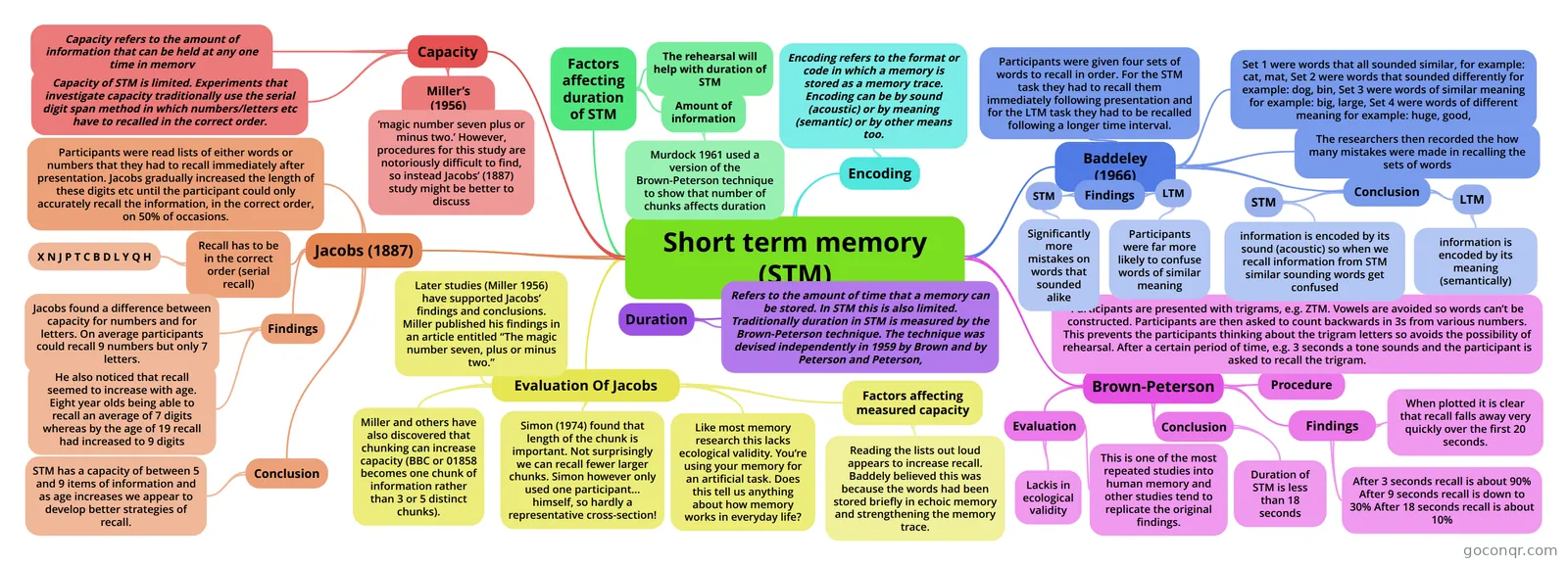
Mind map: Short term memory (STM)
Map content
Short term memory (STM)
Capacity
- Capacity refers to the amount of information that can be held at any one time in memory
- Capacity of STM is limited. Experiments that investigate capacity traditionally use the serial digit span method in which numbers/letters etc have to recalled in the correct order.
- Miller’s (1956)
- ‘magic number seven plus or minus two.’ However, procedures for this study are notoriously difficult to find, so instead Jacobs’ (1887) study might be better to discuss
Jacobs (1887)
- Participants were read lists of either words or numbers that they had to recall immediately after presentation. Jacobs gradually increased the length of these digits etc until the participant could only accurately recall the information, in the correct order, on 50% of occasions.
- Recall has to be in the correct order (serial recall)
- X N J P T C B D L Y Q H
- Findings
- Jacobs found a difference between capacity for numbers and for letters. On average participants could recall 9 numbers but only 7 letters.
- He also noticed that recall seemed to increase with age. Eight year olds being able to recall an average of 7 digits whereas by the age of 19 recall had increased to 9 digits
- Conclusion
- STM has a capacity of between 5 and 9 items of information and as age increases we appear to develop better strategies of recall.
Evaluation Of Jacobs
- Later studies (Miller 1956) have supported Jacobs’ findings and conclusions. Miller published his findings in an article entitled “The magic number seven, plus or minus two.”
- Miller and others have also discovered that chunking can increase capacity (BBC or 01858 becomes one chunk of information rather than 3 or 5 distinct chunks).
- Simon (1974) found that length of the chunk is important. Not surprisingly we can recall fewer larger chunks. Simon however only used one participant… himself, so hardly a representative cross-section!
- Like most memory research this lacks ecological validity. You’re using your memory for an artificial task. Does this tell us anything about how memory works in everyday life?
- Factors affecting measured capacity
- Reading the lists out loud appears to increase recall. Baddely believed this was because the words had been stored briefly in echoic memory and strengthening the memory trace.
Duration
- Refers to the amount of time that a memory can be stored. In STM this is also limited. Traditionally duration in STM is measured by the Brown-Peterson technique. The technique was devised independently in 1959 by Brown and by Peterson and Peterson,
Brown-Peterson
- Procedure
- Participants are presented with trigrams, e.g. ZTM. Vowels are avoided so words can’t be constructed. Participants are then asked to count backwards in 3s from various numbers. This prevents the participants thinking about the trigram letters so avoids the possibility of rehearsal. After a certain period of time, e.g. 3 seconds a tone sounds and the participant is asked to recall the trigram.
- Findings
- When plotted it is clear that recall falls away very quickly over the first 20 seconds.
- After 3 seconds recall is about 90% After 9 seconds recall is down to 30% After 18 seconds recall is about 10%
- Conclusion
- Duration of STM is less than 18 seconds
- Evaluation
- This is one of the most repeated studies into human memory and other studies tend to replicate the original findings.
- Lackis in ecological validity
- Procedure
Factors affecting duration of STM
- The rehearsal will help with duration of STM
- Amount of information
- Murdock 1961 used a version of the Brown-Peterson technique to show that number of chunks affects duration
Encoding
- Encoding refers to the format or code in which a memory is stored as a memory trace. Encoding can be by sound (acoustic) or by meaning (semantic) or by other means too.
Baddeley (1966)
- Participants were given four sets of words to recall in order. For the STM task they had to recall them immediately following presentation and for the LTM task they had to be recalled following a longer time interval.
- Set 1 were words that all sounded similar, for example: cat, mat, Set 2 were words that sounded differently for example: dog, bin, Set 3 were words of similar meaning for example: big, large, Set 4 were words of different meaning for example: huge, good,
- The researchers then recorded the how many mistakes were made in recalling the sets of words
- Findings
- STM
- Significantly more mistakes on words that sounded alike
- LTM
- Participants were far more likely to confuse words of similar meaning
- STM
- Conclusion
- STM
- information is encoded by its sound (acoustic) so when we recall information from STM similar sounding words get confused
- LTM
- information is encoded by its meaning (semantically)
- STM
Information
- Description
- A Levels Psychology (Unit 1 - Cognitive) Mind Map on Short term memory (STM), created by danny-hudson97 on 01/04/2014.
- Created by
- danny-hudson97
- Views
- 27
- Tags
- Rating