
Mind map
Upper Respiratory Tract
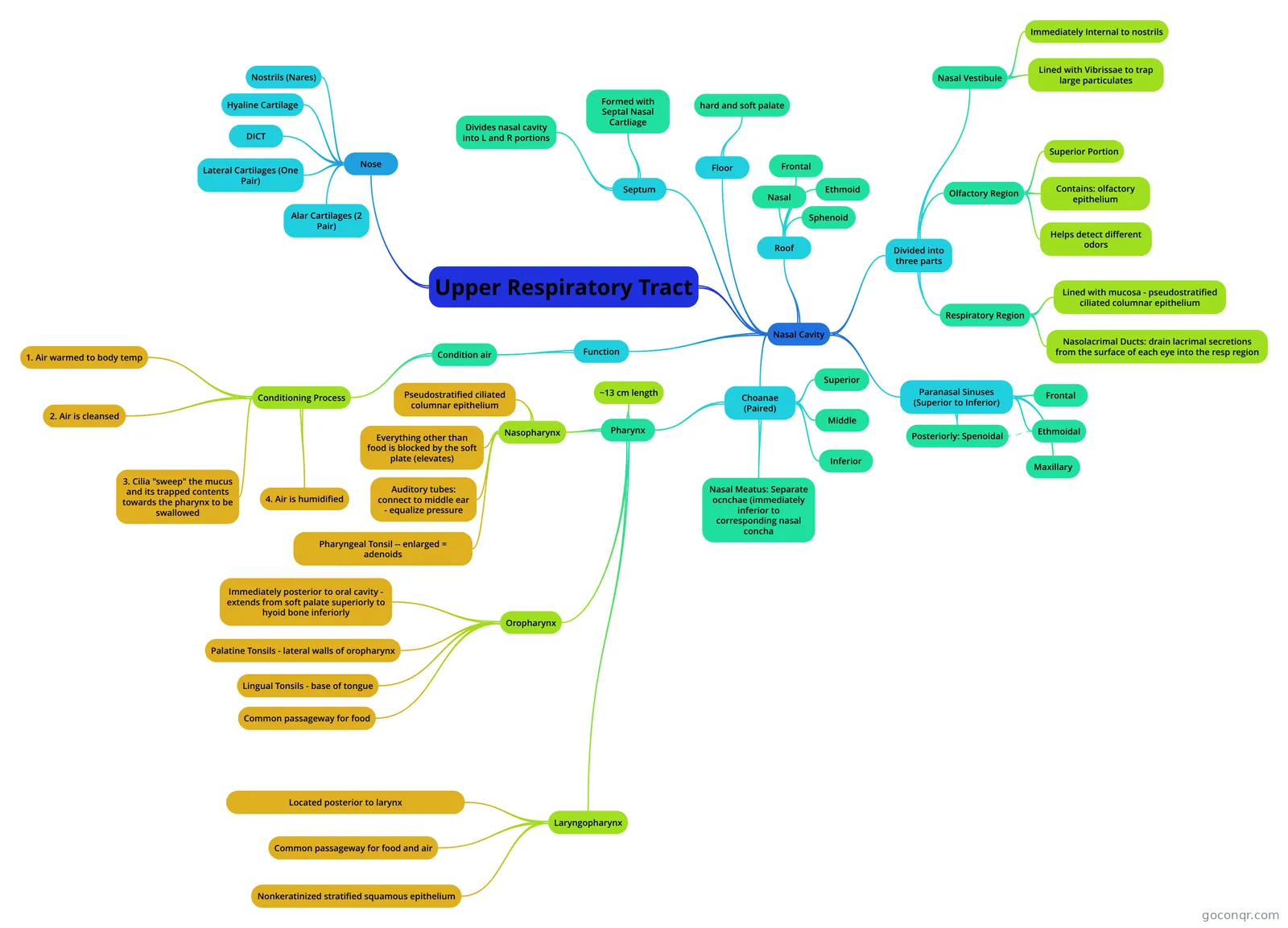
Mind map: Upper respiratory tract
Map content
Upper Respiratory Tract
Nose
- Hyaline Cartilage
- DICT
- Lateral Cartilages (One Pair)
- Alar Cartilages (2 Pair)
- Nostrils (Nares)
Nasal Cavity
- Choanae (Paired)
- Pharynx
- ~13 cm length
- Nasopharynx
- Pseudostratified ciliated columnar epithelium
- Everything other than food is blocked by the soft plate (elevates)
- Auditory tubes: connect to middle ear - equalize pressure
- Pharyngeal Tonsil -- enlarged = adenoids
- helps to prevent the spread of infection.
- Oropharynx
- Immediately posterior to oral cavity - extends from soft palate superiorly to hyoid bone inferiorly
- Palatine Tonsils - lateral walls of oropharynx
- Lingual Tonsils - base of tongue
- Common passageway for food
- Laryngopharynx
- Located posterior to larynx
- Common passageway for food and air
- Nonkeratinized stratified squamous epithelium
- Superior
- Middle
- Inferior
- Nasal Meatus: Separate ocnchae (immediately inferior to corresponding nasal concha
- Pharynx
- Floor
- hard and soft palate
- Roof
- Nasal
- Frontal
- Ethmoid
- Sphenoid
- Septum
- Divides nasal cavity into L and R portions
- Formed with Septal Nasal Cartliage
- Divided into three parts
- Nasal Vestibule
- Immediately Internal to nostrils
- Lined with Vibrissae to trap large particulates
- Olfactory Region
- Superior Portion
- Contains: olfactory epithelium
- Helps detect different odors
- Respiratory Region
- Lined with mucosa - pseudostratified ciliated columnar epithelium
- Nasolacrimal Ducts: drain lacrimal secretions from the surface of each eye into the resp region
- Nasal Vestibule
- Function
- Condition air
- Conditioning Process
- 1. Air warmed to body temp
- The vessels dilate in response to cold air, resuling in increased blood flow that helps to more effective warm the inhaled air.
- 2. Air is cleansed
- in haled microbes, dust, and other foreign material become trapped in the mucus covering the inner lining of the resp tract
- 3. Cilia "sweep" the mucus and its trapped contents towards the pharynx to be swallowed
- 4. Air is humidified
- 1. Air warmed to body temp
- Conditioning Process
- Condition air
- Paranasal Sinuses (Superior to Inferior)
- Frontal
- Ethmoidal
- Maxillary
- Posteriorly: Spenoidal
- Choanae (Paired)